Blog
What Is Lead Scoring and How It Works
By
Nelson Uzenabor

A Monday morning lead queue can feel like a crowded airport with no departure board. Four hundred new contacts sit in the CRM, a few requested demos, many downloaded something months ago, and others may have entered a personal email address just to read an article. Without a consistent way to rank them, reps spend valuable time guessing while a genuine buyer waits.
What is lead scoring? It's a structured method for ranking prospects according to their fit, behavior, and buying intent. A well-run model turns scattered signals into a sales-ready queue, then improves as your team compares scores with real outcomes. The technology matters, but the operating discipline matters more.
Table of Contents
Why Lead Scoring Matters
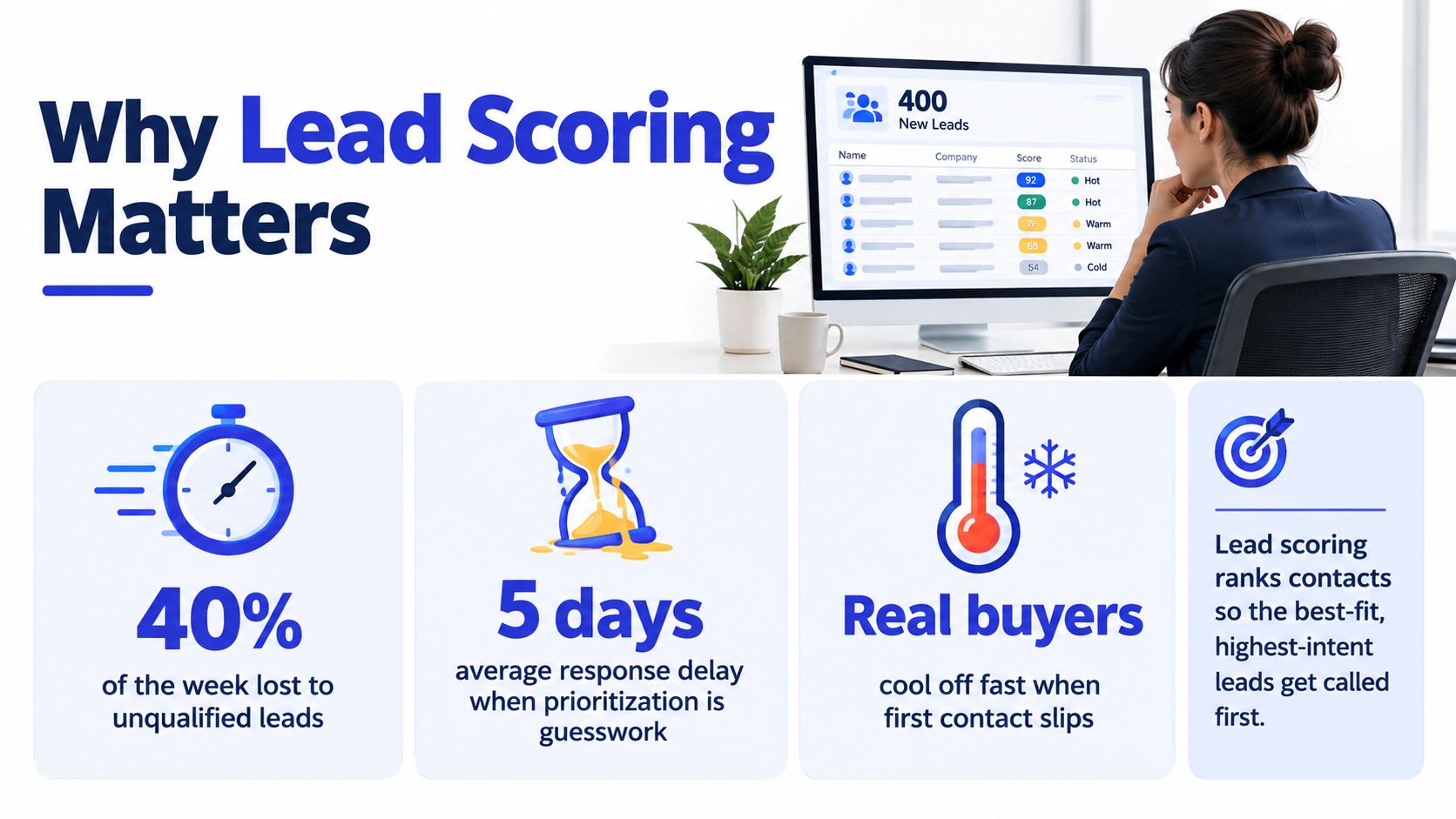
Lead scoring gives a small sales team a shared answer to a basic question: who should we contact first? Instead of treating every form fill as equally valuable, the team can distinguish between a visitor collecting information, a poor-fit contact, and a buyer actively evaluating a solution.
That distinction protects attention. A pricing-page visit, a repeat return to the website, a detailed demo request, and a clear business problem tell a different story from a single blog visit. The score doesn't replace judgment, but it makes judgment faster and more consistent.
The value comes from the workflow
A score only creates value when it changes what someone does. A high-scoring contact should move into a defined follow-up path, while a lower-scoring contact may receive education, monitoring, or no immediate sales attention. Marketing and sales also need one agreed meaning for terms such as MQL and SQL.
The 2024 B2B benchmark reported an average MQL-to-SQL conversion rate of 25.9% and median lead-scoring precision of 68% among predicted MQLs (2024 B2B lead nurturing and scoring benchmarks). The same benchmark identified best-in-class inbound MQL response time as under 5 minutes, which reinforces an operational point: a score can't rescue a handoff that sits untouched.
Teams that need a plain-language explanation of how contacts move through the funnel can also use Eludic's funnel guide alongside their qualification definitions. For the practical handoff itself, a documented lead qualification process helps connect the score to questions, ownership, and next steps.
The compounding effect
Every reviewed lead produces feedback. When sales marks a contact as accepted, rejected, converted, or poorly matched, that outcome becomes evidence for future adjustments. Over time, the team learns which signals separate buying intent from noise.
That creates a useful loop:
Prioritize: Rank contacts by fit and current intent.
Route: Send sales-ready leads to the correct owner.
Review: Compare the score with the rep's qualification and eventual outcome.
Improve: Adjust rules, data capture, and thresholds.
Lead scoring isn't a CRM decoration. For a small team, it acts as an operating system for attention. It helps marketing judge channels by the quality and movement of leads, gives sales a defensible queue, and makes growth less dependent on adding headcount.
How Lead Scoring Actually Works
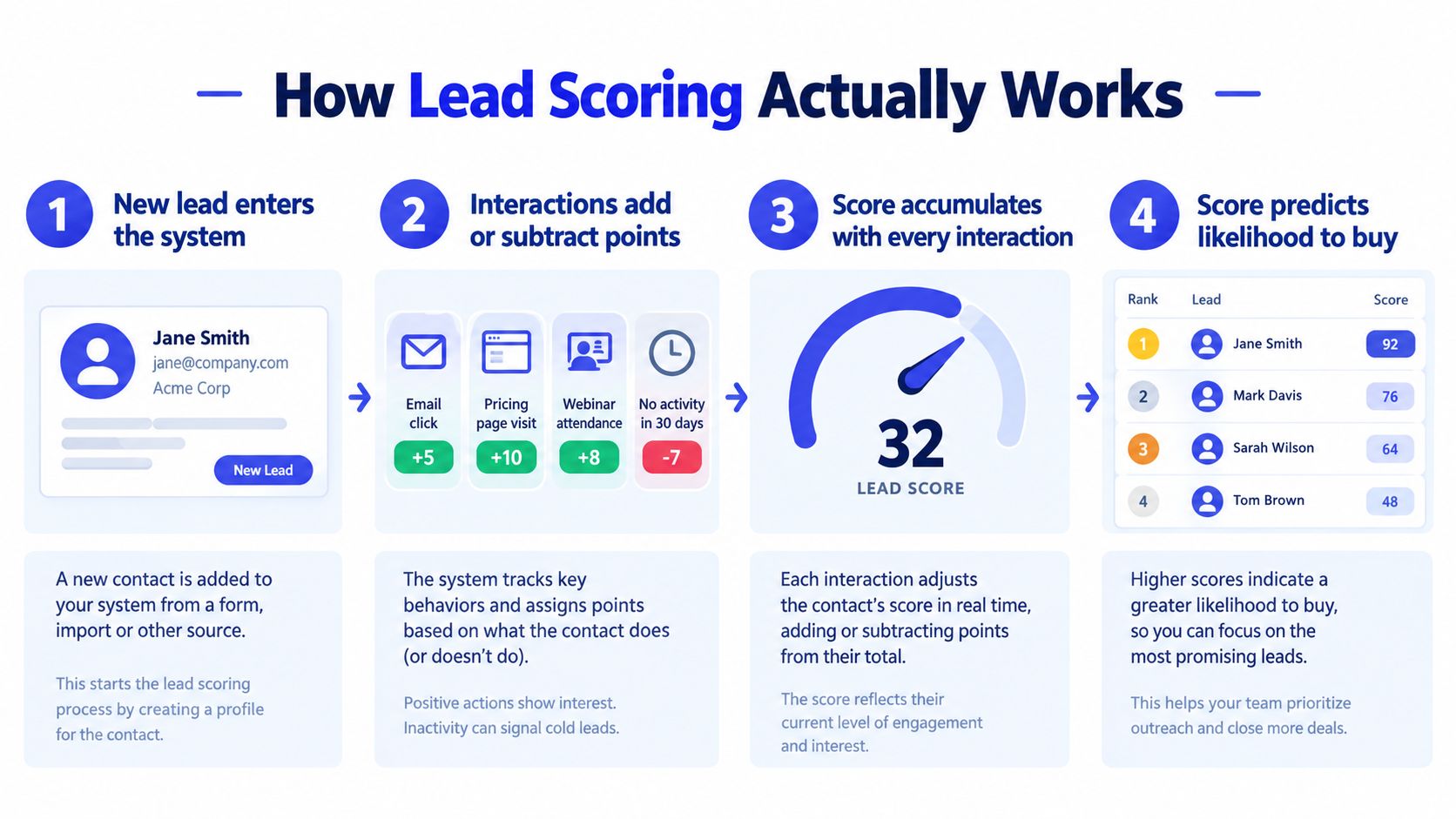
Lead scoring behaves a little like a credit score for a contact. A credit score combines different pieces of evidence into a number that helps someone assess risk. Lead scoring combines profile information and actions into a number that helps a team assess buying readiness.
A new lead starts at a neutral baseline. The model then adds or subtracts points as information arrives. A demo request might carry more weight than an email open, while an unsubscribed address or a clear disqualifying profile can reduce the total.
Two ways to assign weight
Explicit, or rule-based, scoring uses rules your team writes. You might award points for a target industry, a senior role, a corporate email, or a pricing-page visit. You might deduct points for a student address, a competitor domain, or a profile outside your service area.
This approach is transparent and quick to launch. A rep can open the score history and understand why a contact moved upward. Its weakness is that the team may overweight signals that look intuitive while missing combinations that matter in practice.
Implicit, or predictive, scoring uses historical CRM outcomes to infer the relationship between attributes, behaviors, and conversion. Predictive lead scoring is generally framed as a supervised machine-learning classification problem. A 2025 B2B study using lead data from January 2020 through April 2024 benchmarked 15 classifiers and found that a Gradient Boosting Classifier outperformed the others on accuracy and ROC AUC (Frontiers study on predictive lead scoring).
Why hybrid models are practical
Rule-based scoring gives the team visibility and control. Predictive scoring can find nonlinear relationships that a hand-built spreadsheet won't reveal. Many mature programs use both, with explicit rules handling business constraints and predictive analysis helping refine the ranking.
Your CRM should also preserve the journey behind the number. Modern platforms expose current and past scores, score changes, and the events associated with those changes, as documented in HubSpot's lead score history guidance. That history makes a score auditable rather than mysterious.
Scoring Signals and Data Sources
A useful model starts with signals your team can collect reliably. Don't build a rubric around fields that are empty, duplicated, or updated only when a rep remembers.
Four signal groups
Firmographic data describes the organization. Industry, company size, revenue band, geography, and existing technology can show whether an account resembles your ideal customer profile. Enrichment services such as Clearbit or ZoomInfo may provide some of these fields, while your CRM should remain the system of record.
Demographic data describes the person. Job title, department, seniority, and role in the buying process often come from forms, CRM fields, or enrichment. A senior decision-maker may deserve more fit weight than an individual with no purchasing responsibility, but the model shouldn't assume title alone proves intent.
Behavioral data captures actions. Page visits, content downloads, email clicks, webinar attendance, repeat pricing-page views, and demo requests can arrive from marketing automation, web analytics, event tools, and product systems. Weight actions according to how closely they resemble a real buying step, not according to how easy they are to count.
Negative and conversational signals prevent false positives. Unsubscribes, bounced addresses, competitor domains, free-mail addresses, job changes, and language indicating research rather than purchase can lower priority. An AI qualifier can also capture stated timing, role, problem, and requested next step, provided those fields are stored consistently.
The point values below are illustrative starting points, not universal benchmarks.
Signal Category | Example Rule | Point Value | Data Source |
|---|---|---|---|
Firmographic | Target industry | +15 | CRM or enrichment |
Demographic | Senior finance or operations role | +15 | Form or enrichment |
Behavioral | Pricing-page visit | +10 | Web analytics |
Behavioral | Demo request | +25 | Marketing automation or CRM |
Engagement | Webinar attendance | +8 | Event platform |
Negative | Generic free-mail address | -10 | Form or CRM |
Negative | Unsubscribe | -10 | Email platform |
Conversational | States an active buying timeline | +15 | Chat transcript or AI qualifier |
Keep the evidence connected
A score should tell a rep why the lead is prioritized. Store the source event, timestamp, and rule that changed the score. That record helps identify duplicate tracking, stale attributes, and signals that look important but rarely predict a qualified conversation.
A practical model also separates fit from intent. A perfect-fit account that has shown no interest may belong in an account-based nurture motion. A smaller account with a clear problem and urgent timeline may deserve human review. The combined score should support that distinction rather than hide it.
Scoring Rules and Example Calculations
Point systems become useful when they produce a clear decision. Consider two hypothetical leads using the illustrative rules below. These examples demonstrate the mechanics, not measured outcomes from a real company.
Lead A has a strong fit and several direct buying signals. Lead B has shown light interest but also carries signals that make immediate sales outreach less appropriate.
Signal / Action | Lead A: Enterprise IT Director | Lead B: Freelance Consultant |
|---|---|---|
Target or ideal customer profile | +20 | 0 |
Senior target role | +15 | 0 |
Pricing whitepaper download | +10 | +10 |
Webinar attendance | +15 | 0 |
Custom demo request | +25 | 0 |
Corporate email | +5 | 0 |
Blog visits | 0 | +4 |
Unsubscribe | 0 | -10 |
Total | 75 | 4 |
Lead A
Lead A is an IT director at a larger target account, uses a corporate email, downloads pricing material, attends a webinar, and requests a custom demo. The total reaches 75 points under this example rubric.
If the team has defined 70 points as its MQL threshold, the system can route Lead A to an account executive, attach the triggering events, and start the agreed response workflow. The important part isn't the exact threshold. It's that the threshold has a documented meaning and a corresponding action.
Lead B
Lead B downloads the same whitepaper and visits two blog pages, but the contact is a freelance consultant using a free-mail address and later unsubscribes. Under the table, the total is 4 points, so the contact should enter a longer nurture path or receive a manual review rather than immediate AE attention.
Negative scoring is a guardrail, not a verdict. A student, competitor, job seeker, or unrelated consultant might interact heavily with your content. Deductions prevent activity alone from inflating the queue.
Practical rule: A threshold should answer two questions, who receives the lead, and what happens next.
Sales and marketing should also define what qualifies a lead beyond the number. The lead qualification criteria guide can help teams document fit, need, authority, timing, and disqualifying conditions beside the score.
Building and Improving a Scoring Model
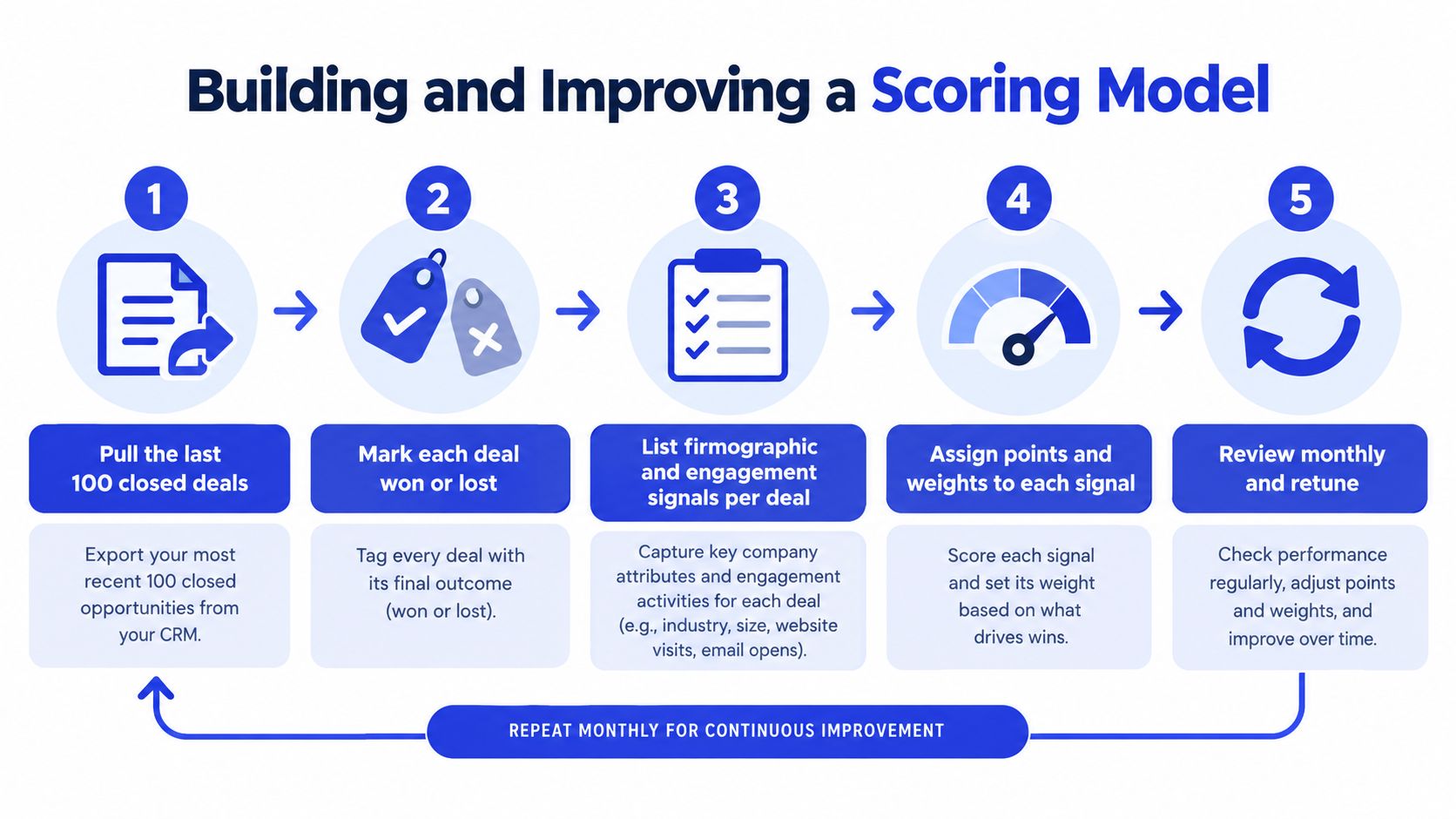
A scoring model is an operating habit, not a one-time configuration. Start with the evidence already in your CRM. Export the last 100 closed deals, label each outcome as won or lost, and inspect the firmographic fields, engagement events, and qualification notes attached to them. This creates a grounded starting point instead of a rubric built from intuition.
The next step is controlled connection. Bring in CRM fields first, then marketing engagement, then enrichment or intent data. Validate that each event enters the record once, carries the correct timestamp, and changes the score as expected. A beautiful dashboard built on missing events is still a broken process.
Establish the baseline
Write one definition of sales-ready. Include the required fit, the minimum intent evidence, the owner, and the response expectation. Then ask sales to test the definition against real records. If reps reject most of the first batch, don't hide that feedback. Use it to correct fields, rules, or the threshold.
Microsoft's predictive lead-scoring guidance recommends recent historical data and notes that two years of training data is ideal, with at least 10 qualified conversion events for each prediction goal (Microsoft Dynamics guidance on predictive lead scoring). That constraint matters for small businesses. A predictive model can't learn dependable patterns from a thin or inconsistent outcome history.
Improve in measured cycles
Keep the first rubric small enough that someone can explain every rule. Review score distribution, accepted-lead rate, rejected-lead reasons, and movement by score band after the initial operating period. Look for inflation, missing data, duplicate events, and contacts whose high scores don't translate into useful conversations.
Predictive scoring should come later, once the baseline is stable and the team has enough trustworthy conversion history. The model is an extension of the discipline, not a shortcut around data governance.
Common Pitfalls and How to Avoid Them
Most scoring failures don't begin with a bad formula. They begin with weak records, conflicting definitions, or a process nobody maintains. A survey cited in the provided research found that 64% of respondents lacked enough data to score accurately, 61% said buying signals were misleading, and 50% reported disagreement between sales and marketing about what qualifies as a lead (lead-scoring survey PDF).
Watch for these failure patterns
Stale records: A contact's job title, company, or role may no longer be current. Add refresh rules and let recent verified activity outweigh old profile data.
Score inflation: If every campaign adds points, the queue stops distinguishing priority. Cap the contribution of repetitive low-intent events.
Double counting: The same page visit may enter through web analytics and marketing automation. Deduplicate events before they affect the total.
Team disagreement: Marketing may celebrate MQL volume while sales sees poor fit. Review accepted, rejected, and recycled leads together.
Hidden bias: A model that heavily rewards familiar titles or company profiles can overlook viable buyers with less conventional paths.
A quarterly audit should inspect score changes, overrides, rejected-lead reasons, stale-field rates, and response compliance. Give reps a way to challenge a score, but require a reason. Gut feel becomes useful feedback when it gets recorded and reviewed.
A score is only as trustworthy as the data and decision it supports.
The strongest safeguard is a closed loop. Sales should report whether a lead was accepted, contacted, qualified, recycled, or disqualified. Marketing and operations can then adjust the model based on evidence rather than defending a score that no longer reflects the market.
How AI Support Fits Into a Lead Scoring Workflow
A small team can combine a simple rubric with an always-on AI qualifier. The rubric provides transparent thresholds. The AI layer gathers context during conversations, asks questions when a form leaves gaps, and sends structured signals back to the CRM.
For example, a visitor on a pricing page may start a web chat with a vague question. An AI support agent can answer the product question, identify the visitor's role, ask what problem they're solving, capture their timeline, and distinguish a buying conversation from general research. Those details can enrich the lead record without asking a rep to conduct an initial discovery call.
Three practical entry points
Inbound web chat can capture stated intent at the moment it appears. A visitor who asks about implementation, integrations, or a demo may provide stronger evidence than an anonymous page view. The transcript should produce structured fields, not just a long conversation that nobody reviews.
After-hours submissions shouldn't wait for the next business morning to become useful. The agent can confirm requirements, answer common questions from approved website and pricing content, and flag urgent or high-fit contacts for the next available owner.
Event and webinar follow-up benefits from context that attendance alone can't provide. An agent can ask whether the person is evaluating a solution, researching a problem, or gathering information for another team. That distinction helps prevent attendance from becoming an automatic high-intent score.
Close the loop carefully
The AI qualifier should act like an always-on junior qualifier, not an invisible replacement for sales judgment. Store intent tags, captured attributes, key answers, and a concise handoff summary. Then compare those signals with accepted leads, SQL progression, and eventual outcomes.
This approach turns scoring into a measurable discipline. Richer conversations improve the record, better records improve prioritization, and faster routing gives sales a clearer reason to respond. Teams evaluating this workflow can review AI lead qualification as a related operational pattern.
Chatgrow can train custom support agents on website pages, FAQs, pricing, and product content, then qualify conversations and escalate stronger opportunities with captured context. Visit Chatgrow to see how an always-on AI qualifier can support your scoring rubric, collect richer buying signals, and keep qualified conversations moving to your team.
Related Posts
Continue Reading
More articles from the ChatGrow Team.