Blog
Chatbot Testing: Your Complete Framework for 2026
By
Nelson Uzenabor

In a 2026 assessment, 100% of sampled chatbots lacked tests for fallback behavior, while 70% had incomplete entity coverage. The same assessment found missing greeting tests and missing precondition-dependent flow tests in 30% of sampled chatbots each (2026 assessment of chatbot conversation-state coverage). Those aren't exotic failures. They're the basic states customers encounter when they don't phrase a request exactly as the training examples expected.
A chatbot can pass a polished demo and still misroute a return request, invent a policy, lose the thread after a follow-up, or keep a frustrated customer trapped in a loop. Effective chatbot testing treats every production conversation as feedback for the next test run, training update, and release decision.
Table of Contents
Why Most Chatbot Testing Misses What Actually Breaks
A pre-launch test suite often proves that the bot can answer questions the team already wrote down. Production asks different questions. Customers omit order numbers, combine multiple requests, change their minds halfway through a sentence, and use the same phrase for different problems.
A small retailer might test, “What is your return policy?” and receive the correct approved answer. The first week after launch, a customer writes, “The shoes don't fit, can I send one pair back and exchange the other?” If the bot recognizes only the general policy intent, it may provide a partial answer, miss the exchange condition, or confidently invent a return window that isn't in the merchant's policy. The merchant then pays for a mistake that looked impossible in the demo.
Practical rule: A passing happy path proves one route works. It doesn't prove the bot knows when to clarify, fall back, escalate, or stop.
The coverage problem is especially visible in conversation states. The 2026 assessment found that fallback behavior was untested in 100% of sampled chatbots, greetings were missing in 30%, precondition-dependent flows were missing in 30%, and entity coverage was incomplete in 70% (the assessment's reported findings). These gaps create silent failures because the assistant may still produce fluent text while failing to advance the user's task.

For an SMB support bot trained on a platform such as Chatgrow, “broken” means more than an error message. It means a customer asks about a refund, the assistant presents an unsupported rule, and no human sees the conversation until after the cost has landed. It also means a greeting doesn't lead into a usable intent, an entity such as order number is collected but never passed to the next action, or a low-confidence request receives a plausible answer instead of a safe handoff.
The practical response is a continuous loop. Start with real intents, add edge cases and adversarial personas, simulate multi-turn exchanges, review failures, update the dataset, and rerun the suite before release. Independent testing guidance recommends separate layers for intent testing, response evaluation, and conversation testing, with human review for flagged cases and regression tests added after every failure (conversational AI testing workflow).
Shipping the chatbot is the start of testing, not the end.
The Six Test Types Every Chatbot Needs
No single test type can expose every failure mode. Build the layers in the order an SMB usually needs them, then keep them connected through one release scorecard.
Functional testing
Begin with the wiring. Send a known request through the complete path and verify the expected intent, entity extraction, API call, permission check, response, and handoff. For an order-status flow, the test should confirm that an order identifier reaches the correct lookup action and that an unavailable order produces the approved fallback rather than a fabricated status.
Functional tests catch broken integrations, incorrect parameters, missing actions, and bad response branches. They won't reliably catch a response that's technically connected but factually wrong, overly confident, or awkward in context.
Conversational UX testing
Read the exchange as a customer would. Test greetings, clarification questions, interruptions, repeated requests, corrections, frustration, and the transition from bot to human. A conversation can pass functional assertions while still sounding dismissive or forcing the user to repeat information.
Human review matters here because tone and usefulness depend on context. Automate structural checks where possible, but send ambiguous or emotionally charged transcripts to a reviewer.
Intent and NLU testing
Create a labeled corpus for every supported intent, including near-neighbors. “Cancel my order,” “change my delivery address,” and “return an item” may share vocabulary, but they require different actions and policies. NLU tests should measure classification, confidence, entity extraction, and fallback behavior when the input doesn't belong to any supported intent.
This layer catches intent collisions and low-confidence routing. It won't show whether the selected intent produces a helpful multi-turn outcome.
Regression testing
Freeze resolved conversations and important failures. Replay them after every prompt, model, training-data, integration, or policy change. A regression suite is the memory of the bot. Without it, a fix for returns can break delivery questions.
Add every confirmed production failure back into the suite, with the expected behavior recorded clearly enough that another reviewer can understand the reason for the pass or fail.
Load and performance testing
Test concurrent sessions, queue behavior, provider limits, webhook timing, and retry logic. Measure latency at the user-visible boundary, not only inside the model call. A response that arrives quickly from the model can still feel slow if retrieval, authentication, or an external API blocks the final message.
Independent guidance commonly uses a latency target under 500 milliseconds and a fallback target below 10%, but these are starting thresholds, not universal guarantees (chatbot testing benchmarks and scorecards). Your acceptable budget depends on the channel and the action.
Security and privacy testing
Probe direct and indirect prompt injection, sensitive-data exposure, unsafe tool calls, excessive permissions, and secrets appearing in logs or payloads. Modern governance guidance recommends testing prompt injection, least-privilege tool connections, and runtime inspection because these risks extend beyond conventional application security (governance-focused chatbot security guidance).
A support assistant should never turn a user instruction into an unauthorized refund, account change, or data disclosure. Treat tools as privileged operations, and require explicit tests for what each tool can and can't do.
Writing Test Cases and Datasets That Catch Real Bugs
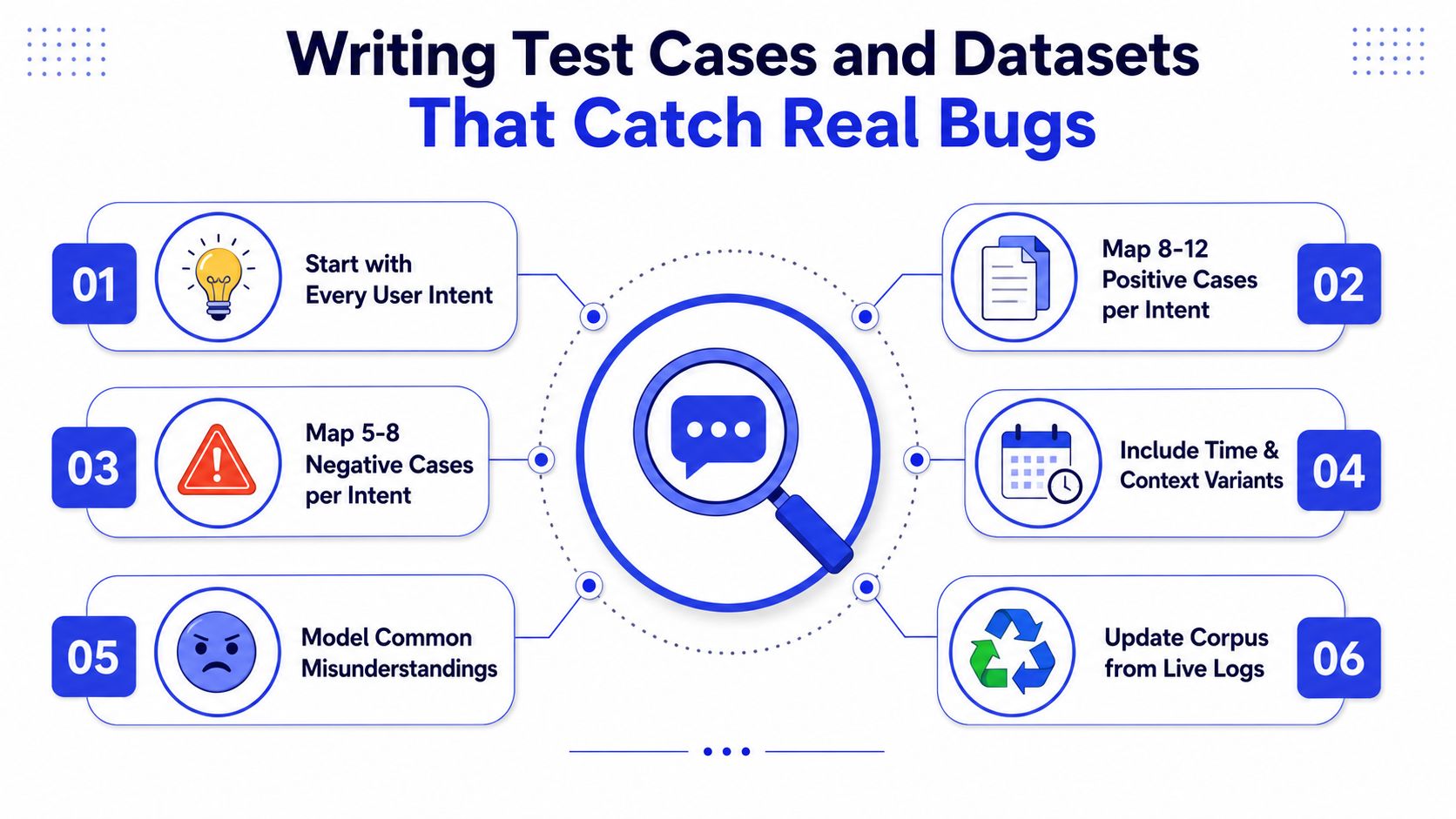
A useful test corpus begins with the intents your customers express, not with sentences that sound tidy in a planning document. Export support tickets, live-chat transcripts, email replies, and escalation notes. Remove unnecessary personal information, preserve the wording that affects meaning, and tag the outcome that should have occurred.
For each intent, build a balanced set of positive and negative examples. The guidance for this workflow uses 8 to 12 positive cases and 5 to 8 negative cases per intent as practical ranges (conversational AI testing guidance). Negative cases shouldn't merely be nonsense. They should resemble neighboring requests, incomplete questions, out-of-scope topics, or messages that require a clarification step.
Use one SMB scenario as a design test
Consider a Chatgrow-trained support agent for a small apparel retailer. The return_policy intent shouldn't contain only “What is your return policy?” Add variations such as:
“Can I return a jacket if I removed the tags?”
“The shirt is the wrong size, what are my options?”
“I bought two items, but only one needs returning.”
“Can I exchange this for a different size?”
“I don't have the order number. Can you still help?”
“I want a refund and an address change on the same order.”
Then add adversarial personas. One customer types in all caps. Another switches languages mid-conversation. A third asks a leading question that tries to make the model confirm an unsupported premise, such as “Your policy says I have 60 days, right?” The expected result may be a correction, a request for the missing order detail, or a human handoff, not a confident yes.
For teams refining training sources, learn how to train a chatbot before turning raw transcripts into reusable examples. Separating training data from evaluation data prevents the bot from appearing accurate only because it has seen the exact test wording.
Record the expected behavior, not just the label
Each test record should include:
User utterance: The exact customer wording, including relevant spelling and punctuation.
Expected intent: The route the classifier should select.
Expected entities: Order number, product, size, date, or other required values.
Expected action or response: The approved tool call, answer, clarification, or escalation.
Expected low-confidence behavior: The fallback or handoff that should occur when the input is ambiguous.
Security review belongs in the dataset too. Test cases that expose prompt injection, unsafe tool requests, or sensitive-data handling help with keeping AI agents compliant, especially when the assistant can act on external systems.
Automation and Tooling for Small Teams
Small teams don't need a sprawling enterprise platform to establish useful coverage. They need a focused tool for each testing layer, a repeatable dataset, and a CI trigger that prevents untested changes from reaching production.
Category | Catches | Common Tools | SMB Cost |
|---|---|---|---|
Intent and entity unit testing | Misclassification, entity omissions, confidence failures | Botium, Rasa Test, Chatgrow's built-in intent tester | Usually low or already included in the platform |
Response evaluation | Unsupported claims, missing policy details, tone violations | LLM-as-judge with a calibrated rubric, manual review for flagged cases | Variable usage cost plus reviewer time |
End-to-end conversation testing | Context drift, broken handoffs, multi-turn loops | Botium Box, custom Playwright flows, scripted user simulators | Moderate setup effort, then repeatable execution |
Load testing | Concurrency limits, latency spikes, rate-limit behavior | k6, Locust | Low software cost, with infrastructure or provider usage costs |
Security testing | Prompt injection, PII leakage, unauthorized actions | Custom abuse cases, permission tests, runtime inspection | Mostly engineering and review time |
The tools catch different defects. Botium or Rasa Test can tell you that an utterance maps to the wrong intent, but they won't prove that a refund response cites the current policy. An LLM judge can review answer quality at scale, but it needs calibration against human labels and can miss a flawed rubric. Playwright can validate a real website flow, while k6 or Locust can expose service degradation under concurrent use, but neither replaces semantic evaluation.
For an SMB, use the smallest stack that creates a dependable feedback loop. One intent-testing tool, one response rubric, a handful of end-to-end flows, and a lightweight load probe are more valuable than an expensive suite nobody maintains. Teams planning the implementation should also account for the ongoing work to set up and maintain testing tools, including ownership, test-data updates, and failure triage.
Put the suite inside CI
A practical GitHub Actions workflow can:
Run intent and entity tests whenever training data changes.
Replay the regression corpus for prompt, model, policy, and integration changes.
Run scripted multi-turn conversations before deployment.
Block the release when critical security or policy assertions fail.
Post a summary to Slack with failed test IDs, changed intents, and reviewer links.
Don't turn every soft tone preference into a deployment blocker. Gate hard failures such as unsupported policy claims, unauthorized tool calls, broken handoffs, and missing required entities. Route borderline response-quality cases to review, then promote confirmed failures into deterministic regression tests.
Metrics and Scorecards That Actually Predict Quality
A chatbot can route requests correctly and still fail the customer. It may miss a second intent, extract the wrong order number, repeat a fallback message, or provide a polished answer that is not supported by the business's approved information. A useful scorecard must expose those failure modes instead of compressing them into one pass rate.
For SMB workflows on platforms such as Chatgrow, track performance across routing, conversation state, task outcome, speed, and safety. Review these measures by flow, intent, channel, and release version. A blended monthly score can hide a serious defect in one high-volume workflow.
Set thresholds by failure cost
The following reference points come from independent testing benchmarks (yrkan.com). Treat them as starting points for investigation, not universal release gates.
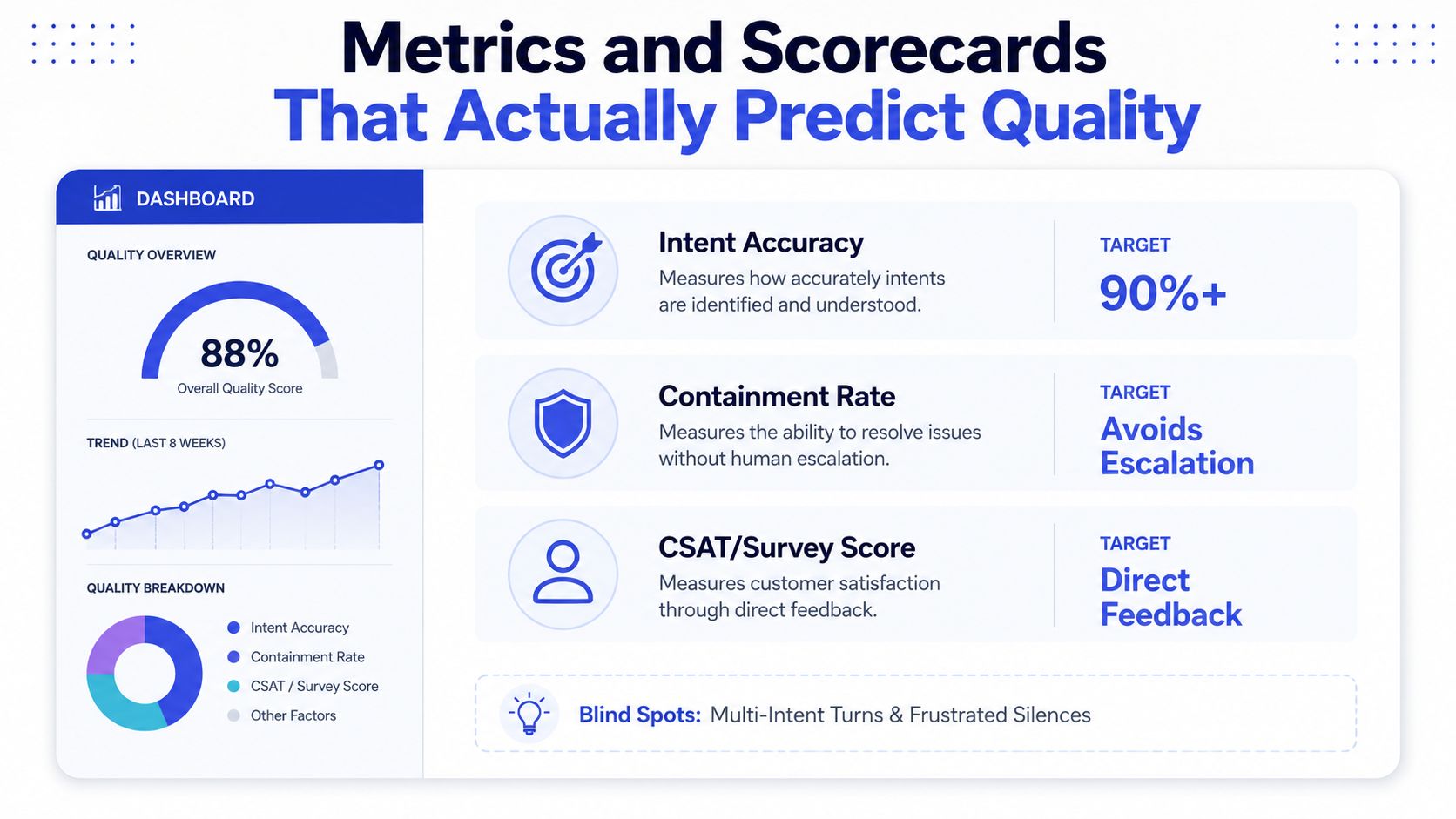
Routing quality: target intent accuracy above 90%, then pair it with entity F1 for values such as order numbers, dates, product names, and account details. A routing score is incomplete if the bot identifies “order status” but extracts the wrong order ID or skips a required slot.
Outcome quality: use task completion above 85% and factual accuracy above 95% as reference points. Add resolution rate, successful handoff rate, and customer-confirmed satisfaction. A conversation should count as successful only when the user reaches the intended result, not when the bot sends several relevant-sounding replies.
Conversation state: measure fallback rate, repeated-fallback rate, greeting success, clarification recovery, and multi-intent handling. A low fallback rate can conceal unsafe guessing, while a high rate may indicate missing training examples or unclear source content. Separate first-turn fallbacks from fallbacks after the user has supplied an entity.
Responsiveness: latency under 500 milliseconds is a useful reference for a responsive interaction, but measure the user-visible path, including retrieval, tool calls, platform processing, and message delivery. Track p50 and p95 latency by workflow. A fast greeting does not offset a slow appointment-booking flow.
Safety and grounding: use hallucination below 5% as a reference for factual assistants, with reviewers applying a written grounding rubric. Count unsupported policy claims, invented availability, unauthorized actions, and answers that should have triggered a handoff. Safety failures deserve more weight than minor wording preferences.
Weight outcomes over activity
Containment measures whether the bot avoided a human handoff. It does not prove that the customer received help. Compare containment with resolution, repeated messages, abandonment, recontacts, and escalation quality. If containment rises while users ask the same question twice or leave after a fallback, the release has reduced visible handoffs without improving service.
A practical scorecard gives the highest weight to successful resolution, factual grounding, and policy compliance. Use intent accuracy, entity F1, latency, fallback rate, and containment as diagnostic measures that explain why outcomes changed. Keep separate thresholds for hard failures, such as an incorrect price, an unsupported refund promise, a fabricated appointment slot, or a missing handoff trigger.
Review metrics at the conversation level. A flow can pass its average score while failing customers who use a greeting followed by an incomplete request, switch topics mid-conversation, or provide an entity in an unexpected format. These states belong in the dashboard because they often expose defects that single-turn intent tests miss.
Instrument events for greeting, intent prediction, entity capture, clarification, fallback, tool invocation, handoff, resolution, and user recontact. The Chatgrow chatbot analytics guide can help teams choose event names and identify transcript patterns for review. Each confirmed failure should become a labeled example, a regression case, or a source-content correction, so the scorecard drives retraining instead of ending as a report.
User Acceptance, Live A/B Testing, and the Retraining Loop
Treat user acceptance testing as a controlled rehearsal with people who understand the business but haven't authored every test case. Give internal staff or selected customers scripted scenarios, then ask them to vary wording, omit information, switch topics, and challenge unsupported assumptions. Record not only whether the answer was correct, but whether the person knew what to do next.
A limited release should expose the new version to a controlled portion of real traffic. Compare model or prompt versions using resolution, satisfaction, escalations, fallback behavior, and safety failures. Volume alone isn't evidence of improvement. Look for meaningful differences in outcomes and inspect the conversations behind surprising results.
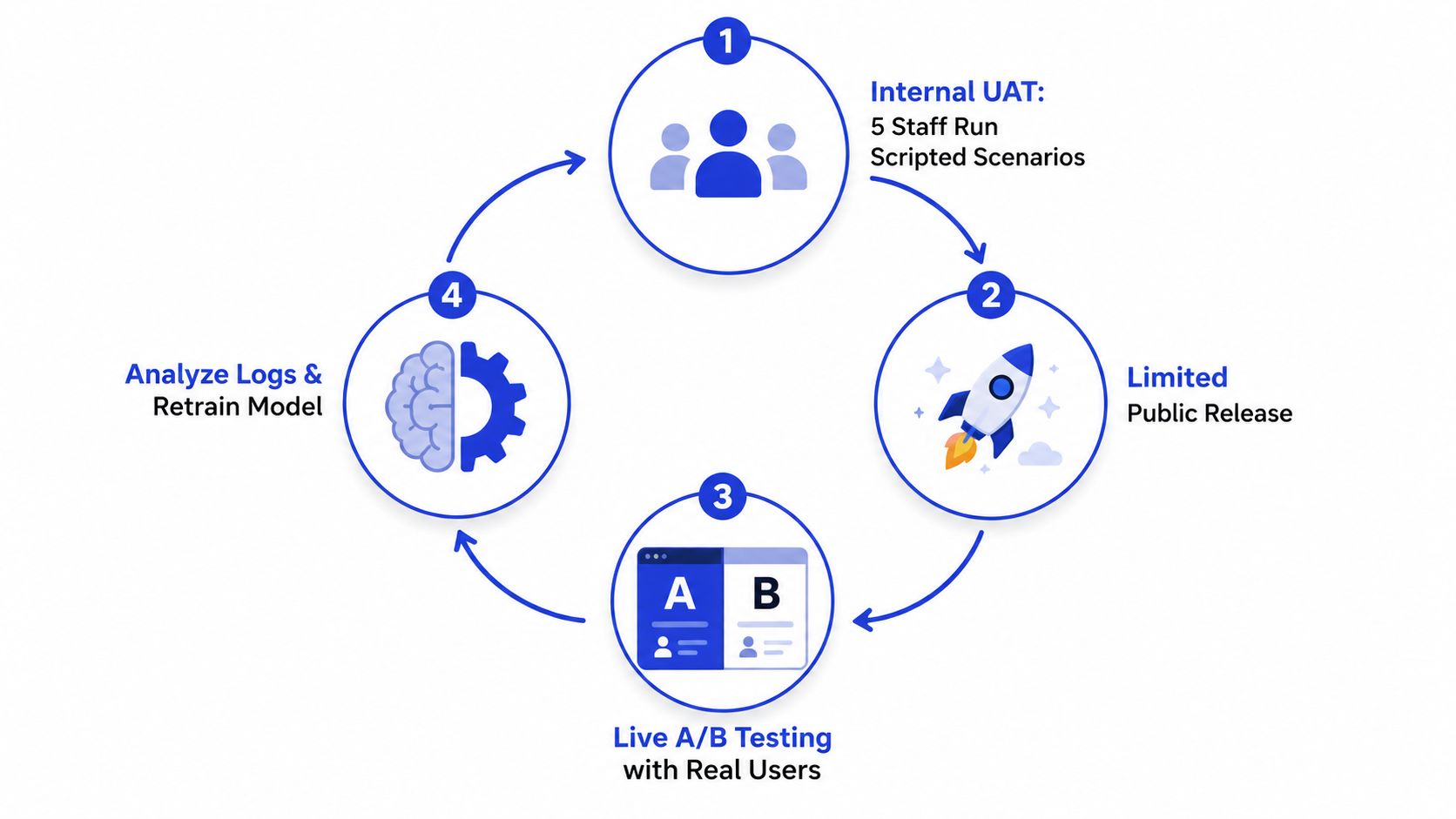
Every human takeover is a labeled training example. Review the transcript, identify the failed intent or missing entity, mark whether the problem was knowledge, routing, tone, policy, integration, or security, and add the corrected behavior to the evaluation set. Then update the source material or training data, rerun the full battery, and keep the failed conversation in regression coverage.
The retraining loop is the product process. A chatbot that never learns from escalations will repeat the same expensive misunderstandings.
Keep data handling deliberate as you move logs between systems. Clear ownership, consistent labels, and structured events help teams streamline data pipelines with AI without turning raw customer transcripts into an uncontrolled training source.
For a practical explanation of this operating model, see what continuous learning means for a chatbot. The key is cadence: review new failures, update the corpus, rerun tests, deploy cautiously, and monitor whether the fix holds.
Pre-Launch and Post-Launch QA Checklist
Use the following as a binary review. If an answer is “no,” either fix the issue or document why the release is blocked from that path.
Before launch
Functional: Do greetings, supported intents, fallback routes, required entities, tool calls, and human handoffs complete successfully?
Conversation: Does the assistant maintain tone and context through follow-ups, corrections, repetition, and frustration?
NLU: Has every current intent been tested with positive, negative, neighboring, incomplete, and out-of-scope utterances?
Regression: Has the suite replayed recent resolved tickets and every confirmed failure from the previous cycle?
Performance: Does a lightweight concurrency probe stay within the team's latency and provider-limit budget?
Security: Do prompts, logs, webhooks, and tool responses avoid unnecessary personal data and unauthorized actions?
After launch and at each retraining cycle
Outcomes: Did the team review containment, resolution, satisfaction, fallback, and escalation signals for unexpected changes?
Escalations: Did someone sample transcripts and label the root cause of each important takeover?
Conversation states: Did the team specifically check greetings, fallback behavior, preconditions, and entity coverage?
Alerts: Are latency spikes, fallback increases, policy failures, and unsafe tool attempts routed to an owner?
Retraining: Were newly labeled conversations added to the training and evaluation datasets without contaminating the test set?
Release: Did the updated agent pass functional, UX, NLU, regression, performance, and security checks before deployment?
For SMBs, this checklist matters more than a glossy pre-launch report. It turns chatbot testing into an operating habit that protects customer trust while giving the team a clear path from failure to fix.
Chatgrow lets businesses create, train, and deploy custom support agents using their website, FAQs, pricing, and product information, with intent handling, escalation, and reporting for ongoing optimization. Visit Chatgrow to test a support workflow, review how conversations fail, and build a retraining loop before those failures reach more customers.
Related Posts
Continue Reading
More articles from the ChatGrow Team.