Blog
What Is Continuous Learning: AI Chatbot Advantage
By
Nelson Uzenabor

A customer lands on your site at 9:14 p.m. They're ready to buy, but they have one last question about a new pricing tier, a limited-time offer, or whether a feature works with their current setup. Your AI support agent answers with last month's information.
The visitor doesn't know your product changed yesterday. They only know your “smart” agent gave a wrong answer. For a small business, that's not a technical glitch. It's a lost lead, a support headache, or a trust problem you now have to fix by hand.
That's why people ask what is continuous learning. In AI customer support, it isn't an abstract education term. It's the difference between an agent that stays useful and one that slowly drifts out of date while your business keeps moving.
Table of Contents
Why Your Smart Agent Suddenly Sounds Dumb
Your team launches a spring promotion on Monday. Marketing updates the homepage, sales updates the pricing page, and support gets a short memo in Slack. By Tuesday morning, a prospect asks the chatbot, “Does the annual plan still include onboarding?”
The bot answers confidently, but it uses the old package details.
Static knowledge breaks first in fast-moving businesses
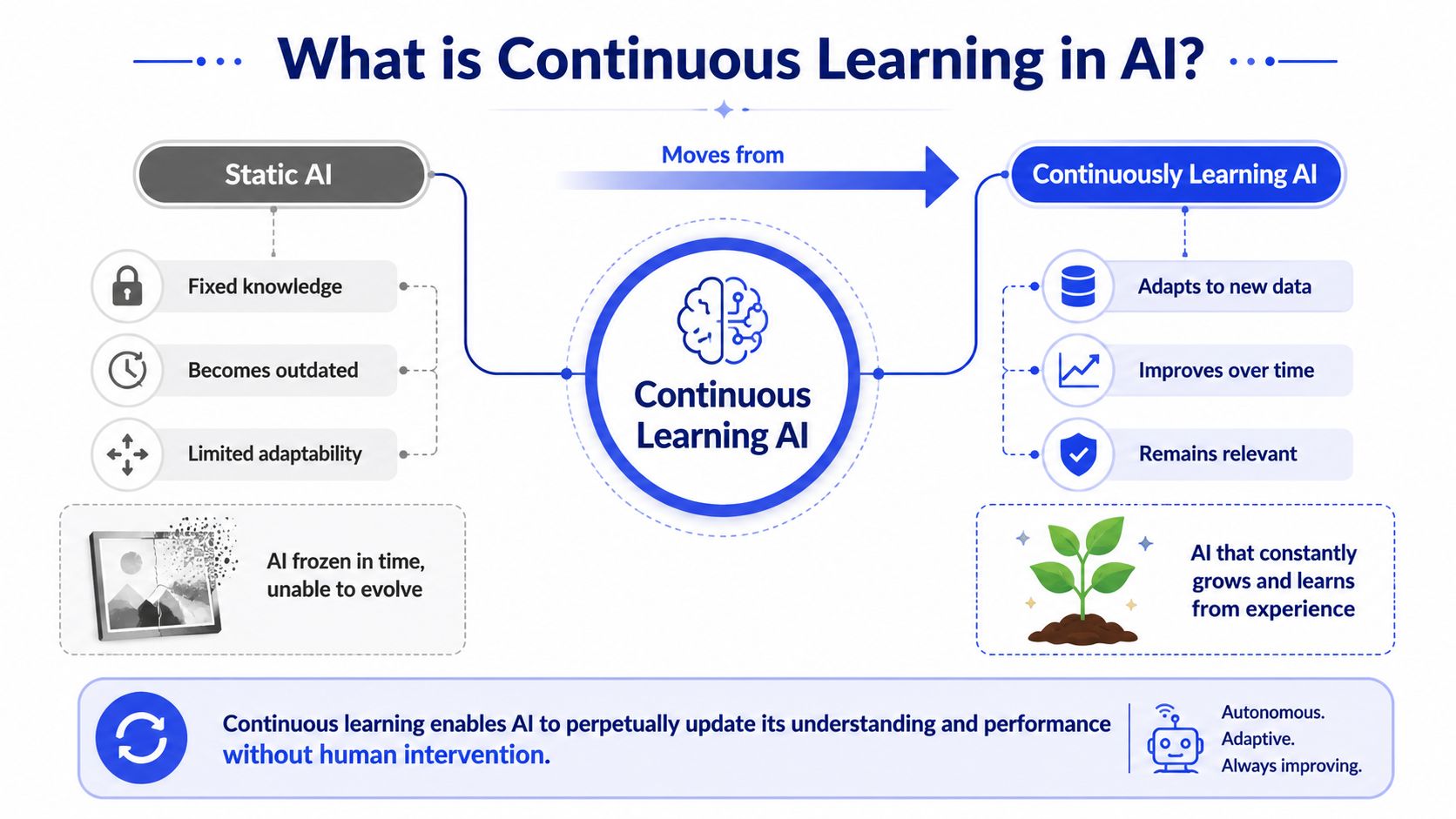
This happens because many AI agents are trained once and then left alone. They're like a new hire who read the handbook on day one and never attended another meeting. At first, they sound polished. A few weeks later, they start missing the small changes that matter most.
The trouble shows up in ordinary moments:
New offers: The agent still mentions an expired discount.
Product changes: It describes features that were renamed, merged, or removed.
Process updates: It gives the old refund steps after your team changed the workflow.
Lead qualification: It asks the wrong follow-up questions because your ideal customer profile shifted.
None of these errors look dramatic on their own. But customers notice patterns fast. If the agent gets one answer wrong, they start doubting the rest.
The issue is rarely the AI model alone
Business owners often assume the model is the problem. Usually, the bigger issue is that the agent's knowledge hasn't kept up with the business. A static chatbot can still sound fluent while being wrong. That's what makes it risky.
A smooth answer isn't the same as a current answer.
This is why support leaders spend so much time checking conversation logs, correcting responses, and spotting blind spots. If you review your chatbot analytics dashboard, you'll usually find the same weak spots clustered around recent changes, edge cases, and questions customers phrase differently than your documentation does.
Where confusion turns into business cost
For a customer, an outdated answer feels like poor service. For your business, it creates three concrete problems:
Problem | What the customer experiences | What your team deals with |
|---|---|---|
Misinformation | Confusion or hesitation | Manual correction and follow-up |
Missed intent | Generic answers to buying questions | Lower-quality leads |
Unnecessary escalation | Delays getting a real answer | More workload for support and sales |
That's why the idea of learning matters so much in AI support. The agent doesn't just need to respond. It needs to stay aligned with what your company is selling, promising, and changing right now.
What Continuous Learning Actually Means in AI
Continuous learning is typically defined as the ongoing acquisition and reinforcement of knowledge and skills after a one-time training event, according to TechTarget's definition of continuous learning. The same source says 72% of executives prioritize continuous learning, and notes it can improve employee retention by 50% and increase productivity for 45% of employees.
In AI customer support, the core idea is similar. A useful agent doesn't rely only on its first training pass. It keeps getting better through updated information, repeated exposure to real questions, feedback on mistakes, and regular adjustment.
The simplest way to think about it
Think about two new support reps.
The first rep attends onboarding once, saves the slide deck, and never gets corrected when the product changes. The second rep joins weekly product updates, reviews tricky tickets, gets feedback from a manager, and learns from repeated customer questions.
Which rep would you trust on a pricing question six months later?
Core idea: Continuous learning in AI means the agent keeps improving its knowledge and behavior over time instead of staying frozen at the moment it was first trained.
That's the practical answer to what is continuous learning in an AI setting. It's not magic. It's a system for helping the agent stay current and useful.
What it is not
People often confuse continuous learning with a few related ideas.
It's not just a software update. Updating the app itself doesn't guarantee the agent understands your newest offer, policy, or customer phrasing.
It's not just adding more documents once. Uploading a PDF today helps today. Continuous learning means your process keeps working when tomorrow's content changes.
It's also not random self-improvement without oversight. In business settings, you want a controlled loop: updated knowledge goes in, conversations happen, weak spots are reviewed, and the agent improves in a measurable way.
A good mental model is this:
Approach | What happens |
|---|---|
One-time training | The agent learns once, then slowly gets stale |
Continuous learning | The agent keeps absorbing updates, corrections, and recurring patterns |
For customer support, that difference matters because your business isn't static. Prices shift, promotions end, objections evolve, and customers ask the same question in ten different ways. If the agent can't learn with the business, it eventually becomes a polished version of old information.
Key Approaches to Continuous Learning for AI Agents
Continuous learning sounds advanced, but the mechanics are easier to grasp when you compare them to how a strong support team works. In workplace learning, the key is embedding learning into daily routines so that small, regular learning moments compound into better adaptability and performance over time, as explained in Docebo's guide to continuous learning.
That same logic applies to AI agents. The question isn't only whether the system can learn. It's how it learns, when it learns, and who steps in when it's unsure.
Online learning
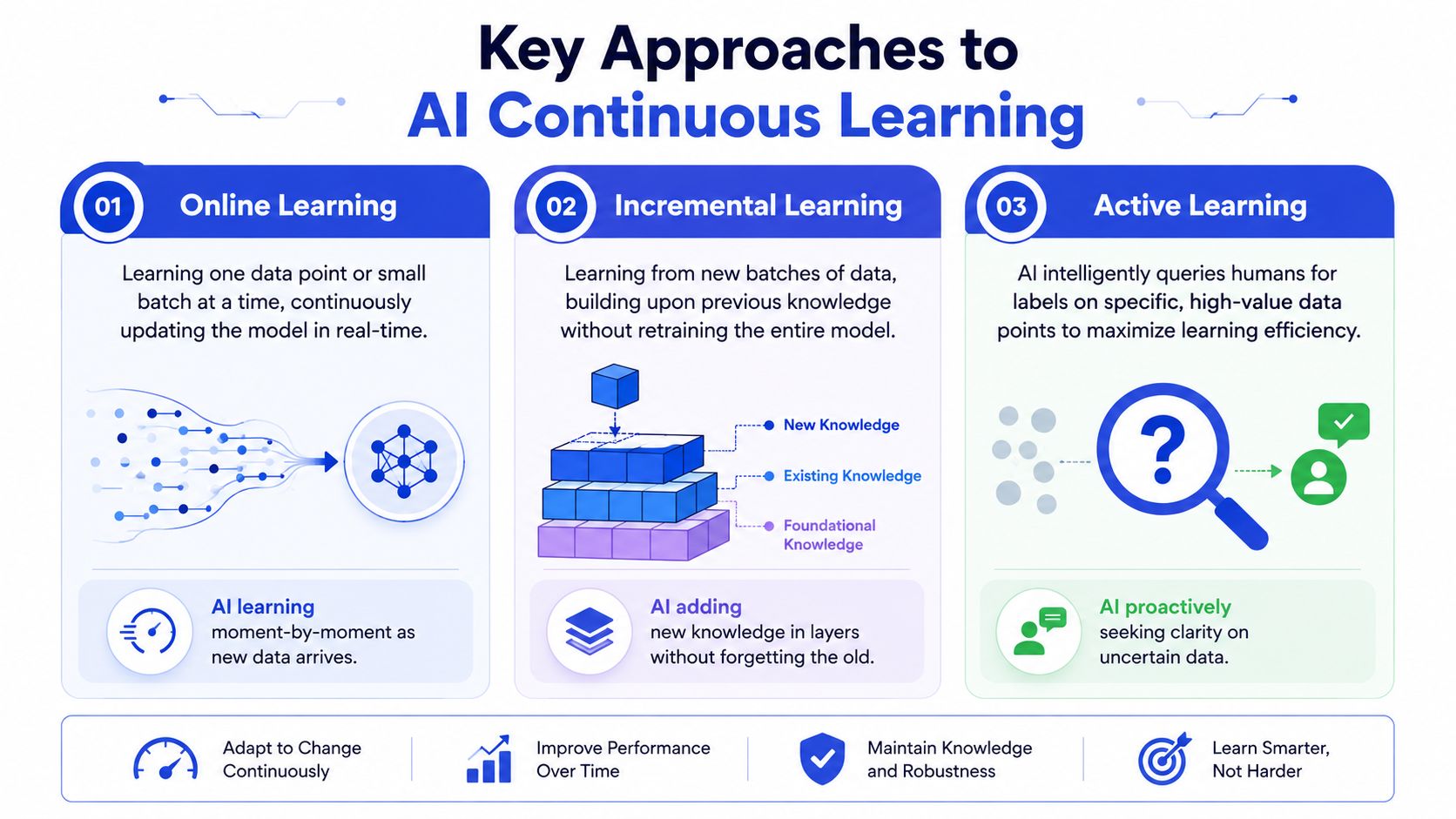
Online learning is the closest thing to learning in the moment.
A simple way to picture it is a support rep who adjusts after each conversation. If customers keep asking, “Can I connect this with Shopify?” instead of using the formal term from your docs, the system starts recognizing that wording as important.
This approach is useful when your agent deals with changing language, repeated objections, or fresh user intent signals. It helps the system respond to patterns as they emerge rather than waiting for a big retraining cycle.
Best fit: fast-changing environments, high conversation volume, and frequent wording variation.
Watch for: if you let the system react to everything without control, it can become noisy or inconsistent.
After your knowledge sources are connected, a strong customer data integration setup makes this kind of adaptation more useful because the agent can interpret questions against your actual product, customer, and support context.
A quick walkthrough can help make these approaches feel less abstract:
Incremental learning
Incremental learning is more structured. Instead of learning from every single interaction immediately, the agent learns in batches.
Think of a team lead who reviews this week's conversations, updates the playbook, and then rolls those improvements into next week's support flow. The old knowledge stays in place, and the new knowledge is added on top.
This works well when you want stability. For example, if you changed your onboarding policy, launched a new feature, and updated your FAQs, you might want the agent to absorb those changes together instead of piecemeal.
Good for: product updates, policy revisions, and regular content refreshes.
Trade-off: it's not as immediate as online learning, but it's often easier to govern.
Active learning and human review
Active learning is the most business-friendly concept of the three. It means the AI knows when it's uncertain and asks for help.
That can look like smart escalation, flagged responses, or queues where a human reviews confusing chats. Then the correction teaches the system what to do next time.
The best self-improving agent isn't the one that guesses most confidently. It's the one that knows when to hand off.
This is often the safest path for customer support because it blends automation with judgment. Your team doesn't need to monitor every conversation. They only need to review the ones that carry the most value or risk.
Here's the side-by-side view:
Approach | Simple analogy | Strength | Limitation |
|---|---|---|---|
Online learning | Learning after each conversation | Fast adaptation | Can become noisy without controls |
Incremental learning | Weekly playbook updates | Stable and manageable | Less immediate |
Active learning | Asking a manager when unsure | High-quality correction | Depends on human follow-up |
Most useful support agents combine all three in some form. They absorb updates, learn from batches, and involve people when the stakes are too high for guessing.
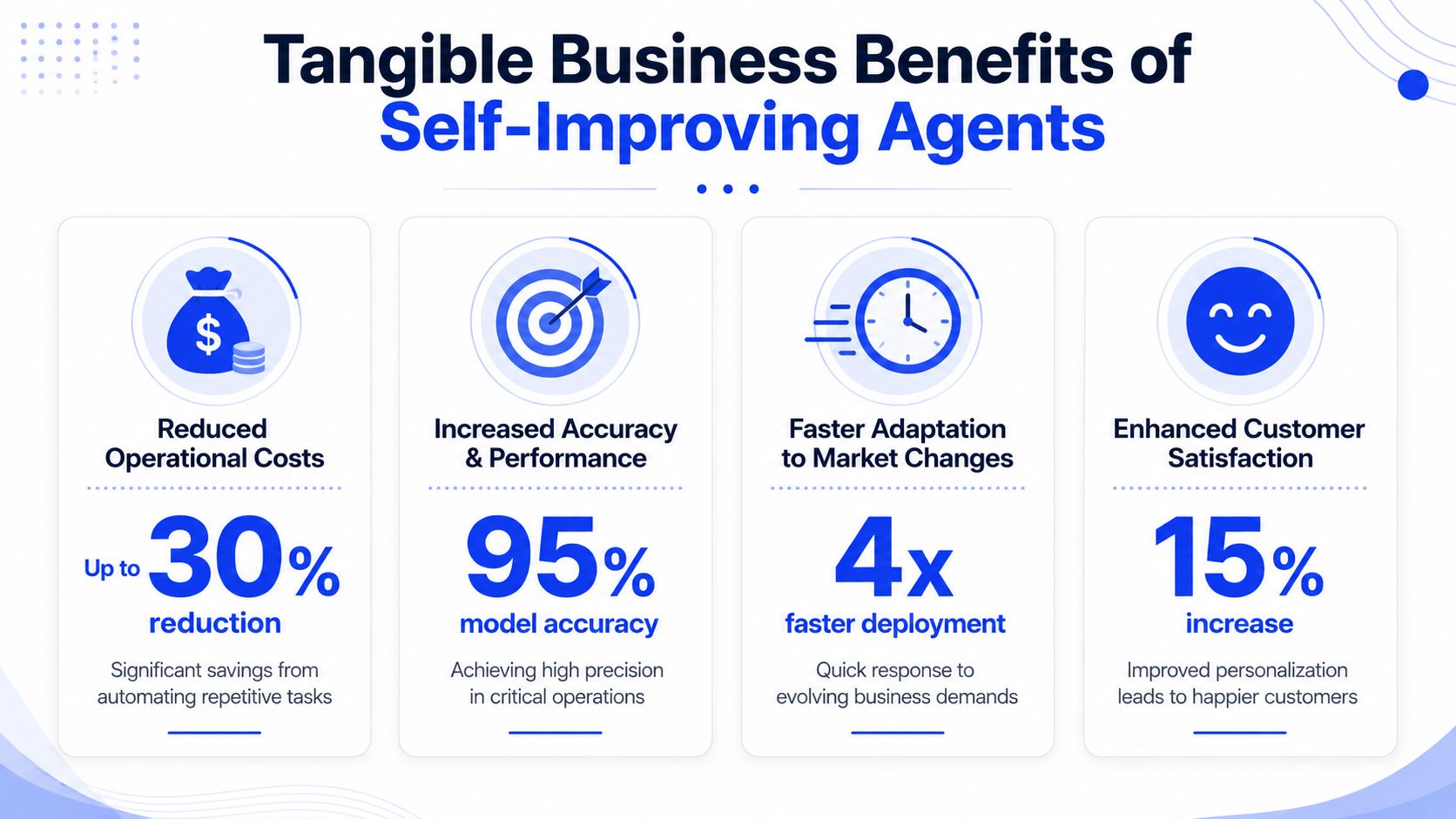
The Business Benefits of a Self-Improving Agent
The case for a learning agent gets stronger when you stop thinking about AI as a widget and start treating it like part of your customer experience. A changing market already forces people to keep their skills current. Aspen University's overview of upskilling notes that the World Economic Forum projected nearly half of all employees would need reskilling by 2025 due to technological change. The same source says 94% of employees would stay longer if their employer invested in career development.
For a business owner, the lesson is simple. If people have to keep learning to stay effective, your AI support layer does too.
Better answers create better outcomes
When an agent learns from recent changes and repeated customer questions, it becomes more useful in the moments that drive revenue.
A prospect asks whether your service includes setup help. A stale bot gives a generic answer. A learning agent recognizes the intent behind the question, uses current information, and moves the conversation forward.
That improves business outcomes in practical ways:
More credible pre-sales support: Customers get answers that reflect what you sell now, not what you sold last quarter.
Stronger lead qualification: The agent can adapt to the signals that separate casual browsers from serious buyers.
Better service consistency: Customers hear the same core message across web pages, FAQs, and chat.
If you're evaluating whether an AI agent for business growth makes sense, this is the true benchmark. Don't ask whether it can answer questions. Ask whether it can keep answering the right questions as your business changes.
Learning systems reduce wasted team time
A self-improving agent doesn't only help customers. It protects your team from repeat work.
When the agent keeps misunderstanding the same pricing objection or policy question, your staff ends up fixing the same mistake over and over. When it learns from those interactions, the correction compounds. The next customer gets a better answer without another human stepping in.
Business rule: Every repeated support correction should become training material, not permanent busywork.
That creates a cleaner operation:
If the agent stays static | If the agent improves over time |
|---|---|
Staff repeatedly fix the same misunderstanding | Fewer recurring mistakes reach the team |
New offers create confusion in chat | Recent changes show up faster in responses |
High-intent leads get generic treatment | Buying signals are handled with more context |
The biggest gain isn't that the system sounds smarter. It's that your business becomes easier to run. Fewer avoidable escalations. Better answers on nights and weekends. More confidence that the automated layer is helping instead of subtly creating cleanup work.
How ChatGrow Enables Continuous Learning
For most businesses, continuous learning only matters if it's operational. The concept sounds good on paper, but owners need a clear process that fits real support work.
That process has three moving parts: feeding the agent with current information, using human feedback to correct weak answers, and measuring whether those changes improve performance. Coursera's enterprise guidance on continuous learning emphasizes that strong programs use reporting and analytics to track skill growth and iterate based on identified gaps.
Start with living knowledge sources
The first step is simple. Don't train your agent on a frozen snapshot if your business changes every week.
Use sources that already reflect the current state of your company. That usually means your website, pricing pages, help center, FAQ library, product documentation, and any channel where policy or offer changes appear first.
For an AI support agent, this matters because customers ask live-business questions:
Sales questions: “Do you still offer the annual discount?”
Support questions: “Where do I cancel now that the dashboard changed?”
Product questions: “Does this feature work on my plan?”
If those source materials change, the agent should be able to learn from the change rather than wait for a full rebuild.
Use feedback to improve future conversations
The second part is the loop many companies skip. The agent needs correction, not just content.
When a conversation gets escalated, stalls, or receives a manual fix, that interaction becomes valuable training material. It shows where the AI misunderstood intent, lacked context, or answered too broadly.
A healthy feedback loop usually looks like this:
The agent handles routine questions using available knowledge.
Uncertain or high-risk chats get flagged for human review.
A team member corrects the response or adds missing context.
The system uses that feedback to improve future handling of similar questions.
This is what turns an AI agent from a static FAQ layer into a working member of the support stack. It learns from the edge cases your real customers create.
Measure what the agent is learning
The third part is measurement. Without it, “continuous learning” becomes a vague promise.
You want to monitor patterns such as which questions trigger escalation, where answers need correction, which topics cause confusion, and whether the agent improves after updates. The point isn't to drown in dashboards. The point is to spot the handful of gaps that matter most.
A practical review rhythm includes:
Recent misses: Look for wrong or incomplete answers tied to product, pricing, and policy.
Escalation themes: Group handoffs by topic so you can see recurring blind spots.
Knowledge freshness: Check whether recent content updates are reflected in conversations.
Lead quality signals: Review whether the agent is asking useful follow-up questions on buying intent.
When those pieces work together, continuous learning stops being a theory. It becomes a repeatable operating habit: update, observe, correct, improve.
Common Pitfalls and How to Avoid Them
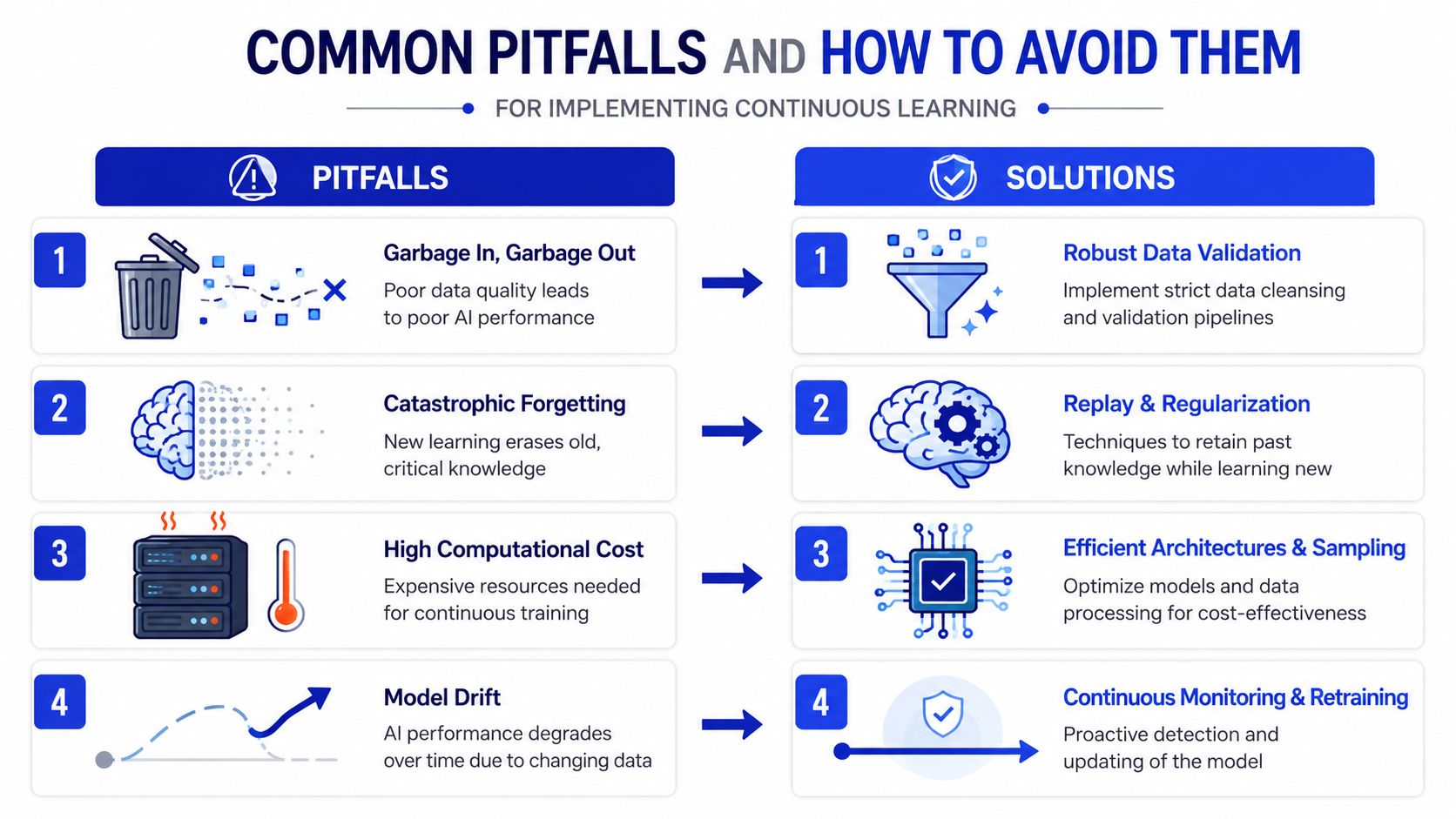
Continuous learning sounds like an automatic win, but it can go wrong if you treat “more learning” as the same thing as “better learning.” The pressure to keep up is real. Edume's discussion of continuous learning notes that the World Economic Forum expects 39% of workers' core skills to change by 2030, and highlights the risk of creating perpetual reskilling fatigue.
That warning applies to AI systems too. If you overload the process, ignore quality control, or never review what the agent is absorbing, the system can become busier without becoming better.
Bad inputs create bad outputs
If your knowledge base contains conflicting answers, outdated offers, duplicate docs, or unclear policy language, the agent can only work with what you gave it.
This is the classic garbage-in, garbage-out problem. The fix isn't more AI sophistication. The fix is better source hygiene.
Use a short cleanup routine:
Remove duplicate content: If two pages answer the same question differently, the agent may pull the wrong version.
Archive expired material: Old promo pages and retired feature docs create confusion.
Write for real questions: If customers ask “Can I talk to sales?” but your docs only say “Schedule a revenue consultation,” the language gap matters.
Set ownership: Someone on your team should own updates to support-critical content.
Too much change can create confusion
A second risk is instability. If the agent constantly absorbs changes without enough review, it may start handling familiar questions less consistently.
Teams sometimes call this forgetting old knowledge or drifting away from the answers that used to work well. You don't need the technical label to manage it. You just need guardrails.
Review uncertain conversations first. Don't try to “teach” the system from every chat equally.
The safest approach is selective learning. Prioritize high-impact topics such as pricing, cancellations, onboarding, integrations, and pre-sales objections. Those are the areas where wrong answers cost you the most.
Here's a simple checklist:
Pitfall | What to do instead |
|---|---|
Messy source material | Clean and consolidate your knowledge base |
Unreviewed feedback loops | Approve corrections before they shape future answers |
Too much low-value retraining | Focus on high-frequency and high-stakes topics |
Ignoring confusing chats | Review escalations and flagged conversations regularly |
The goal isn't nonstop retraining. It's useful learning with enough control that your agent gets sharper, not noisier.
Conclusion Your Agent Is Always in Training
A support agent that never learns doesn't stay smart for long. In a real business, products change, offers shift, and customers ask new questions every week. That's why understanding what is continuous learning matters so much in AI customer support.
The best way to think about it is simple. Your agent is always in training. Every update, correction, and customer conversation can make it more accurate, more helpful, and more valuable to your business. When that loop works well, your chatbot stops acting like a static tool and starts acting like a reliable digital team member.
If you want to put this into practice, Chatgrow gives you a practical way to build AI support agents trained on your website, pricing, FAQs, and product pages, then keep improving them through continuous retraining, analytics, and smart escalation. It's a straightforward path to turning everyday conversations into better support and better leads.
Related Posts
Continue Reading
More articles from the ChatGrow Team.