Blog
Lead Qualification Automation: A Practical Guide
By
Nelson Uzenabor

At 11:42 PM, a high-intent prospect submits a demo request. The form captures the company name, job title, and use case, but nobody sees the notification until 9:00 AM. By then, the prospect may have booked a competitor, lost urgency, or decided that your team isn't responsive.
Lead qualification automation closes that gap. It captures information, evaluates fit and intent, and sends each lead to the next appropriate action without forcing a sales rep to inspect every submission manually. The important design question isn't whether a bot can ask questions. It's which decisions the bot should own, which signals require a person, and how sales can trust the handoff.
Table of Contents
What Lead Qualification Automation Actually Does
Lead qualification automation sits between a prospect's first interaction and a human sales conversation. It can collect answers from a form or chat, enrich a record with available business information, score the lead against defined criteria, and route the result to a rep, meeting calendar, nurture sequence, or disqualification path.
That makes it more than a chatbot and more than a scoring field in a CRM. It's an operating model for the top of the funnel. The system decides what should happen next while preserving a clear path to human involvement.
A practical flow looks like this:
Capture: A visitor submits a form, starts a chat, or requests pricing.
Evaluate: The system checks firmographic fit, stated needs, urgency, and engagement.
Route: A qualified lead reaches the right rep with context. A lower-intent lead receives relevant follow-up. An unsuitable lead is filtered out.
Escalate: Ambiguous answers, hesitation, sensitive requests, or complex buying situations move quickly to a person.
If you're still defining the basics, Growform's guide to qualify leads with Growform provides useful context on qualification criteria and the difference between interest and genuine sales readiness.
The system isn't replacing discovery
The strongest setup doesn't ask automation to imitate a senior account executive. It gives the system repeatable work, such as asking company-size questions, identifying a product category, checking a timeline field, or offering a meeting slot.
A rep then receives a concise record: what the buyer wants, why they reached out, which criteria they met, what the system couldn't determine, and what should happen next. That context prevents the prospect from repeating the entire conversation.
The rest of this operating model depends on three linked ideas. First, the system needs clean data capture and useful scoring. Second, response latency must influence prioritization, not sit in a separate service-level report. Third, trust, buyer experience, privacy, and regulation must define the boundary between automated action and human judgment.
The Three Core Components Working Together
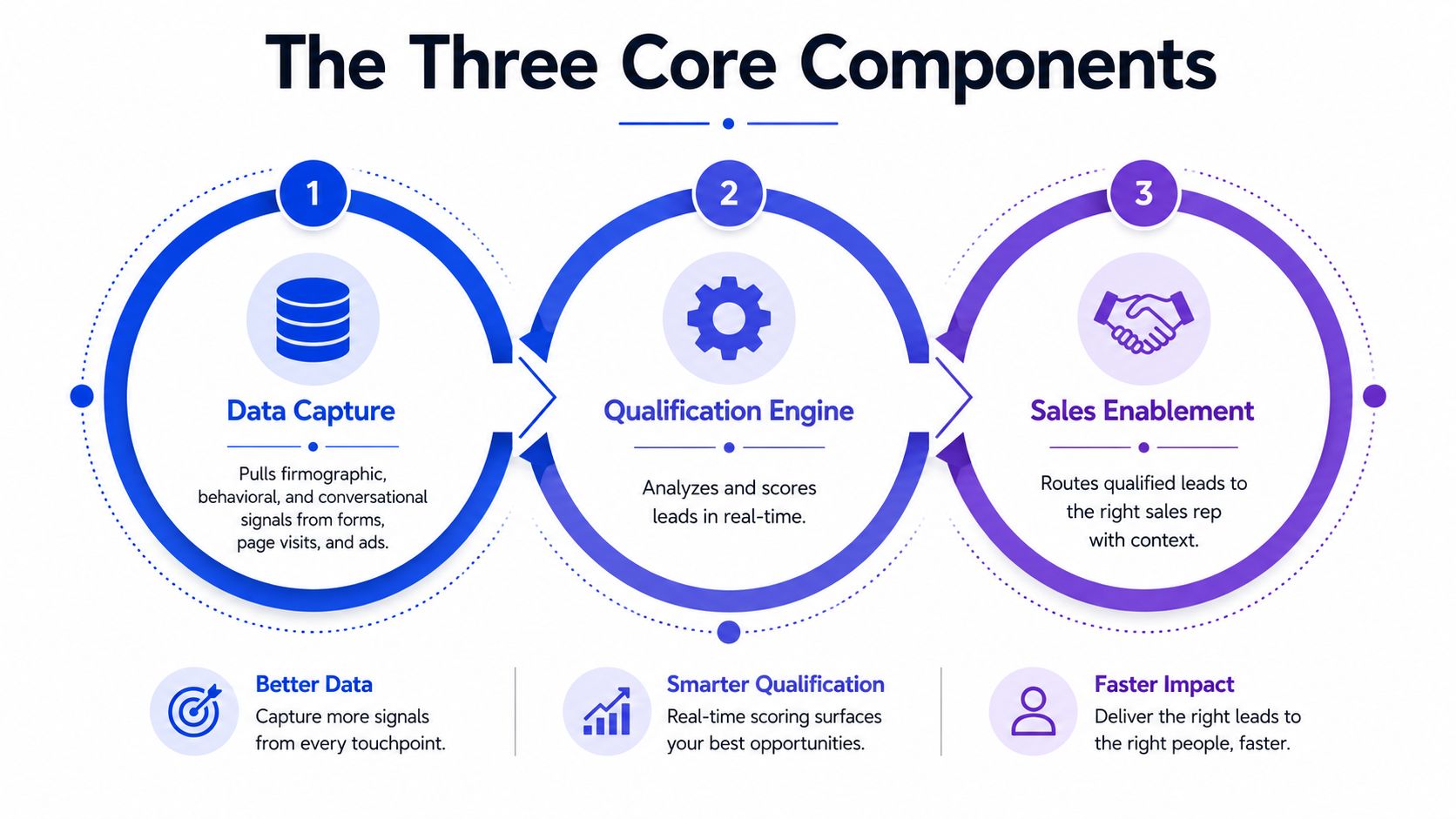
Lead qualification automation works as a chain. Data capture feeds scoring, scoring feeds routing, and routing creates the sales action. If one link is weak, the entire process becomes unreliable.
Data capture creates the raw material
The capture layer gathers information from forms, website behavior, advertising responses, and conversations. Some signals are explicit, such as company size, role, use case, budget range, or purchase timeline. Others are behavioral, such as repeated visits to pricing or comparison pages.
The best forms don't ask every possible question. They ask for the fields a rep will use. A software company might need the visitor's role, team size, current process, and reason for evaluating a solution. A service business may need location, project type, and desired start date.
Bad capture creates bad decisions. If a form stores “interested in learning more” for every visitor, the scoring layer has little useful evidence to work with.
Scoring turns signals into a priority
The qualification engine applies rules or an AI model to the captured information. It can produce separate judgments for fit and intent, rather than collapsing everything into one opaque number.
Fit asks, “Does this account resemble the customers we can serve well?” Intent asks, “Is this person showing evidence of an active problem or buying process?” Keeping those dimensions visible makes a score easier to challenge and improve.
By early 2026, 79% of B2B marketing and sales teams were using or piloting AI-powered lead scoring, up from 48% in 2023, according to the 2026 AI lead scoring automation benchmark. The same benchmark reports 72% to 85% predictive accuracy for AI models, compared with 48% to 54% for traditional rule-based threshold scoring.
Routing turns a score into work
A score has no commercial value if it sits unused in a CRM. Workflow routing assigns the lead to a territory, product specialist, round-robin queue, calendar, or nurture path.
Teams can also connect this layer to automated lead scoring workflows so a new signal triggers a new action. For example, a high-fit visitor who requests a demo can alert a human immediately, while a lower-fit visitor can receive a self-serve resource and remain eligible for future review.
The chain is simple to describe, but operationally important: capture must be deliberate, scoring must be explainable, and routing must be decisive.
Why Speed Changes the Whole Equation
Response time belongs inside lead qualification. A lead's stated fit may be strong, but that value declines when the team leaves the conversation untouched.
One benchmark summary reports that contacting a lead within one hour can improve outcomes by 7x. The source is Landbase's lead qualification statistics summary, which frames response latency as a routing and prioritization variable rather than a simple SLA.
That distinction changes the workflow. The system shouldn't only say, “This lead is qualified.” It should also say, “This qualified lead is active now, so a human needs to see it immediately.”
Response Time | Relative Conversion | Operational Implication |
|---|---|---|
Within 1 hour | 7x improvement reported | Prioritize immediate human follow-up |
Longer than 1 hour | Lower relative outcome | Continue qualification, enrichment, or nurture based on intent |
The queue needs more than a timestamp. It should recognize high-intent behavior, score recent activity appropriately, and deliver urgent leads to a person while the buyer is still engaged. A pricing-page visitor who asks about implementation is different from someone who downloaded a general guide weeks ago.
Speed needs operational support
Fast routing can fail if the sales calendar has no available slots, ownership rules are unclear, or alerts disappear inside a crowded inbox. Teams should connect qualification to scheduling, and resources on boost efficiency through calendar management can help clarify how availability affects response workflows.
Automation can offer a meeting immediately, but it shouldn't force a meeting when the buyer is only researching. The right approach combines urgency with intent. Escalate strong buying signals quickly, and let weaker signals proceed through enrichment or nurture without creating unnecessary pressure.
Practical rule: Treat latency as part of the lead's qualification state. A strong lead without a timely owner is still an operationally neglected lead.
Where Automation Wins and Where It Struggles
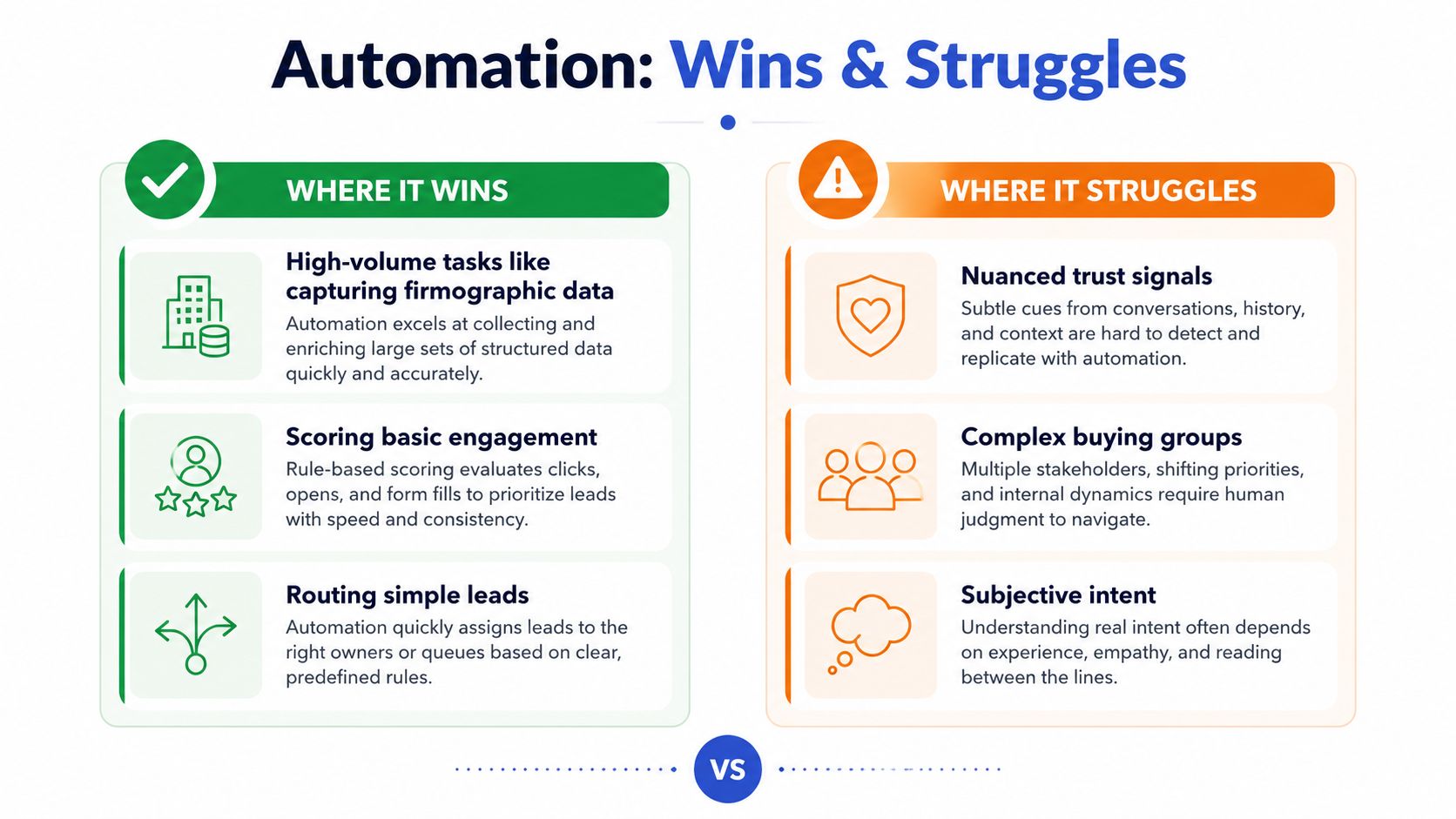
Automation performs best when the task is repetitive, observable, and governed by criteria the team can explain. It can ask the same baseline questions every time, apply territory rules consistently, and operate outside business hours without fatigue.
Human judgment becomes more important when the buyer's meaning isn't explicit. A prospect may answer every structured question but still be hesitant, politically constrained, or unsure who needs to approve the purchase.
The clean side of the boundary
Automation handles these jobs reliably when the inputs are clear:
Firmographic capture: Collect company size, industry, location, and role in a consistent format.
Structured qualification: Ask about use case, timeline, project size, or product interest.
Basic prioritization: Combine fit and explicit intent into a visible priority level.
Routing: Send leads to a territory, product queue, specialist, or booking flow.
Scheduling: Offer available times and record the selected appointment.
Recycling: Place lower-intent contacts into a relevant follow-up path instead of sending them to a rep prematurely.
These tasks reduce triage. They don't remove the need for judgment.
The human side of the boundary
A published comparison of chatbot and representative performance found that chatbots can come within about 4 to 5 percentage points of trained reps on structured BANT-style fields, including budget, timeline, company fit, and project size. The same comparison reports a much larger gap for hesitation detection, 34% versus 91%, and decision-authority inference, 61% versus 88%. Those figures come from LiveHelpNow's chatbot qualification comparison.
That gap matters because buyers rarely announce every concern directly. A delayed answer, a vague “we're exploring options,” or repeated references to internal approval may signal a stalled buying process, not a lack of interest.
Let the bot own deterministic questions. Let a person own ambiguity.
Escalation should happen when a buyer expresses hesitation, multiple stakeholders appear, the use case is unusual, or the conversation involves sensitive commercial or contractual judgment. The goal isn't maximum automation. It's appropriate automation.
Trust, Buying Groups, and the New Qualification Stack
Sales reps trust AI-qualified leads when they can inspect the reasoning. A handoff that contains only a score creates suspicion. A handoff that shows the captured fields, triggered criteria, recent activity, unanswered questions, and recommended next action gives the rep something they can verify.
That transparency also changes the unit of qualification. A single contact isn't always the opportunity. A buying group may include a user, budget owner, technical reviewer, executive sponsor, and procurement contact, each revealing a different part of the decision.
From a lead record to an account view
Industry commentary describes qualification as shifting from a single lead record toward the buying group, with AI-driven scoring and intent data becoming a default direction in 2025. It also identifies MQL-to-SAL conversion as a key diagnostic measure, because a marketing-qualified lead matters only when sales accepts it for action. These observations appear in The Starr Conspiracy's B2B lead qualification trends brief.
The practical design is an account-level view with contact-level evidence. The system can associate several conversations with one organization, identify whether the group contains relevant roles, and avoid treating one enthusiastic contact as proof that the entire account is ready.

The handoff should expose uncertainty
A useful handoff has four parts:
Evidence: What the visitor said, selected, or did.
Decision logic: Which fit and intent criteria fired.
Gaps: What the system couldn't confirm.
Action: Who owns the follow-up and why.
AI-driven models can weigh fit, intent, and engagement together, but governance still matters. Rule-based scoring may be reduced or retired where predictive models have enough reliable data, yet the model needs monitoring, feedback, and a human review path.
The resulting stack has four layers: capture, scoring, routing, and human review. Each layer should pass context forward, not hide it behind a black box.
Real Use Cases for Small and Growing Teams
A small team usually doesn't need automation everywhere. It needs coverage in the places where buyer intent is easiest to recognize and missed conversations are most expensive.
Consider a visitor who lands on a pricing page at 2:00 AM from another time zone. An AI agent can ask what the visitor is evaluating, collect contact details, identify the relevant use case, and offer a calendar option. The sales team starts the day with a structured conversation instead of an anonymous form notification.

High-intent pages need different treatment
A visitor reading a general educational article may not want a sales conversation. A visitor comparing plans, reviewing a demo page, or asking about integration is giving the system stronger context.
A team can place targeted prompts on those pages and ask only the questions needed for routing. For example, a SaaS company could ask about team size, current workflow, and implementation timing. A consultant might ask about the project type, desired outcome, and whether the visitor wants a conversation or a written estimate.
This approach also supports performance marketing workflows, because campaign traffic can enter a qualification path designed around the promise made in the ad or landing page.
E-commerce and hybrid journeys
Not every qualified lead should go to a rep. An online buyer may need one product clarification before checking out. A chat agent can answer a common question, identify whether the visitor needs sales assistance, and route only the higher-consideration conversations to a person.
Chatgrow can be used as one example of this model. Its AI sales agent can qualify visitors in conversation, capture details a rep needs, and route high-intent users to the appropriate inbox or handoff path. Teams evaluating the broader category can also compare approaches in lead qualification tools for different workflows.
Use the first month to observe, not to promise a guaranteed outcome. Track after-hours conversations that previously went unseen, the questions visitors ask before booking, and the amount of manual triage removed. Then review rejected or escalated conversations with sales and adjust the criteria.
The video below offers a product-oriented view of an agent workflow. Treat it as a demonstration of the interaction pattern, not as a substitute for testing your own qualification logic.
Getting Started With an AI Qualifying Agent
A small team can launch a controlled qualification flow without automating the entire website. Start with a narrow surface area, clear ownership, and a review loop.
Choose the pages
Begin with pricing, demo request, and contact pages. These surfaces usually provide more context than a general homepage, and they let the team observe whether the agent's questions help or interrupt the buying experience.
Define the criteria
Translate the ideal customer profile into three to five questions. Choose fields that change the next action, such as company size, timeline, use case, geography, or product interest. Add one routing branch, for example, “send implementation questions to a specialist” or “offer self-serve checkout for a straightforward purchase.”
Don't ask for information that nobody uses. Every extra question adds friction and creates another field the sales team must interpret.
Deploy in a controlled environment
Test the agent with expected answers, incomplete answers, contradictory answers, and clear requests for a person. Connect the output to the CRM fields your reps already use, then define escalation rules for ambiguity, hesitation, privacy requests, or sensitive topics.
Tools in this category can start at about $39 per month with a 7-day trial, as described in the supplied Chatgrow product information. That type of entry point lets a team validate the conversation before committing significant budget or engineering time, but the trial should still have a defined test plan.
Measure the first 14 days
Track three operating signals:
Response time: How quickly does a high-intent conversation reach a human?
Qualification rate: How often does the agent collect enough information to make a routing decision?
Sales acceptance: How often does sales agree that the lead deserves follow-up?
Don't optimize only for completed chats. A bot that collects many answers but sends poor-fit leads to sales has created administrative work, not qualification quality.
Iterate from rejection
Ask reps why they reject or downgrade a handoff. If the same missing field appears repeatedly, add a question. If the agent overreacts to a weak signal, adjust the rule or model instruction. If buyers abandon the conversation at one prompt, rewrite the wording or remove the question.
The system improves when sales feedback becomes structured input rather than informal criticism.
A 90 Day Plan to Make It Stick
A launch becomes durable when the team treats it as an operating rhythm.
Days 1 to 14, build the foundation
Confirm that data capture, scoring, and routing connect correctly. Agree with marketing and sales on what qualifies a lead, what sales accepts, and which situations require immediate human review. Record baseline response time, qualification quality, and sales acceptance before changing the workflow.
Days 15 to 45, expand with evidence
Add the agent to the next high-intent pages only after the first flow produces understandable handoffs. Introduce buying-group detection by connecting relevant contacts to account records, then test model-driven scoring where the available data supports it.
Use the practical guidance in how to deploy AI agents to keep deployment tied to a real workflow rather than a broad automation project.
Days 46 to 90, harden the process
Audit privacy and compliance flags, document the exact conditions for human escalation, and review rejected conversations on a regular cadence. Publish a trust report that includes sales-accepted lead rate, speed-to-contact, and pipeline influenced, with definitions everyone understands.
A mature system connects speed, trust, and workflow integrity. Capture supplies evidence, scoring creates prioritization, routing assigns responsibility, and human review protects the buyer relationship. That combination is more valuable than maximizing the number of automated conversations.
Chatgrow offers custom AI agents that answer questions, qualify visitors, capture lead details, and escalate conversations with structured context for human follow-up. Visit Chatgrow to test a focused qualification flow on your pricing, demo, or contact pages.
Related Posts
Continue Reading
More articles from the ChatGrow Team.