Blog
How to Define and Optimize Marketing Qualified Leads
By
Nelson Uzenabor

A marketing qualified lead is only as useful as the handoff rule behind it. That's why the number that should grab your attention isn't lead volume, it's the fact that the average MQL-to-SQL conversion rate is 13% and the median B2B cost per sales-qualified lead reached $612 in 2024, according to the Demand Gen Report benchmark summarized by The Starr Conspiracy. If only about 1 in 8 MQLs becomes sales-qualified, a vague definition turns into expensive noise fast.
For SMB teams, that changes the job of marketing. You're not trying to label every contact as qualified, you're trying to decide which contacts deserve nurturing, which deserve routing, and which should keep self-educating until their behavior changes. A clear MQL definition also helps sales trust the queue, so less time gets wasted arguing about lead quality and more time goes into actual follow-up.
If you want a quick plain-English refresher before you build your own system, EmailScout explains MQLs in a way that pairs well with the framework below.
Table of Contents
Why Marketing Qualified Leads Matter
A lead only becomes valuable when your team can tell the difference between curiosity and buying movement. That's the core reason the 13% MQL-to-SQL benchmark matters so much, because it shows how few leads survive the trip from marketing interest to sales readiness The Starr Conspiracy. If your scoring is loose, you can build a big pipeline on paper and still hand sales a list full of people who aren't ready.
Why poor definitions waste money
The cost side is just as blunt. When the median B2B cost per SQL is $612, every bad handoff gets expensive, especially if paid media and automation are already driving up acquisition costs The Starr Conspiracy. A vague MQL rule doesn't just create messy reporting, it makes each qualified handoff more costly than it needs to be.
Practical rule: if your MQL definition can't tell sales who should be contacted now versus nurtured later, it isn't specific enough.
Why alignment beats volume
The business value of MQLs is that they create a shared language. Marketing can say, “this person fit the profile and showed intent,” while sales can say, “this person crossed the handoff threshold.” That shared language helps SMB teams avoid one of the most common funnel problems, paying for more leads while getting less useful pipeline.
A stronger definition also changes how you judge channel performance. A source that creates fewer leads but produces better-qualified MQLs is usually more useful than a channel that floods the top of the funnel with weak intent. For a broader primer on how lead stages fit together, What an MQL is gives a straightforward overview that pairs well with this framework.
Understanding Marketing Qualified Leads and Sales Qualified Leads
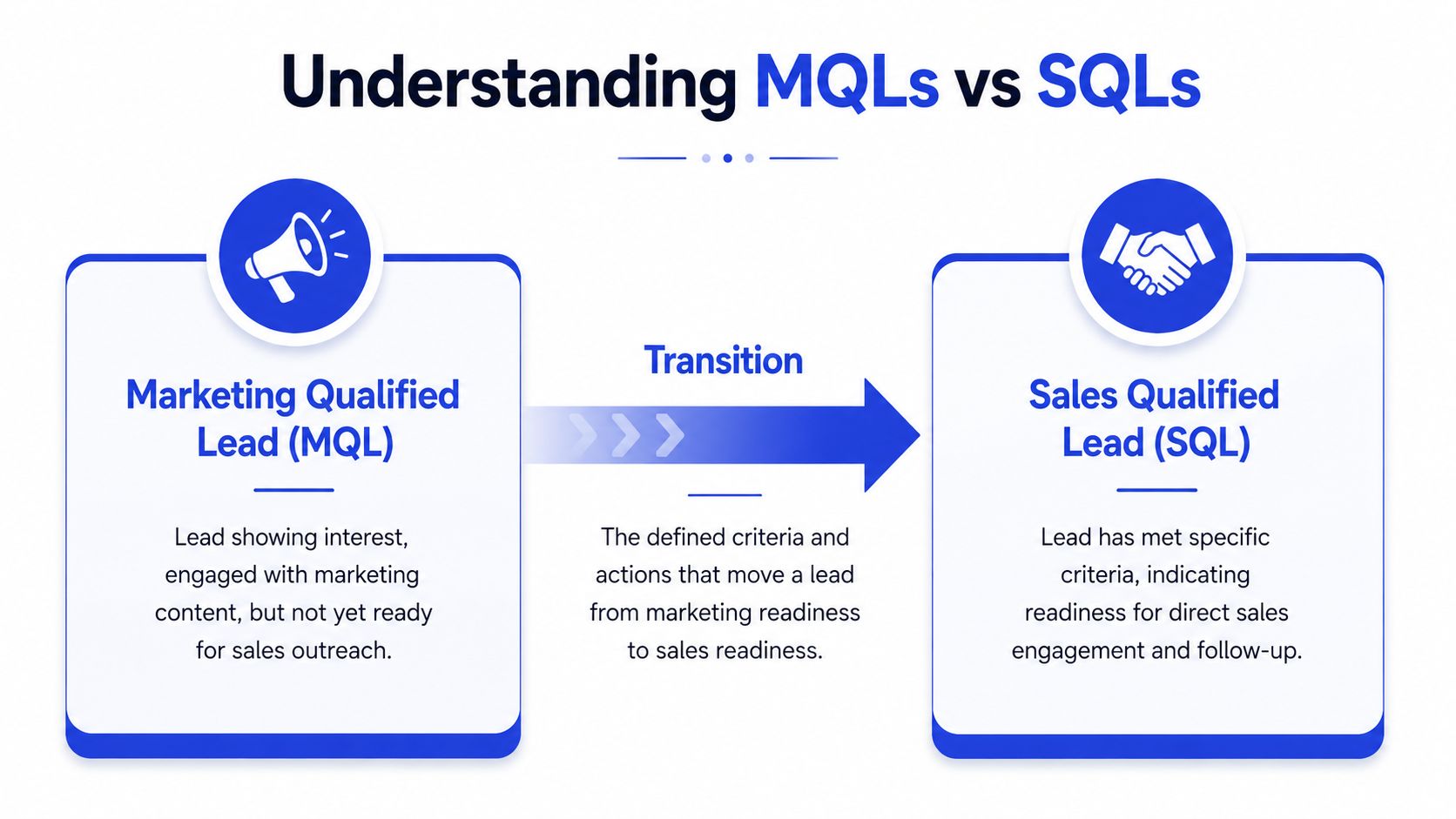
The easiest way to separate these stages is to ask one question, “Is this person interested, or is this person ready?” MQLs show meaningful interest and usually need nurturing before sales contact, while SQLs are explicitly sales-ready Tableau. That's a simple distinction, but teams often blur it when they treat every click the same way.
What changes at the handoff
An MQL might download a guide, attend a webinar, or return to a key page several times. Those are useful signals, but they don't automatically mean budget, authority, or urgency. An SQL has crossed a higher bar, usually through stronger intent signals that make direct sales outreach appropriate Tableau.
That transition matters because the ownership changes too. Marketing keeps nurturing MQLs, but sales takes over once the lead has earned a sales conversation. If you skip that distinction, sales gets interrupted by early-stage curiosity and marketing loses the chance to warm up borderline contacts.
A clean handoff is less about labels and more about timing.
A simple side-by-side view
MQL: shows interest, fits the target profile, but still needs education and proof.
SQL: shows enough intent to justify direct sales engagement.
MQL action: keep nurturing, score behavior, and watch for stronger intent.
SQL action: route to sales with context and a follow-up plan.
For a deeper explanation of how lead stages are usually framed in practice, What an MQL is is a useful companion read for teams trying to tighten their language around qualification.
Defining MQL Criteria and Building Scoring Models
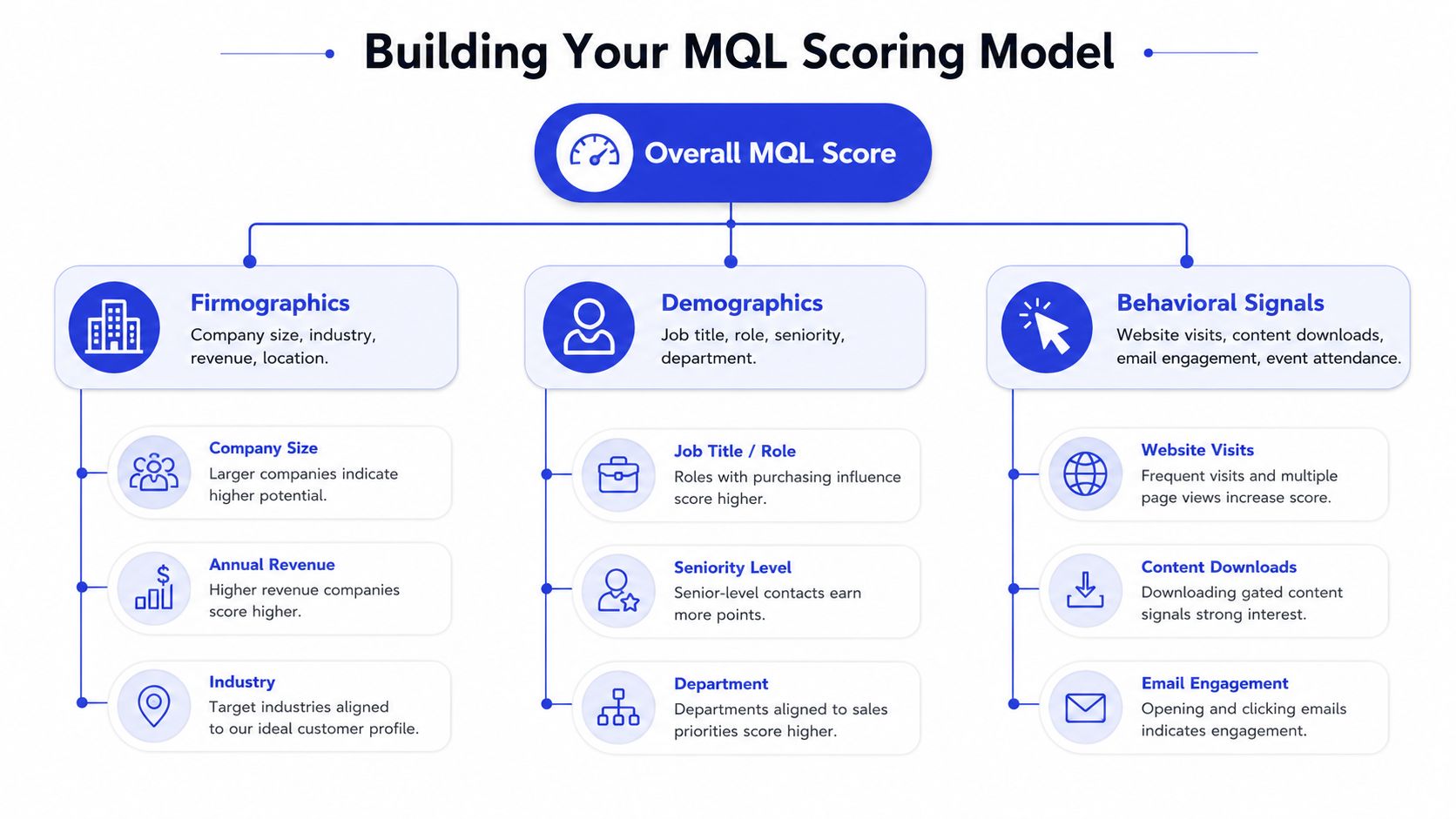
A solid MQL model combines three things, fit, role, and behavior. In practice, that means a prospect should resemble your ideal customer, sit in a relevant role, and show actions that suggest active evaluation SalesHive. When those pieces work together, your score becomes more predictive than any single action on its own.
Start with fit before intent
Fit answers the question, “Should we even care about this lead?” That usually means checking industry, company size, geography, and whether the account type matches your best customers. Demographic fit adds the human layer, such as job title, seniority, and department SalesHive.
If someone looks like your ideal buyer but hasn't engaged, they may still be worth tracking. If someone engages heavily but sits far outside your target profile, the score should stay restrained. That balance keeps your funnel from rewarding low-value curiosity.
Then assign points to behavior
Behavior is where the model becomes practical. Repeated site visits, downloads, webinar attendance, and email engagement all show different levels of interest, and they shouldn't carry the same weight SalesHive. A points-based model lets you reward deeper actions more than surface-level ones.
High-intent actions: pricing-page visits, demo requests, calculator usage.
Mid-intent actions: webinar attendance, case study downloads, repeat visits.
Lower-intent actions: newsletter signups, single blog reads, broad content clicks.
A simple points model works best when the team agrees on why each signal matters. If you're looking at automated ways to apply and maintain those rules, automated lead scoring shows how a structured scoring process can support that setup.
Useful habit: review the score after real sales outcomes, not just after campaign launches.
Tracking and Measuring MQL Performance
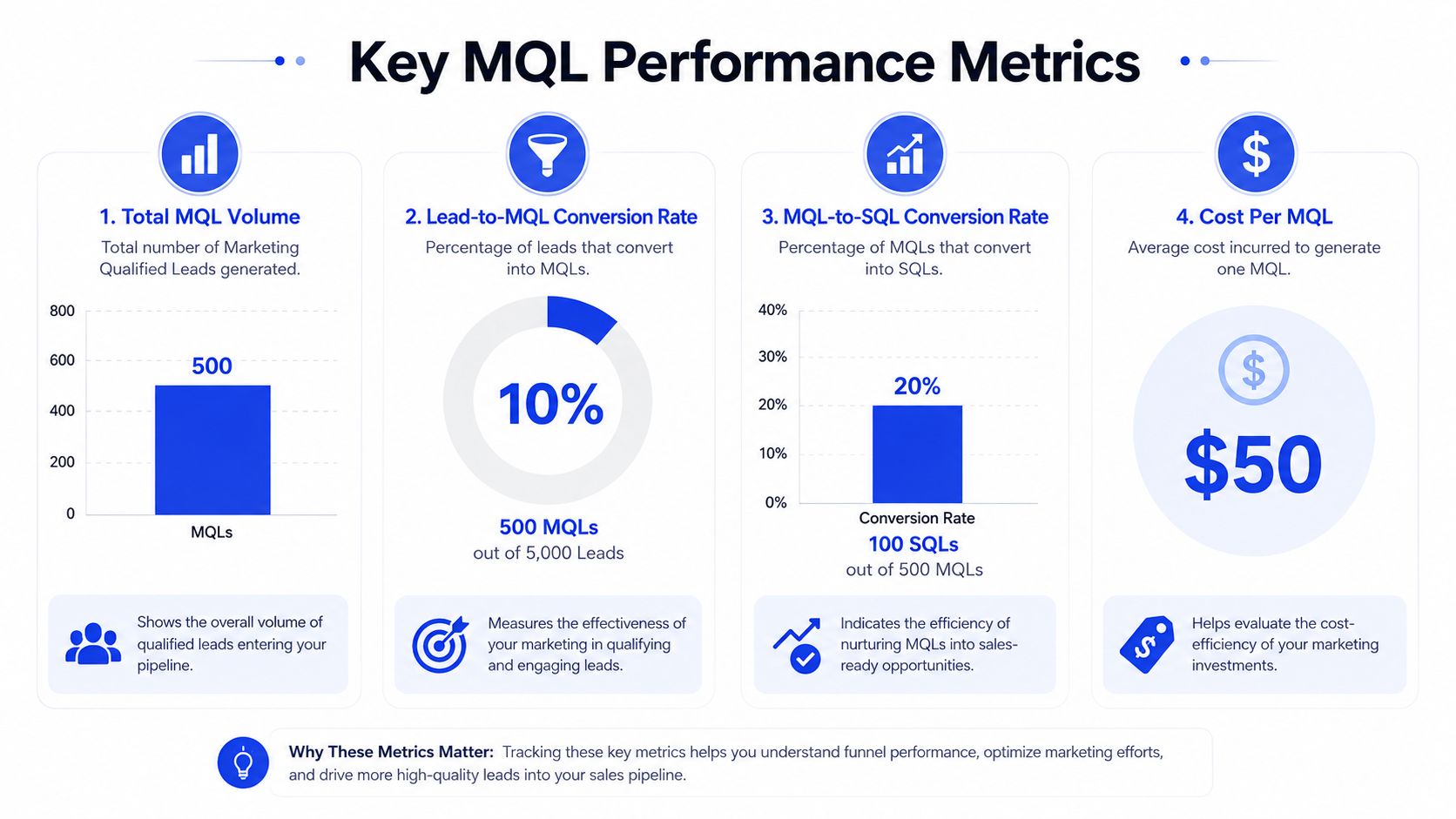
MQL systems get clearer when you measure them like a funnel, not like a vanity list. The first metric is total MQL volume, but the second, and more important, is how many of those leads become SQLs. The 2025 benchmark data shows 39% lead-to-MQL conversion for B2B SaaS, compared with 31% across all industries, while referrals convert to MQLs at 56% and SEO at 41% GTM 80/20.
The KPIs worth putting on the dashboard
You don't need twenty charts. You need a few that answer different questions. Total MQL volume tells you whether demand is coming in, while lead-to-MQL conversion tells you whether your acquisition mix is producing usable contacts GTM 80/20. MQL-to-SQL conversion shows whether qualification is working, and cost per SQL tells you whether the pipeline is efficient enough to scale The Starr Conspiracy.
A clean dashboard usually separates source performance too. If referrals and SEO produce stronger MQLs than broad paid campaigns, you've got a clue about where your best intent comes from GTM 80/20. That doesn't mean you abandon every other channel, it means you stop treating all traffic as equal.
How to read the numbers without overreacting
Strong volume with weak SQL conversion usually points to scoring problems, not demand problems.
That's the diagnostic move many teams miss. If MQLs are growing but SQL handoff isn't, the issue may be the definition, the lead source, or the follow-up process. If high-intent channels keep outperforming broad ones, your routing and budget should reflect that reality instead of chasing raw lead counts.
For teams already using conversation-based capture, chatbot for lead generation is a practical reference for turning site traffic into measurable qualification activity.
Strategies to Optimize MQL Generation and Conversion
Optimization starts when you stop asking for more leads and start asking for better ones. The fastest gains usually come from tightening your content offers, focusing on channels that attract stronger intent, and reducing friction in the path from interest to handoff. One useful way to think about it is simple, if a lead still needs education, marketing owns it, and if it's ready for direct contact, sales should see it.
Prioritize intent, not just traffic
The channel data makes the case clearly. Referrals and SEO outperform broader sources on lead-to-MQL conversion in the 2025 benchmark, which means they're bringing in more people who are already closer to evaluation GTM 80/20. That doesn't mean other channels are useless, it means you should weight them by intent quality, not just by the number of forms they fill.
The same logic applies to content. Gated assets should match the buyer's stage. A generic top-of-funnel guide might create interest, but a comparison page or calculator usually tells you more about readiness.
Use messaging that matches stage
Nurture content should move people forward, not just keep them entertained. That's where the AIDA framework can help, because it pushes you to align attention, interest, desire, and action in the offer structure. If you want a crisp breakdown of that approach, powering content with AIDA is a useful companion for shaping emails and landing pages around progression.
Pitfall | Impact | Solution |
|---|---|---|
Treating every signup as an MQL | Sales gets weak handoffs | Add fit and behavior rules before qualification |
Overvaluing low-intent content | More leads, fewer SQLs | Weight high-intent pages and repeat engagement more heavily |
Ignoring negative scoring | Bad-fit leads inflate the pool | Subtract points for poor fit or irrelevant roles |
Slow follow-up on strong signals | Hot leads cool off | Route faster and alert sales on high-intent actions |
If you want to compare how conversational capture fits into this stack, chatbot for lead generation shows how a website conversation can support qualification instead of replacing it.
Automating Lead Qualification with AI Chat Agents
AI chat works best on pages where the buyer is already leaning in. That usually means pricing pages, comparison pages, demo pages, and high-value product pages where intent is already visible. Current guidance on MQLs still says many prospects qualify through content engagement, but modern buying journeys increasingly include self-qualification through chat and real-time on-site interaction ClickPoint Software.

What to set up first
Start with one page type, not your whole site. Train the agent on the content the visitor is already reading, then define what counts as a qualified conversation, such as role fit, company fit, timing, or use case. If you want the build process laid out step by step, how to create an AI agent is a practical reference for turning a conversation flow into a working qualification layer.
The point is speed. Buyers expect instant answers, and the chat should be able to answer common questions, surface the next best action, and capture enough context for a clean handoff. That's especially useful for SMBs that can't keep humans on every page around the clock.
Where Chatgrow fits
One option is Chatgrow, which can be trained on your website content, set to ask qualification questions, and routed toward escalation when a lead meets your rules. Used this way, the chat becomes part of the MQL process, not a separate support toy. It's most relevant when you want to qualify visitors while they're already in buying mode, rather than waiting for a form fill.
Strong chat qualification doesn't replace scoring, it adds a live signal to the score.
You can also use chat transcripts to see which questions keep coming up before leads convert. That feedback helps you rewrite pages, improve qualification prompts, and remove the friction that's slowing people down. In other words, the bot isn't just capturing leads, it's showing you where your funnel leaks.
Next Steps to Elevate Your MQL Pipeline
A stronger MQL pipeline comes from consistency, not from one big campaign. Start by tightening your definition so marketing and sales agree on the same threshold for handoff. Then review your scoring model, especially the balance between fit and intent, so your best leads don't get buried under high-volume noise.
The next step is channel discipline. Keep comparing lead sources by quality, not just quantity, and pay attention to where the strongest MQLs come from. The benchmark data already points toward higher-intent sources like referrals and SEO, so your budget should follow the patterns your own pipeline confirms GTM 80/20.
After that, add real-time qualification where it matters most. High-intent pages are the right place for chat, because that's where buyers are already asking themselves whether your solution fits. If the conversation tool can collect role, need, and timing signals in the moment, your handoff gets cleaner and your sales team gets better context.
A simple rollout plan looks like this:
Audit your current definition. Make sure every MQL rule matches a real buying signal.
Review scoring inputs. Keep the model focused on firmographic fit, role fit, and meaningful behavior.
Check handoff timing. Sales should get leads only when intent justifies outreach.
Test real-time chat on one page. Start where buyers show the strongest intent.
Measure the outcome. Watch whether SQL quality improves, not just lead count.
Keep the system moving, because MQL quality decays when no one revisits the rules. The teams that win here don't treat qualification as a one-time setup, they treat it as an operating habit.
A CTA for Chatgrow.
Related Posts
Continue Reading
More articles from the ChatGrow Team.