
Blog
Multilingual Support Guide for AI Customer Service
By
Nelson Uzenabor

At 11:47 p.m., a customer reaches the checkout page, notices a charge they don't understand, and opens the support chat. They explain the problem in their first language. The bot answers in English with a translated sentence that misses the question. The customer tries again, waits for a human handoff, and eventually closes the tab.
Nothing was wrong with the product. The failure happened in the support operation. The business may have had translated FAQs, a language selector, and an AI tool that technically recognized several languages, but the customer still couldn't get a clear answer.
That distinction matters for multilingual support. Language coverage isn't successful because a system can translate words. It's successful when a customer can explain an issue, receive an accurate response, follow the next step, and reach the right person without losing context.
This guide treats multilingual support as an operational performance problem. You'll learn how to define real coverage, compare delivery models, prepare an AI chat agent, create language-aware escalation, and measure resolution by locale rather than relying on a broad multilingual label. You can also explore how natural language processing improves chatbot conversations before designing your own support workflow.
Table of Contents
Introduction Why Language Determines Support Success
A customer who cannot get help in a familiar language may misunderstand a return condition, abandon a subscription upgrade, submit repeated requests, or choose a competitor with an easier buying process. For an SMB, one unresolved conversation can affect revenue and trust while adding work for a small support team.
The failure often appears in routine situations. A traveler needs to change a booking after business hours. A software user asks whether an integration works with their plan. A parent buying educational materials needs delivery details. If the answer is awkwardly translated or sent to a team that cannot respond in the customer's language, the company feels unavailable even when its website is accessible.
Translated help pages provide a starting point. They do not answer every follow-up question, interpret an unusual situation, collect account details, or explain a policy that depends on context. Resolution, not translation, is the standard customers feel.
The access gap affects operations
A 2026 UNESCO/ICANN report says only around 400 languages are fully accessible online, although the world has about 7,000 spoken languages. It describes a persistent gap between linguistic diversity and the languages supported by digital services. The UNESCO/ICANN multilingualism report provides broader context.
The practical lesson for an SMB is narrower than “support every language.” Start with the locales that generate demand, revenue, or repeated service friction. Then measure whether customers in each locale receive answers, complete the intended task, and reach the right specialist when automation cannot resolve the issue.
Language therefore becomes an operating variable, not a translation checkbox. A business can report broad language coverage while one locale has lower resolution, longer handoffs, or more repeat contacts. Those signals show where the workflow needs attention.
AI changes the operating model
Human language teams remain valuable for complex, sensitive, or regulated requests. AI chat agents can answer common questions, identify intent, collect relevant details, and direct conversations at any hour.
The strongest setup assigns each layer a clear job. AI handles repeatable requests in the customer's language. Trained staff receive the conversation summary, detected language, customer intent, and unresolved details when judgment or account access is required. Teams that understand how natural language processing improves chatbot conversations can configure this handoff around meaning, not word-for-word translation.
That model helps a small support team set language-aware escalation rules and compare performance by locale, rather than trying to staff every language and every hour manually.
What Multilingual Support Means in Customer Service
Multilingual support means a customer can complete a support journey in their preferred language, from the first question through resolution or human escalation. It includes the language used in the interface, the understanding of the request, the answer itself, the internal workflow, and the follow-up.
A simple translation widget behaves like a phrasebook. It can convert a sentence, but it doesn't necessarily know whether the customer wants a refund, is reporting a damaged item, or is asking about a contract term. A multilingual concierge works differently. The concierge understands the request, checks the relevant policy, answers naturally, and knows when to bring in a specialist.
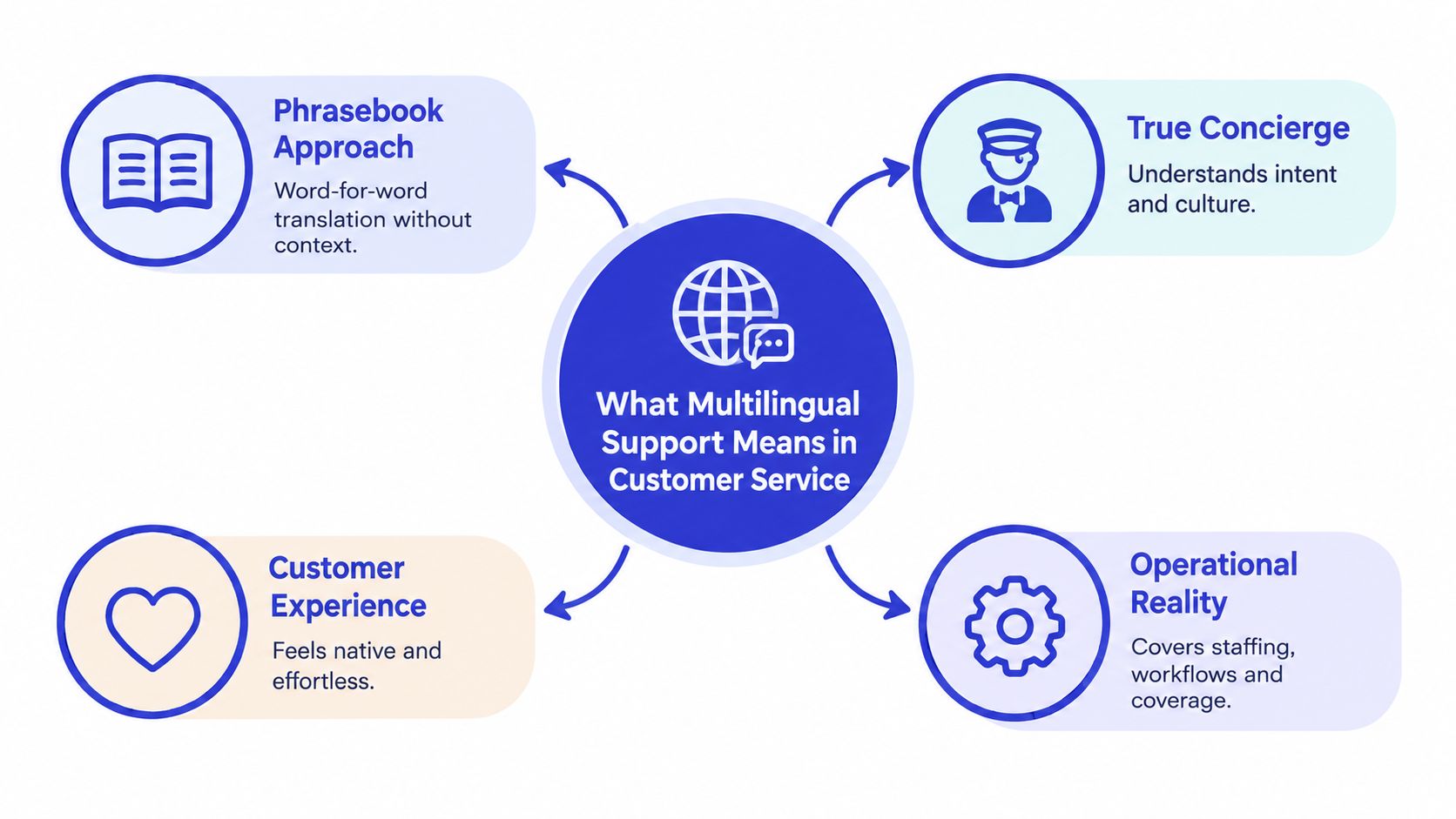
Four layers of real coverage
Start with the customer-facing layer. Your website, chat prompt, help articles, buttons, automated emails, and error messages should make sense in the supported language. Partial translation creates friction when the customer switches between languages to finish a task.
Next comes intent understanding. Customers don't always use formal product terms. They may use regional expressions, misspell a word, mix languages, or describe an outcome rather than the feature name. An AI agent must connect that phrasing to the correct answer or workflow.
The third layer is operational. If the agent can't resolve the issue, it should route the conversation to a team that can. That handoff needs to retain the original question, relevant account details, and the language preference. Sending a customer from a Spanish conversation into an English-only queue without context isn't multilingual support. It's a language failure hidden inside a workflow.
Finally, measure the experience. Ask whether the customer received a useful answer, not whether the system displayed a translated response.
Layer | What customers experience | What the business must provide |
|---|---|---|
Interface | Clear prompts and navigation | Localized customer-facing content |
Understanding | The system recognizes intent | Locale-aware training and testing |
Resolution | The answer solves the problem | Accurate knowledge and policy logic |
Escalation | A human can continue naturally | Language-aware routing and summaries |
For additional guidance on human workflows, the Translators USA LLC support guide offers useful context on organizing multilingual customer care.
Practical rule: If a customer must repeat the issue after escalation, your language coverage is incomplete.
Why Multilingual Support Has Become Essential
A customer finds your product through a localized search, reviews the pricing page in a familiar language, then asks for help and receives an English-only reply. The problem is operational: each language switch adds effort at a point where the customer is deciding whether to continue.
The online market already reflects this shift. A 2026 study found that multilingual websites represented 15% of the broader web and 33.7% of the one million most visited sites. Among the most visited properties, sites averaged 7 languages, compared with 5 languages in the broader sample. Webiano's analysis of multilingual websites details these differences and the language distribution behind them.
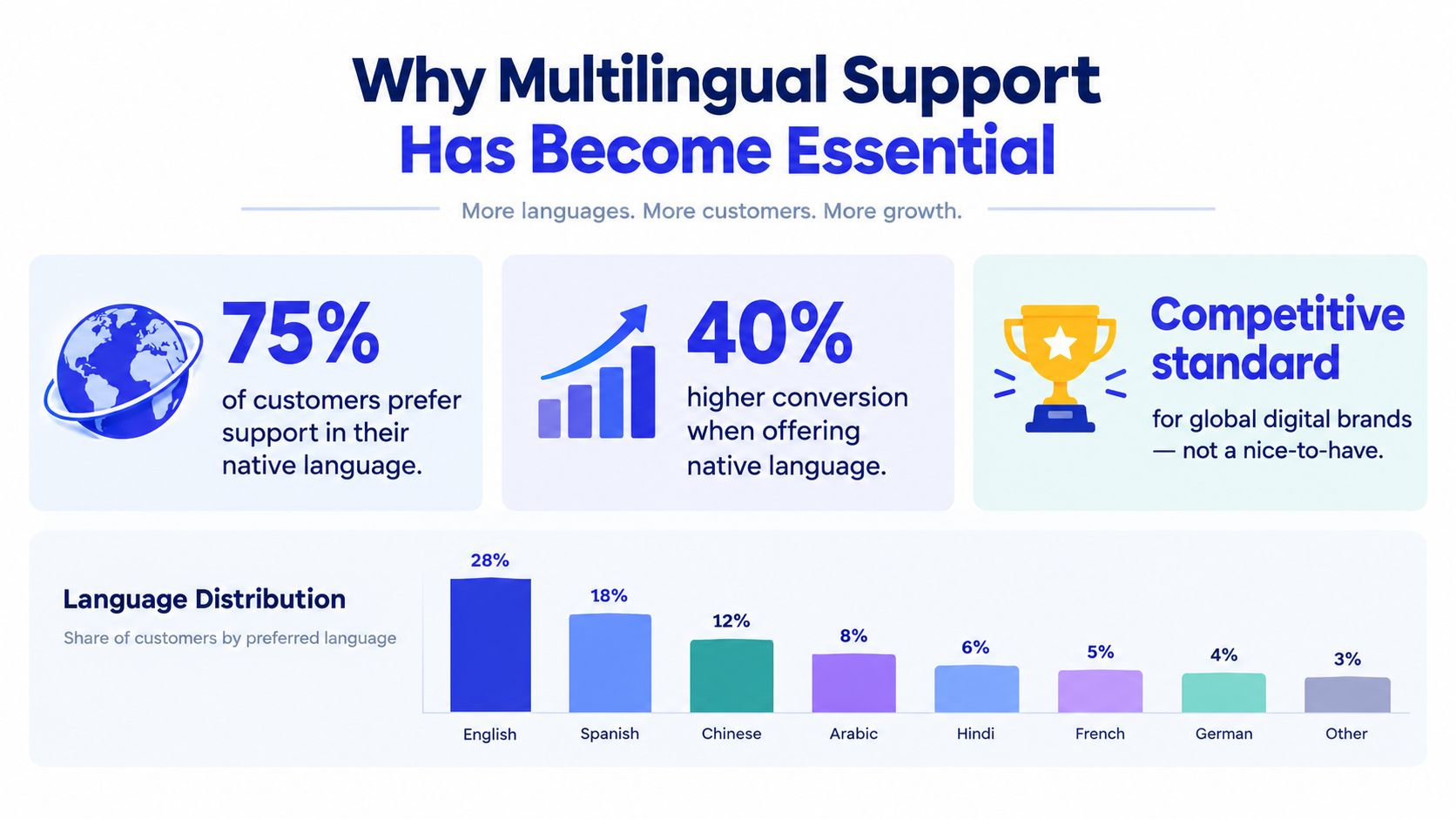
English reaches many customers, but not every customer
English accounts for about 20.08% of web content in the broader sample and 21.77% among the most visited sites, according to the same 2026 analysis. Chinese, Spanish, Hindi, Arabic, French, and Portuguese also represent meaningful portions of online content. An English-only service model therefore leaves important customer groups with fewer ways to understand, buy, and get help.
The right language priorities depend on your operation. Review visitor locations, customer records, support requests, sales opportunities, and expansion plans. A regional ecommerce business may start with a different set of languages from a SaaS company serving distributed teams.
Language gaps affect the whole funnel
Language coverage should follow the customer journey, not sit in a separate translation project. A useful framework measures performance across five stages:
Acquisition: Can prospects understand the product and ask pre-sales questions?
Conversion: Can they resolve objections without changing languages?
Onboarding: Can new users configure the product correctly?
Retention: Can existing customers solve problems before they consider leaving?
Operations: Can staff receive escalations with the conversation history and language context intact?
As noted earlier, the UNESCO/ICANN report highlights the limited online accessibility of many world languages. That context supports a practical business conclusion: language access affects market reach and service capacity, not only website presentation.
For support leaders, the key measurement is performance by locale. Compare useful-answer rates, escalation rates, resolution time, repeat contacts, conversion, and retention across languages. An AI agent that answers quickly in one language but sends another language's customers into an English-only queue is creating an operational gap, even if its translation appears accurate.
This framing turns multilingual support into a measurable service capability, with language-aware routing, escalation, and reporting built into the customer journey.
Approaches to Delivering Multilingual Support Compared
There isn't one correct delivery model. The right choice depends on the complexity of your product, the consequences of a wrong answer, the languages your customers use, and how much live coverage your team can sustain.
A native-language support team offers strong cultural understanding and judgment. It works well for high-value accounts, complex troubleshooting, and conversations where tone or local practice matters. The tradeoff is operational: hiring, scheduling, training, and maintaining consistent coverage across languages can be difficult for a small business.
A machine translation layer adds language capability to an existing English workflow. It's relatively simple to introduce, but translation alone doesn't solve intent detection, policy interpretation, routing, or escalation. Customers may receive grammatically acceptable text that still answers the wrong question.
A hybrid model pairs AI or translation with human review. It can be effective when an automated system handles routine requests and humans take over for exceptions. The design challenge is deciding which conversations require review and making sure the handoff includes enough context.
An AI-native chat agent treats language as part of the conversation logic. It can be trained on approved knowledge sources, recognize intent, follow business rules, maintain brand voice, qualify leads, and escalate when the request falls outside its authority. It still needs locale-specific testing and human oversight, especially for sensitive issues.
Choosing Your Multilingual Support Approach
Approach | Best For | Trade Offs |
|---|---|---|
Native-language human teams | Complex service, strategic accounts, sensitive cases | Higher staffing demands and slower expansion |
Machine translation layer | Basic content access and early language experiments | Translation may not understand intent or workflow |
Human and AI hybrid | Routine volume with human review for exceptions | Requires clear escalation rules and queue ownership |
AI-native chat agents | Always-on FAQs, qualification, and repeatable support across locales | Needs careful training, testing, monitoring, and fallback design |
A useful decision rule is to separate language difficulty from business risk. A simple delivery-status question may be safe to automate in several languages. A question about a financial obligation, legal term, medical issue, or cancellation consequence may require a human even when the AI understands the language.
Also check whether the system handles more than direct translation. Smart intent recognition connects different customer phrasings to the same operational goal. Brand voice controls keep the answer aligned with your company. Escalation summaries prevent the human team from starting over.
How to Implement Multilingual Support with AI Chat Agents
Implementation works best as a controlled workflow, not a large translation project. Start with the conversations customers already have, then expand coverage after you can observe quality.
Audit the current experience
List the languages customers use in chat, email, forms, and sales conversations. Review where those customers stop progressing. Look for unanswered questions, repeated handoffs, abandoned forms, and tickets that staff manually translate.
Create a language inventory with four fields:
Customer demand: Which languages appear in real interactions?
Journey importance: Which languages affect sales, onboarding, or retention?
Content readiness: Which policies and product pages are approved for use?
Human backup: Who can handle an escalation in each language?
Choose a manageable starting group based on evidence. Don't promise broad coverage before you know how the workflow behaves.
Prepare one reliable knowledge base
An AI agent can't compensate for contradictory source material. Centralize current pricing, product documentation, shipping rules, refund policies, account instructions, and lead qualification criteria. Mark content that varies by market, plan, or customer type.
Write the source information in plain language before translating it. Short rules, explicit conditions, and clear exceptions are easier for an agent to apply consistently. Keep an owner for each knowledge area so updates don't remain invisible to the support system.
For teams managing larger content systems, this resource on customizing multilingual features in Sitecore can help clarify how language variations fit into a broader content architecture.
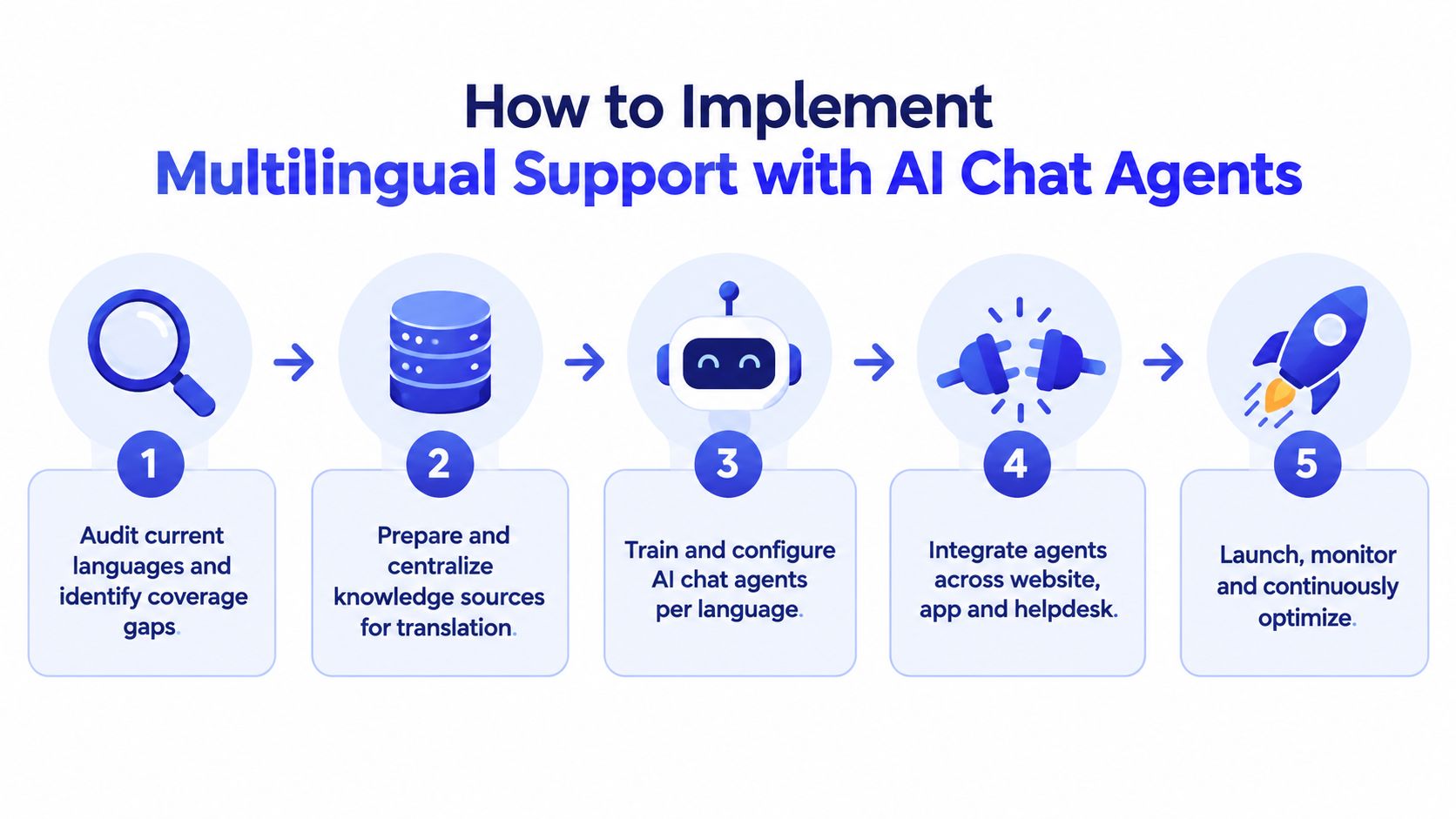
Configure intent, voice, and escalation
Train the agent on approved sources and test how customers phrase the same need across locales. Configure the desired tone, terminology, prohibited claims, and rules for uncertainty. The agent should say when it lacks enough information instead of filling gaps with a confident guess.
Set escalation triggers for account-specific requests, sensitive topics, unresolved repetition, and explicit requests for a person. Capture the customer's language, intent, key facts, and attempted steps in a concise summary. The receiving team should know what happened before opening the conversation.
The following walkthrough can help teams visualize an AI agent setup before deployment.
Deploy where intent is highest
Place the agent on product pages, pricing pages, checkout, onboarding screens, and support areas where customers already need help. A visible language option can help, but automatic language detection should remain easy to correct.
Begin with a narrow set of high-frequency questions. Review real conversations, update the underlying knowledge, and add examples for recurring phrasing. When the agent performs reliably, extend it to another journey stage or language instead of expanding everywhere at once.
Teams that want a deeper process for improving responses can use this guide to train an AI agent effectively.
Testing Measuring and Proving ROI by Language
A multilingual system can appear healthy in aggregate while failing a specific customer group. Test each locale separately, using real customer wording rather than only polished translations. Include abbreviations, regional terms, misspellings, mixed-language messages, and questions that depend on local policy.
The 2026 Microsoft multilingual evaluation survey found that 36% of evaluated languages appeared in only one benchmark. It also reported that low-resource languages were typically tested across 1 to 3 task categories, compared with 14 for high-resource languages. The Microsoft survey is a strong reason to avoid relying on one overall multilingual quality score.
Build a language-level scorecard
Track outcomes by language, channel, and journey stage. Useful measures include resolution rate, escalation rate, first-contact resolution, customer satisfaction, repeat contact, lead qualification, conversion events, and time to human response.
Don't treat a high automation rate as success by itself. An agent can close conversations quickly while leaving customers confused. Pair operational metrics with conversation review and customer feedback.
Measurement principle: Report what customers achieved in each language, not just what the system supported.
Compare similar journeys across locales where possible. For example, examine whether customers asking about pricing receive a useful answer, move to the next step, and request human help at comparable rates. The comparison doesn't need to prove identical behavior. It needs to reveal where a language-specific defect affects the journey.
Include voice and difficult interactions
Voice support deserves separate validation. Recent industry coverage says voice represents 40% of contact center volume, and a September 2026 launch introduced real-time voice translation for 13 languages. Ainora's coverage of multilingual business communication also highlights why voice is harder than text, including accents, code-switching, latency, and weaker quality in lower-resource languages.
For healthcare, legal, financial, and property-related interactions, define the point where AI translation must give way to a qualified human. Test pauses, names, numbers, dates, consent language, and corrections. A fluent-sounding voice response can still create serious risk if it changes meaning.
Connect outcomes to business value
Calculate value by language segment using the measures your business already trusts. Compare support effort with retained customers, completed purchases, qualified leads, or successful onboarding outcomes. Keep the analysis grounded in your own baseline rather than borrowing a generic conversion claim.
Use chatbot analytics to organize conversation data, then review the results with the people who own each language queue. Their qualitative feedback often explains why a metric changed.
Common Pitfalls Best Practices and Next Steps
The most common mistake is treating language as a checkbox. Teams add translated content, announce coverage, and never verify whether customers can complete the full journey. The 88% versus 28% perception gap makes that danger clear: one source reports that 88% of support teams say they offer multilingual support, while only 28% of customers report receiving it. The 2026 bilingual customer service study connects the gap to routing, staffing, escalation, and customer-visible resolution.
Avoid these failure patterns:
Aggregate scoring: A strong overall score can hide poor performance in a specific locale.
Low-resource neglect: Test every target language independently, especially where benchmark coverage is limited.
Broken escalation: Preserve language preference, intent, and conversation context for human follow-up.
Stale knowledge: Assign owners and review policies whenever products, pricing, or terms change.
Translation-only design: Validate whether the customer reached a useful outcome, not whether the sentence sounds fluent.
Start with one or two priority languages, one high-intent journey, and a defined human fallback. Review conversations weekly, fix knowledge gaps, and expand only when language-level results support the next step. That operating discipline turns multilingual support from a marketing claim into a dependable service capability.
Build that capability with Chatgrow, where you can create AI support agents trained on your website and business knowledge, configure multilingual conversations, qualify leads, and route complex requests with useful summaries. Visit Chatgrow to explore a practical way to make every customer conversation easier to resolve, regardless of language.
Related Posts
Continue Reading
More articles from the ChatGrow Team.