
Blog
What Is Lead Qualification: Qualify & Convert Leads
By
Nelson Uzenabor

Your team says the leads are “hot.” Sales takes the calls. Then the pattern repeats. The prospect is a student doing research, a company you can't serve, or someone curious with no timeline, no internal buy-in, and no reason to move now.
That's the day-to-day problem lead qualification is supposed to solve. Not as a theory exercise. As a way to stop burning time on conversations that were never real opportunities in the first place.
For SMBs, this matters even more. Many SMBs don't have a bench of SDRs to manually screen every form fill, chatbot conversation, and inbound message. They need a process that starts simple, works in real time, and can be automated without turning into enterprise sales ops overhead. If you want a broader view of how qualification fits into pipeline building, Receiver's lead generation content is a useful companion read.
Table of Contents
What Is Lead Qualification Really
Lead qualification is the process of deciding whether a prospect is worth active sales attention right now.
That sounds obvious, but it's often still treated like a loose gut check. Marketing sends over anyone who downloaded something, filled a form, or clicked around a pricing page. Sales then tries to sort it out live on the call. That's backwards. Qualification should happen before a rep spends calendar time.
The need for speed has changed the definition of what good qualification looks like. Buyers don't want to wait around for a callback and a discovery sequence just to find out whether you can help them. According to Highspot's lead qualification research, 74% of buyers expect instant responses and 58% abandon sites that don't qualify them immediately.
Good qualification answers four questions
A practical qualification process usually checks some version of these:
Are they a fit for the business you serve
Do they have a real problem your product or service can solve
Are they showing intent beyond casual browsing
Should a human talk to them now, later, or not at all
That last point matters most. Qualification isn't only about saying yes or no. It's also about routing. Some leads need a sales call. Some need support content. Some belong in nurture. Some should be disqualified quickly and respectfully.
Practical rule: If your team can't explain in one sentence why a lead reached sales, your qualification process is too vague.
It's not just filtering
Teams often hear “what is lead qualification” and think of a gate. A form field. A checklist. A score threshold.
In practice, it's a decision system. It combines what you know about the account, what the person is doing, and what your sales team can realistically follow up on. For a small business, that system might be lightweight. For a larger B2B team, it might include CRM rules, scoring, and routing logic. The principle stays the same. Don't let noise consume selling time.
Manual qualification still has a place
Traditional qualification frameworks still work when used properly. A rep asking smart questions can uncover more than any form can. But manual qualification breaks down when every lead has to wait in line for human review.
That's why modern teams blend both approaches. They use a basic framework to define what matters, then automate the first pass so buyers get answers fast and reps only step in when there's a real opportunity.
Why Lead Qualification Is a Non-Negotiable
Poor qualification doesn't just create annoying calls. It damages revenue.
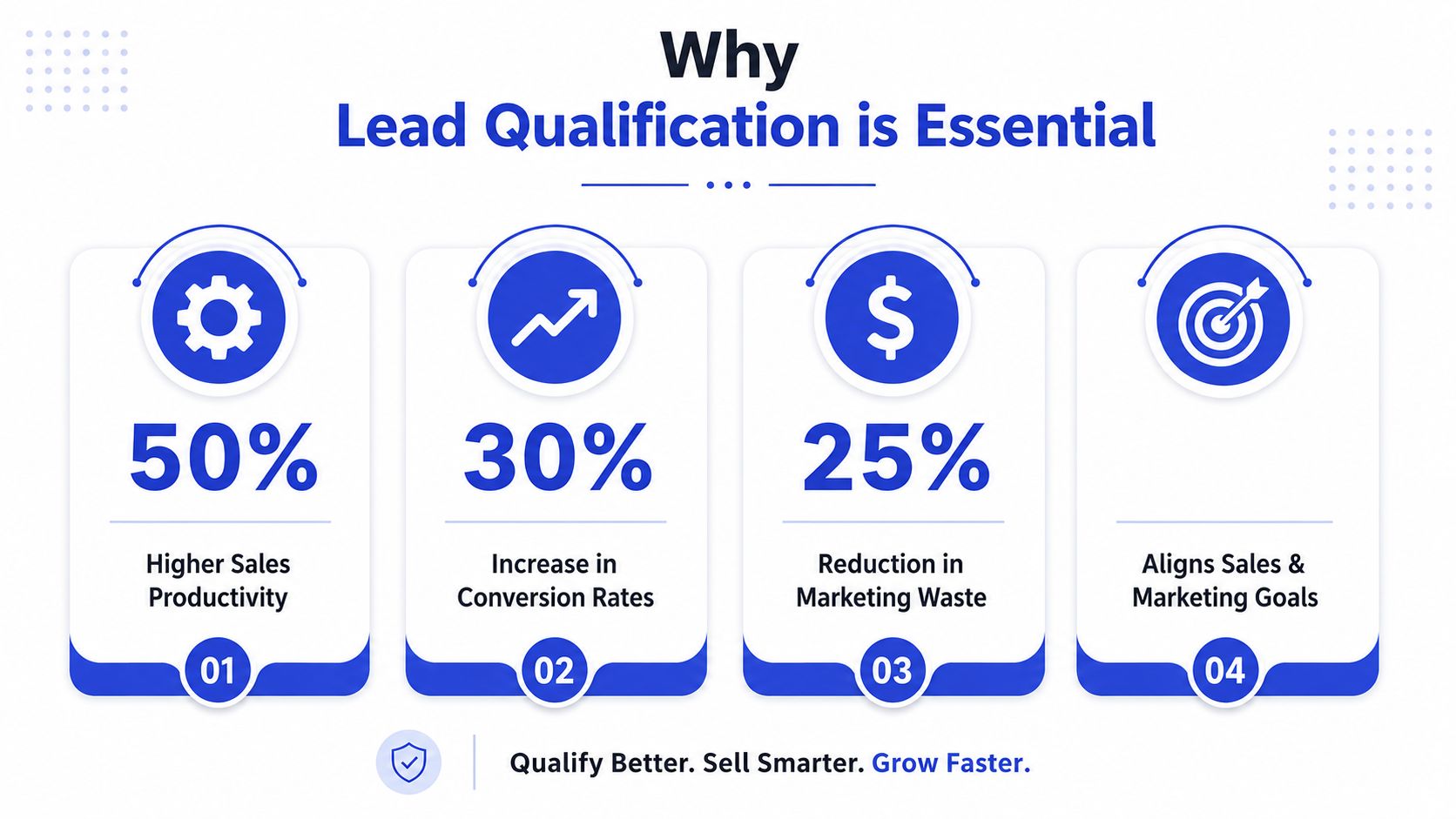
According to LeadResponse lead qualification statistics, approximately 67% of lost sales are directly attributed to poor lead qualification, and 79% of all generated leads never convert to sales at any stage, largely because teams lack structured qualification and nurturing.
It protects sales time
Sales capacity is limited. Every weak meeting takes time from a better one.
When qualification is loose, reps end up doing basic screening work during live calls. They ask questions that should have been answered earlier. They spend energy on accounts outside the ICP. They chase people who were never in a buying process.
That creates a hidden cost: your best reps start distrusting inbound. Once that happens, follow-up quality drops even on the leads that are worth pursuing.
It improves forecasting and handoffs
Qualification also cleans up the line between marketing and sales. If marketing calls everyone an MQL and sales rejects most of them, nobody trusts the funnel.
A stricter process gives both teams a shared standard. Marketing knows what kind of engagement and fit matters. Sales knows why a lead was passed over. Operations can track where leads stall, where they're getting misrouted, and which criteria are too loose.
Bad qualification usually shows up as a team problem before it shows up as a reporting problem.
It changes how you think about volume
A lot of SMBs still assume more leads will solve the pipeline problem. Usually the opposite is true. More low-quality leads create more distraction, slower follow-up, and worse close rates.
Lead qualification forces a better question: which signals predict a real sales conversation?
That's where teams gain an advantage. Instead of counting all inbound equally, they focus on leads with fit, intent, and timing. The result is a cleaner funnel, less wasted effort, and a process sales will use.
Common Frameworks and Key Qualification Signals
Most qualification frameworks are just ways to organize the same core judgment. Is this prospect a fit, and is there a reason to engage now?
An effective process usually layers frameworks like BANT and CHAMP, sets clear disqualifiers in the CRM, defines a shared ICP, and tracks intent signals such as pricing page views and demo requests, as outlined in Salesmotion's lead qualification framework guide.

Frameworks are prompts, not scripts
Think of BANT and CHAMP like a doctor's intake questions. They help you diagnose. They're not the treatment.
BANT is straightforward:
Budget checks whether the buyer can realistically purchase
Authority looks at decision-making influence
Need confirms there's a real pain point
Timeline tells you whether this matters now
CHAMP often works better for modern SMB and mid-market sales because it starts with the problem:
Challenges first
Authority second
Money after value is clearer
Prioritization to understand urgency
For smaller teams, the mistake isn't choosing the wrong framework. It's treating the framework like a rigid script. Prospects don't speak in acronyms. Reps and chat flows should use these models as a checklist behind the scenes.
Fit tells you who they are
Fit signals answer whether the account belongs in your funnel at all.
That usually includes:
Signal | What it tells you |
|---|---|
Company size | Whether the account matches your typical customer |
Industry | Whether your offer is built for their use case |
Region | Whether you can sell and support them |
Role | Whether the contact can influence a purchase |
Existing stack or business model | Whether your product is even relevant |
You don't need a huge scoring model to start. A plain-language ICP and a few hard disqualifiers are usually enough for an SMB. If you're refining how those signals turn into routing and score thresholds, Chatgrow's guide to automated lead scoring is a useful operational reference.
Intent tells you whether now is the right time
A lead can fit your ICP and still be a bad use of sales time if the timing is wrong.
Intent signals add the missing context:
Pricing page visits usually show evaluation behavior
Demo requests suggest active interest
Repeat visits can indicate internal circulation or comparison shopping
Multi-stakeholder activity often signals a more serious buying process
A good qualification system separates “right company” from “right moment.” You need both.
The strongest setup combines fit and intent. Fit alone can over-prioritize inactive accounts. Intent alone can flood sales with the wrong visitors. When you combine them, qualification gets much sharper.
Real-World Examples and Scripts
Most bad qualification calls fail in the first three minutes. The rep jumps to a demo, the prospect stays vague, and both sides leave without learning whether there's an actual buying process.
What bad qualification sounds like
A weak version sounds like this:
Rep: “Happy to walk you through the platform. Want to see the dashboard?”
Prospect: “Sure, we're just exploring options.”
Rep: “Great, let me show you the features.”
That conversation feels polite, but it's not qualification. The rep hasn't learned what triggered interest, who's involved, what problem matters, or whether the account should even be in pipeline.
What a better conversation sounds like
A stronger version is still simple:
Rep: “Before I show anything, what prompted you to look at this now?”
Prospect: “We're spending too much time answering the same inbound questions.”
Rep: “Got it. Is this mainly a support issue, a lead response issue, or both?”
Prospect: “Both.”
Rep: “Who besides you would weigh in on a tool like this?”
Prospect: “Our founder and head of marketing.”
Rep: “And are you trying to solve this this quarter, or just researching?”
Prospect: “We want something in place soon.”
That gives you problem, scope, buying group, and urgency. Now the rep knows whether to continue, route, or pause.
A simple chatbot qualification flow
A site chatbot can ask the same questions without making the visitor wait for a callback. A simple sequence looks like this:
Start with context
“What are you trying to do today?” Support, pricing, booking a demo, or something else.Check fit
“What kind of business are you?” Then ask a lightweight question about company type, team size, or use case.Check urgency
“Are you actively looking for a solution now, or gathering options?”Capture routing info
“Who should we follow up with, and what's the best work email?”Escalate appropriately
High-intent leads go to sales. Low-intent or poor-fit visitors get self-serve help or nurture.
For examples of how conversational flows can work outside a website widget too, these WhatsApp bot examples show how businesses structure automated qualification in messaging environments.
How to Automate Lead Qualification with Chatgrow
The move from manual qualification to automated qualification doesn't require a giant rev ops project. For most SMBs, it comes down to four decisions: what your agent should know, what it should ask, where it should appear, and when a human should step in.
Qualification automation matters because manual screening doesn't scale well. In the automation context, one benchmark worth noting is that implementing marketing automation can generate up to 451% more qualified leads, while AI-driven lead scoring can improve conversion rates by 30% and produce 50% more sales-ready leads, according to Saleshandy's lead generation statistics.
Step 1 Train your agent on your business
Start with your actual customer-facing information. That means your website, pricing pages, help docs, FAQs, service descriptions, and product explanations.
If the agent can't answer basic questions accurately, qualification breaks down fast. Buyers won't keep going if every answer sounds generic or evasive.
For businesses building a broader automation layer around this, it also helps to map and automate customer journeys so qualification isn't isolated from the rest of the buyer experience.
Step 2 Define your qualification rules
Keep the rules simple at first. Most SMBs don't need a dense lead scoring model on day one.
Focus on practical conditions such as:
Good-fit accounts that match your target customer type
Relevant use cases that your product or service is built for
High-intent behavior such as pricing or demo interest
Clear disqualifiers like unsupported regions or non-business use cases
A tool like an AI agent for business becomes useful operationally. The point isn't to mimic a full SDR team. It's to collect the right context and route conversations without delay.
The best automated qualification flows don't ask everything. They ask enough to decide the next action.
Step 3 Deploy on high-intent pages
Don't put your most advanced qualification flow only on the homepage. Put it where buying intent is already showing up.
That usually means:
Pricing pages
Demo or contact pages
Service pages with strong commercial intent
Comparison or solution pages
Here's a walkthrough of how that kind of setup works in practice:
When the right prompt appears on the right page, visitors answer questions they'd ignore in a cold form. The interaction feels more like guided buying than form completion.
Step 4 Escalate the right conversations
Automation shouldn't trap serious buyers in a bot loop.
Once a visitor shows strong fit and clear intent, pass the conversation to a person with context attached. That summary should include what the visitor asked, what they're trying to solve, and any qualification details already captured.
This is the only place where many SMBs need real sophistication. Not in complex scoring models. In smart escalation. If automation can answer routine questions, capture fit and urgency, and send clean handoff notes to sales, the process is already doing the job.
Measuring and Optimizing Your Qualification Process
Qualification isn't a one-time setup. Teams change, offers change, and inbound quality shifts. If you don't review the process, it drifts.
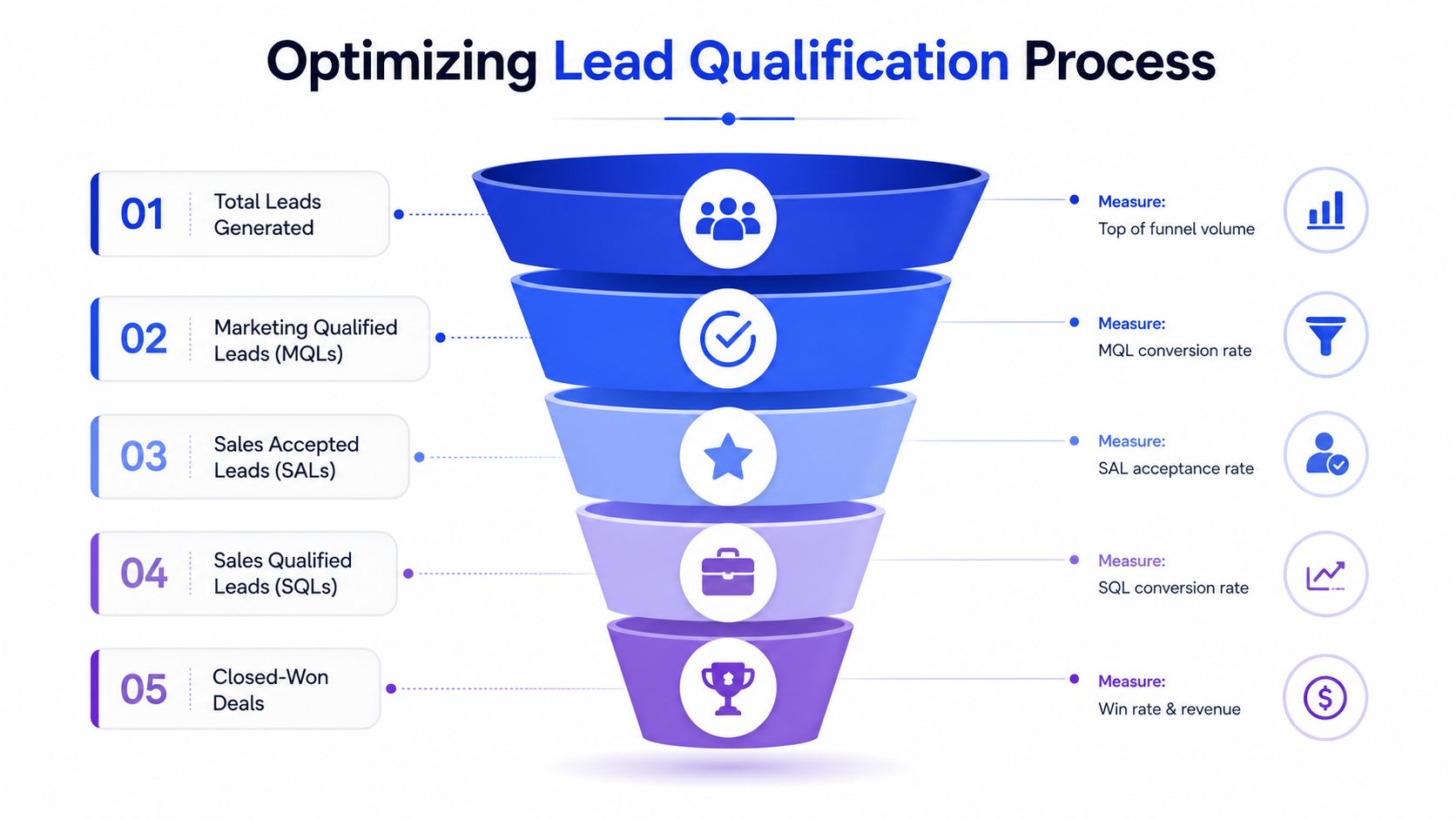
Top-performing B2B teams using behavioral scoring models achieve MQL-to-SQL conversion rates as high as 39% to 40%, compared with an industry average of 12% to 21%, according to the benchmark cited in the earlier automation section. The takeaway isn't that every SMB needs a complex model. It's that better criteria produce better downstream conversion.
The metrics that matter
You don't need a giant dashboard. Start with a short list.
Lead to MQL rate
This shows whether your top-of-funnel traffic is producing leads that match your initial standards.MQL to SQL conversion
This is the clearest test of whether marketing qualification aligns with sales reality.Sales cycle length
If qualified leads still move slowly, the issue may be weak intent signals or poor follow-up.Closed-lost reasons
Track why deals die. Poor fit, bad timing, no budget, competitor, and went dark all tell you something different.
A simple monthly review loop
Run one review each month with sales and marketing in the same room.
Use this sequence:
Pull recent qualified leads and look at which ones became real opportunities.
Check disqualified leads that later came back or converted through another path.
Review lost deals by reason to spot patterns your criteria missed.
Adjust one or two rules only. Don't rewrite the whole model every month.
If your sales team keeps saying “these aren't real opportunities,” don't argue about lead quality in the abstract. Pull the records and inspect the criteria.
That feedback loop is what turns qualification from a static checklist into an operating system. Over time, you stop debating opinions and start using actual conversion behavior to refine who gets routed, who gets nurtured, and who should never hit the sales queue in the first place.
If your team wants to qualify inbound leads faster without adding manual screening work, Chatgrow gives you a practical way to do it. You can train an AI agent on your site content, ask qualification questions in real time, and route serious conversations to a human with the right context already captured.
Related Posts
Continue Reading
More articles from the ChatGrow Team.