Blog
What Is a Sales Promotion and How to Run One
By
Nelson Uzenabor

Promotions now absorb about 31% of a company's promotional dollars, according to MIT Sloan Review, which is why a sales promotion isn't a side tactic anymore, it's a core revenue decision MIT Sloan Review's strategic perspective on sales promotions. In consumer markets, the effect is even more concrete, because a promotion can change what people buy today, what they postpone, and what they ask support about before they click. The problem is that too many teams still treat the discount as the strategy, when the promotion is really the mechanism.
A sales promotion is a temporary incentive designed to trigger a specific customer action now. That action might be a first purchase, a larger cart, a faster close, a repeat order, or a reactivation after silence. It is different from advertising, which builds awareness, and different from PR, which builds credibility over time.
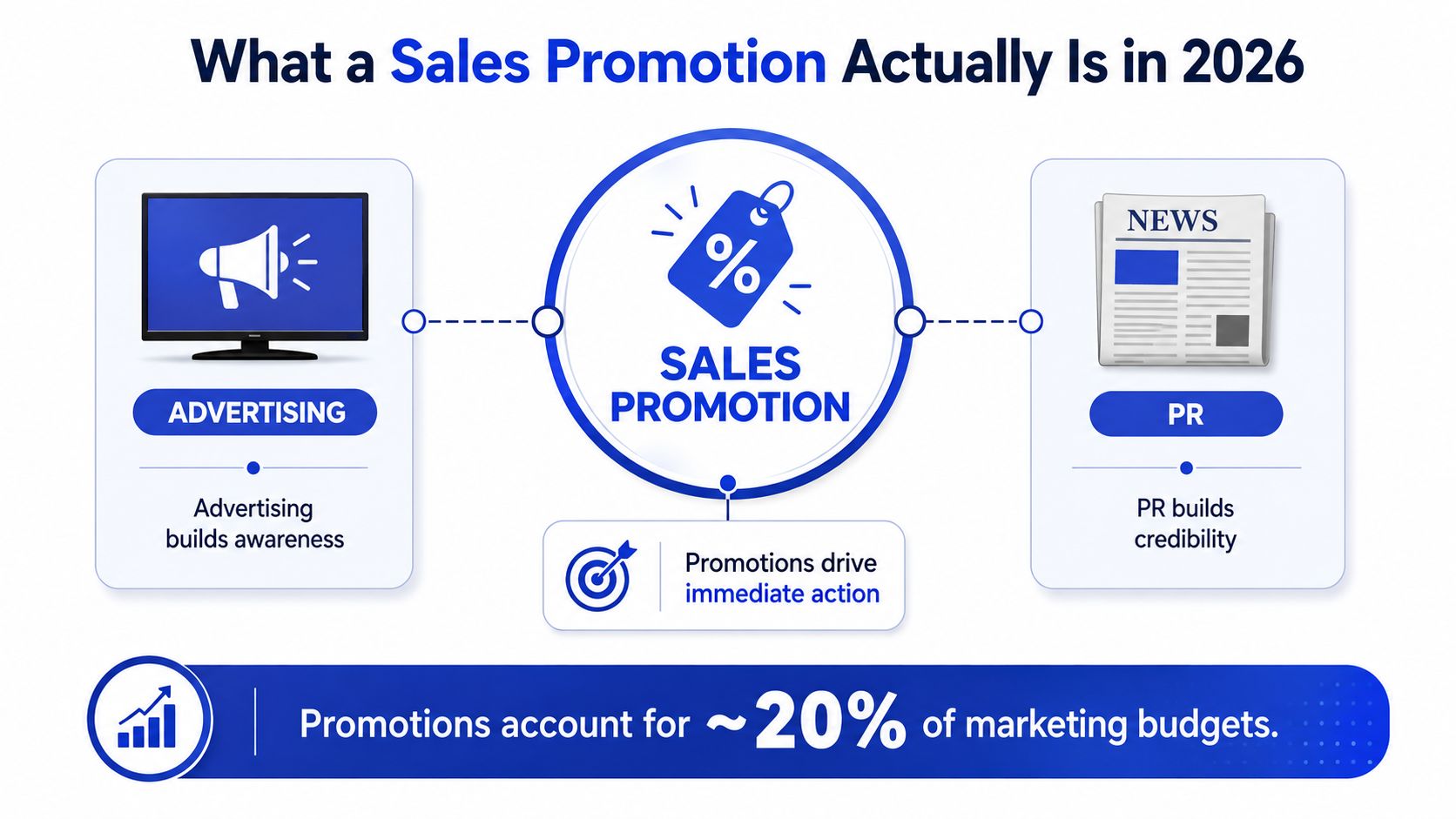
The cleanest way to explain it to a stakeholder is this. Advertising creates the memory that your brand exists. PR makes the brand easier to trust. A sales promotion gives someone a reason to act before they drift away.
That distinction matters because promotions are judged by behavior, not sentiment. If the goal is immediate conversion, a promotion can be the right tool. If the goal is long-term position or reputation, use other levers first and let the promotion support them. Quikly's practical warning on stop the discount death spiral is useful here, because the danger isn't promotion itself, it's using discounts so often that buyers learn to wait.
Where a sales promotion fits in the marketing mix
Think of promotions as the decision accelerator inside the broader funnel. They work when a buyer already has some intent, some need, or some curiosity, and you want to remove friction quickly. They do not work well when the market doesn't understand the product, the offer is vague, or the customer needs education before buying.
Practical rule: if the buyer needs persuasion, use content, demos, or sales conversations first. If the buyer already wants the product and needs a nudge, a promotion can do the job.
In practice, that means teams should stop asking whether promotions are good or bad. The better question is what behavior the offer changes, whether that change is profitable, and whether the post-promo customer still behaves like a customer you want.
Table of Contents
Promotion Types and When Each One Actually Works
The right promotion mechanic depends on the goal, not the trend. A percentage discount can be useful for simple acquisition or clearing a broad assortment, but it can also train people to anchor on the lower price. A BOGO offer works when you want to move units fast or raise basket size, although it can be clumsy if the second item is low-value to the buyer. Bundles are strongest when the items naturally belong together, because they increase convenience as much as value.
A coupon is best when you want to target a specific segment or channel, while loyalty rewards are better when the goal is repeat behavior. Free shipping removes a classic online objection, and it often works better than a blunt price cut when the cart is already close to purchase. Limited-time offers and flash sales create urgency, but they're also the fastest way to condition customers to delay buying until the next event. Referral bonuses fit growth goals because they turn satisfied customers into acquisition channels. Gift-with-purchase works when the extra item supports trial or makes a premium order feel more complete.
Sight AI's overview of real benefits of marketing is helpful context if you're comparing promotions to broader marketing programs, because the trade-off is always between immediate action and longer-term value creation. Promotions are not interchangeable, and the wrong mechanic can attract the wrong buyer.
Promotion Type | Best Goal | Main Trade-Off |
|---|---|---|
Percentage discount | Acquisition or inventory movement | Can compress margin quickly |
BOGO | Basket growth or unit movement | May reward low-intent buyers |
Bundles | Average order value | Less flexibility for buyers |
Coupons | Targeted conversion | Easy to overuse and stack |
Loyalty rewards | Retention | Can become a cost center |
Free shipping | Cart conversion | Raises fulfillment pressure |
Flash sale | Fast sell-through | Trains waiting behavior |
Referral bonus | New customer acquisition | Needs clean tracking |
Gift-with-purchase | Trial and upsell | Adds operational complexity |
Match the mechanic to the buyer behavior
A good rule is to map the promotion to the action you want. If you want first-time trial, make the offer simple and low-friction. If you want repeat purchases, make the reward feel earned rather than random. If you want to move surplus stock, don't hide behind brand language, just clear it with a clean mechanic and a clear deadline.
Operational note: the best promotion is rarely the loudest one. It's the one that changes behavior without teaching the market to wait for a better offer.
The mechanics above also behave differently across channels. A coupon can work in email and chat, while a bundle may sell better on a landing page where the value is explained. A referral bonus usually needs trust and clarity, not hype. The right match between mechanic and channel is what keeps the offer from turning into noise.
Planning a Promotion That Survives Contact with Reality
Promotions fail before launch because the math, the inventory, or the support flow never got stress-tested. The offer looks exciting in a deck, then the team discovers the margin is thin, the code doesn't work everywhere, or the warehouse can't absorb the spike. Recent promotion guidance also stresses aligning stakeholders, testing discount codes, verifying inventory tracking, and making sure customer service is ready before launch, which is exactly the discipline teams skip Salesforce's 5 key elements of a successful sales promotion.
The pre-launch checklist that keeps teams out of trouble
Start with the offer itself. Define exactly what the customer gets, what they must do to qualify, when it ends, and what is excluded. Then stress-test the economics with your finance or growth lead, because a promotion that sells more but destroys contribution margin is just expensive motion.
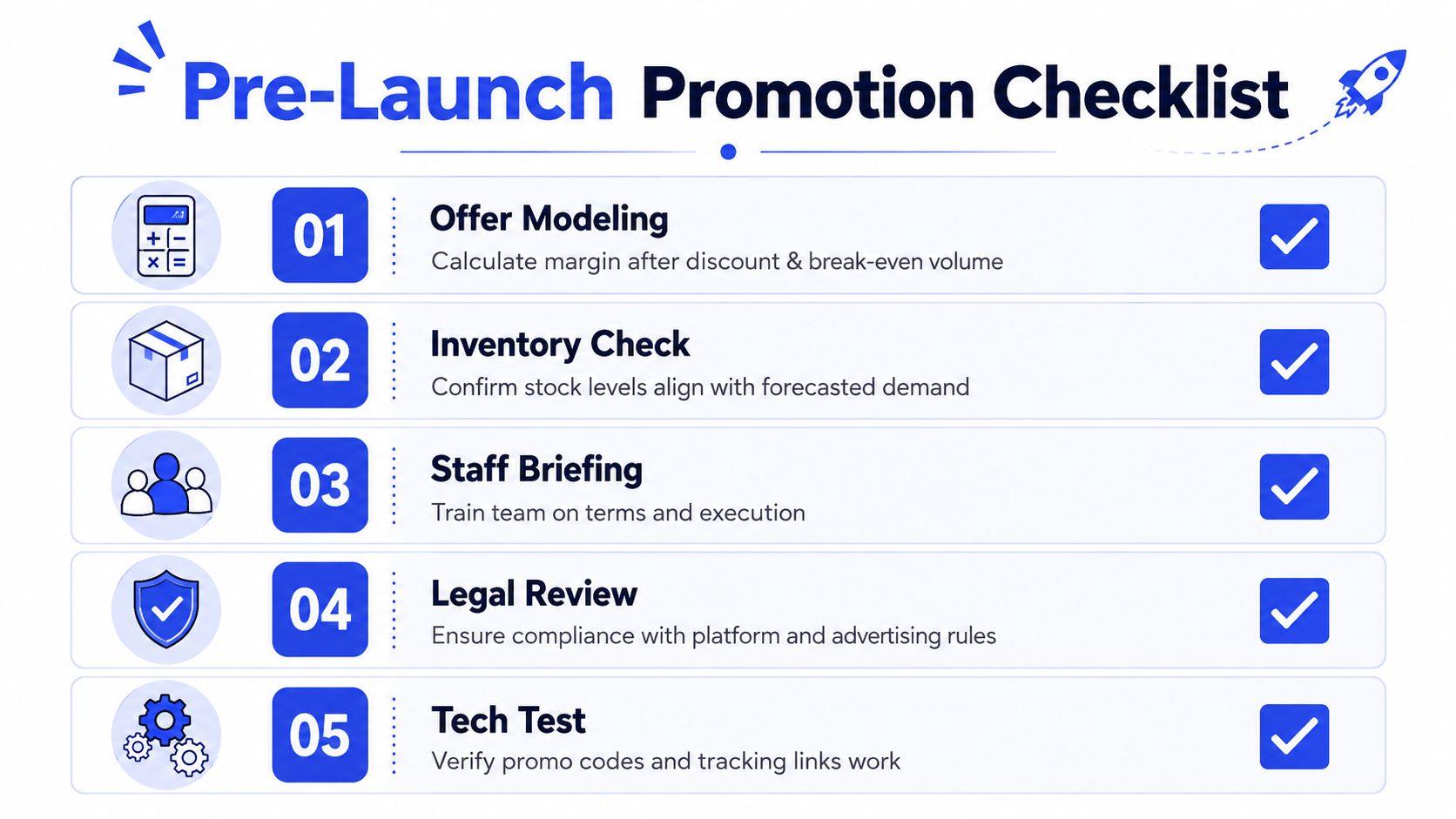
A practical launch checklist usually includes these moves.
Offer modeling: calculate margin after discount, then decide what volume makes the offer worthwhile.
Inventory check: confirm stock, fulfillment capacity, and any item-level restrictions.
Staff briefing: make sure sales, support, and operations all know the terms.
Legal review: validate the language, the restrictions, and the channel rules.
Tech test: confirm promo codes, tracking links, and landing pages all work.
The best teams also define a fallback plan. If demand spikes, they should know whether to shorten the offer, cap redemptions, or shift support coverage. If demand underperforms, they should know whether to adjust messaging or channel mix without rewriting the whole campaign.
A simple calendar keeps the work moving
A compact timeline helps small teams avoid last-minute chaos. At T-minus 30, lock the offer and the target segment. At T-minus 14, finish creative, landing pages, and internal reviews. At T-minus 7, test the code paths and the support responses. At T-minus 1, do a final inventory and routing check. On launch day, keep one person watching the systems while everyone else stays ready to respond.
The work feels boring, but that's the point. Promotions fail when execution gets treated like an afterthought.
Measuring Promotion Success Beyond Redemption Rate
Redemption rate gets the most attention because it's easy to read, not because it tells the whole story. A promotion can generate a lot of redemptions and still damage margin, pull in the wrong customers, or create ugly support costs. The measurement model should start with the economics, then move outward into customer behavior and service load. Market Edge's guide to promotional effectiveness key KPIs is a good reminder that promotion reporting needs more than one line in a dashboard.
The numbers that matter on day one
The core dashboard should separate redemption rate by channel, incremental revenue, average order value, new versus repeat buyer mix, cost of acquisition, support ticket volume, and repeat purchase behavior after the promotion ends. That way, you can tell the difference between a campaign that looks busy and one that creates value. Attribution alone is not enough, because attributed revenue can overstate what the promotion caused.
The internal lens matters too. If support traffic jumps while conversion stays flat, the offer may be too confusing. If new customers flood in but never come back, the promotion may be buying low-quality demand. If repeat buyers respond well, the offer may be strengthening the relationship instead of just discounting it.
Here's the simple readout I'd use.
Signal | What it usually tells you |
|---|---|
High redemption, weak margin | The offer was too generous |
High traffic, low conversion | The message or landing page missed |
Strong new-customer mix, weak repeat behavior | The promotion attracted bargain seekers |
Rising support volume | The terms were confusing or the team was underprepared |
Daily check: watch traffic, redemption, and support volume while the promotion is live. Check margin and repeat behavior after the dust settles.
Build the dashboard before you need it
The fastest way to improve measurement is to define the channel tags, code paths, and lead handoff rules before launch. If your promotion touches chat, email, social, and search, then each source should be visible in reporting. That becomes even more important when AI support tools are part of the journey, because they can capture intent that never shows up in a normal form fill. For deeper instrumentation ideas, the article on customer service analytics is a useful companion.
The takeaway is simple. A promotion is only successful if the margin, the customer mix, and the post-promo behavior all make sense together.
Promotions That Quietly Damage Your Business
The most dangerous promotions are the ones that look great in the short run. Blanket percentage discounts can move volume fast, but they also flatten price discipline across the catalog. Repeated flash sales can make every future campaign feel less urgent. Stackable coupons can turn a normal offer into a margin leak before anyone notices.
Spot the warning signs early
There's usually an early signal before the damage shows up in finance. Customers start asking when the next sale is. Full-price conversion softens. Support gets more confused about exceptions and exclusions. At that point, the promotion is no longer driving demand, it's shaping expectations.
The cleanest alternative is to make the offer narrower and more intentional. A category-specific discount can preserve pricing on stronger items. A member-only offer can reward loyalty without broadcasting weakness. A bundle can raise value without making the whole catalog look cheap.
The same logic applies to loyalty rewards. If the payoff is too easy or too generous, the program can become a liability instead of a retention tool. If the goal is reactivation, a targeted offer usually works better than a permanent price cut. If the goal is volume, a timed incentive is safer than an always-on discount banner.
Better mechanics for the same objective
Use this shorthand when reviewing a calendar.
If the goal is urgency: prefer a time-bound offer over a permanent markdown.
If the goal is reactivation: target dormant buyers instead of everyone.
If the goal is margin protection: use bundles or thresholds instead of broad cuts.
If the goal is loyalty: reward behavior, not just cart value.
Good promotions create a buying reason. Bad promotions create a waiting habit.
Many teams get stuck here. They celebrate the spike and ignore the behavioral lesson the customer just learned. A promotion that teaches shoppers to pause until the next discount can be worse than no promotion at all.
How AI Customer Service Agents Capture the Promotion Surge
A promotion doesn't just create orders, it creates questions. Buyers want to know whether the code works, whether items can be stacked, whether sale items can be returned, and whether stock is still available. If those answers take too long, people bounce or flood human support with repetitive work that should've been automated in the first place.
What the AI agent should do during a live offer
An AI customer-service agent can handle the first layer of demand by answering routine questions from the business's own pages, then passing only qualified leads to people. That's where Chatgrow fits as one option. It can be trained on site content, pricing, FAQs, and product pages, then deployed on high-intent pages so buyers get immediate, on-brand responses while the team sees concise handoffs for the conversations that deserve human follow-up. If you want a practical reference on this workflow, the article on AI customer support lays out the logic clearly.
The setup is straightforward. Train the agent on the live promotion terms, define what counts as a qualified lead, place it on the landing page and high-traffic support pages, and make sure escalation collects the few details the sales team needs. That prevents the common failure mode where support spends the whole day re-answering the same five questions while hot leads wait.
A simple operational split works well.
AI handles: offer basics, eligibility, stock status, return policy, and scheduling.
Humans handle: edge cases, enterprise questions, custom pricing, and live objections.
Routing handles: summary, intent, and contact details for follow-up.
What changes when the agent is live
Without an always-on agent, a promotion can swamp support, slow response times, and leave qualified buyers waiting in the queue. With one in place, the business can absorb inquiry spikes without scaling headcount for every campaign. The bigger win is that sales promotion traffic becomes a source of clean conversations instead of a pile of unread tickets.
That matters most for SMBs. They usually don't have spare staff sitting around for launch day, and they can't afford to let interested buyers fall through the cracks just because the team is busy answering the same promo question for the twentieth time.
Your Sales Promotion Playbook and Decision Rules
Choose the promotion type from the goal, not the calendar. If you want trial, use a simple first-purchase incentive. If you want bigger baskets, use a bundle or threshold. If you want repeat behavior, reward loyalty or reactivation instead of discounting everyone. Then run the pre-launch checklist, because the offer only works if inventory, tracking, and support are ready.
The one metric that matters most is incremental profit after the promotion, not redemption alone. If the offer sells more but leaves the business weaker, it wasn't a win. For follow-up automation and lead handoff, the guide on lead nurturing automation is the right next read.
If you're planning your next promotion, use Chatgrow to answer offer questions, qualify high-intent visitors, and keep the support queue from getting crushed while the campaign runs. Visit Chatgrow if you want to turn promotion traffic into cleaner conversations and faster handoffs.
Related Posts
Continue Reading
More articles from the ChatGrow Team.