
Blog
Conversational AI for E-Commerce: A Practical Guide
By
Nelson Uzenabor

At 9:47 p.m., a shopper lands on your product page, compares two similar items, checks the size guide, and adds both to the cart. They leave after four minutes because nobody answers one question about fit. Your live chat closed hours ago, your FAQ buries the answer, and tomorrow's retargeting campaign will pay to bring back someone who was already close to buying.
That's the gap conversational AI for e-commerce can close. Used properly, it's not a decorative chat bubble or a cheaper ticket queue. It's an always-on sales associate that handles product discovery, removes purchase friction, retrieves order information, and knows when a human needs to take over. The opportunity is substantial, but only for stores that connect the assistant to accurate commerce data and measure business outcomes rather than conversation volume.
Table of Contents
The High-Intent Shopper You Keep Losing
Consider a small outdoor retailer with a busy product catalog. A visitor searches for a waterproof hiking jacket, opens two product pages, compares insulation and delivery dates, then asks whether a medium will fit over a fleece layer. The answer exists somewhere in the size guide, but the shopper doesn't want to hunt through policy pages while deciding. They close the tab.
That visitor wasn't casually browsing. They'd already supplied strong buying signals through comparison behavior, product-page engagement, and cart activity. A conversational assistant could have asked what the shopper normally wears, explained the relevant fit difference, compared the two jackets, and surfaced the delivery information without forcing another search.
Practical rule: Put AI where uncertainty meets intent. A generic welcome message on every page is weaker than a timely answer on a product or checkout page.
Most small and midsize stores default to one of three imperfect fixes:
Limited-hours live chat: Helpful when an agent is online, invisible when an evening or weekend shopper needs an answer.
Static FAQs: Efficient for the business, but often difficult for shoppers to find the right answer at the moment of purchase.
Retargeting: Useful for re-engagement, but it pays again for traffic you already earned and may remind the shopper without resolving the original objection.
The commercial case is becoming harder to dismiss. Independent industry reporting says 96% of ecommerce professionals used AI in their roles in 2026, compared with 77% in 2025 and 69% in 2024. The same reporting says 57% of brands use AI for 26% to 50% of customer interactions, while 37% expect AI to handle 51% to 75% within the next two years. These figures describe broad commerce AI adoption, but they show why conversational systems are moving into discovery, service, and sales rather than remaining isolated support tools. (Industry reporting on conversational commerce adoption)
The rest of this guide focuses on what the technology does, where the ROI comes from, which use cases deserve priority, how to deploy without damaging trust, how to evaluate vendors, and how to launch a measured first version in 30 days.
What Conversational AI for E-Commerce Means
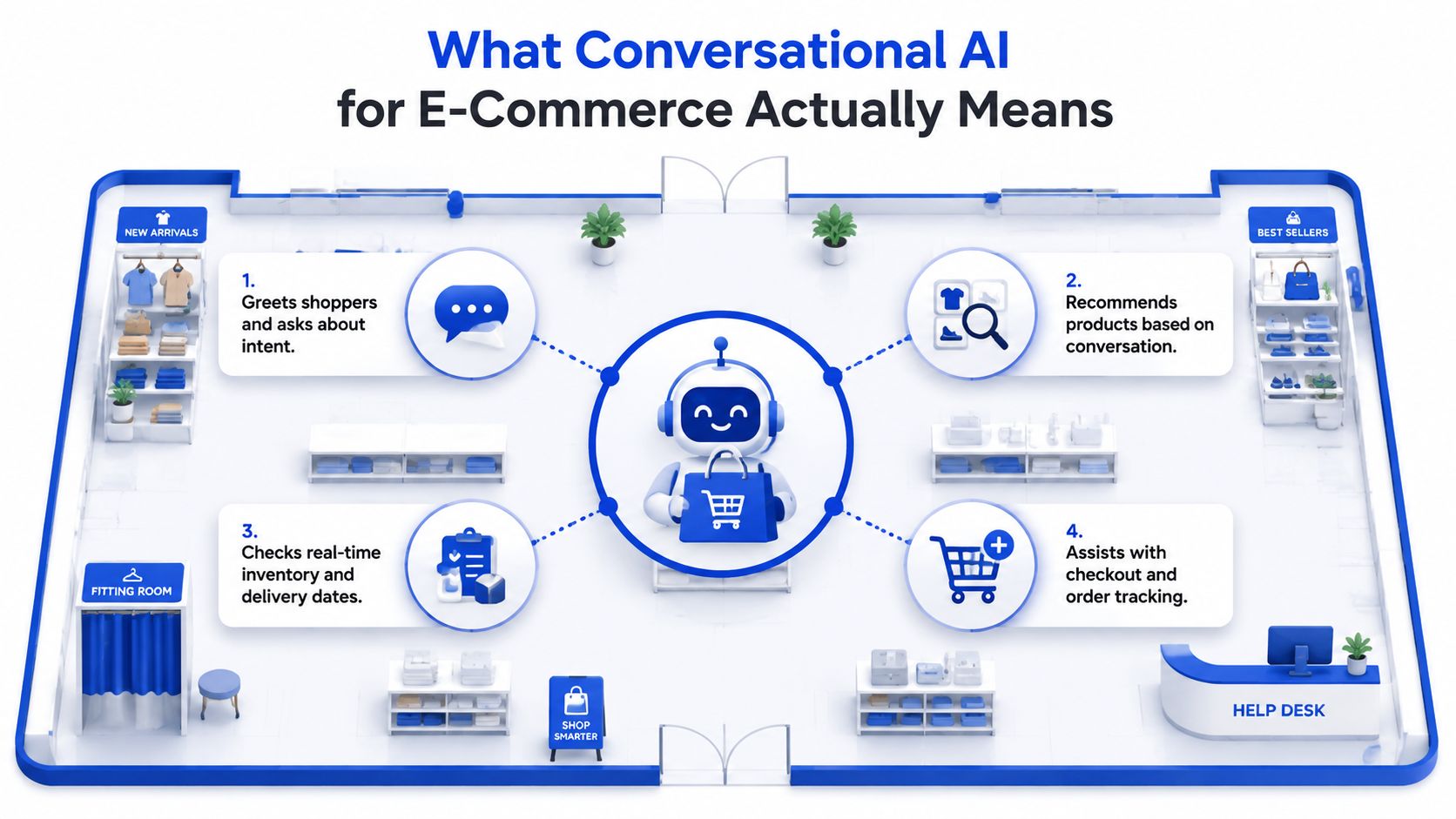
A well-designed conversational commerce assistant works like a capable floor associate. It greets shoppers, asks what they want to accomplish, recommends products from the catalog, checks stock and delivery information, and calls a specialist when the question requires judgment. Its job is to move each shopper toward a useful next step, whether that means comparing products, completing checkout, or getting a clear answer.
The system usually combines four practical layers:
Language understanding: It interprets phrases such as “I need something for cold, wet commutes” and identifies intent, constraints, and follow-up context.
Knowledge grounding: It retrieves information from product records, FAQs, shipping rules, sizing guidance, and return policies.
Decision logic: It chooses whether to answer, ask a clarifying question, recommend an item, trigger a workflow, or escalate.
Action execution: Through integrations, it can retrieve order status, check availability, create a return request, or assist with checkout.
The fourth layer separates a useful commerce agent from a polished FAQ interface. An assistant that promises return help but cannot access the order system creates another dead end. A connected system can verify eligibility, collect required details, and hand the case to a person with the conversation intact. Set clear permissions and escalation rules before launch, because inaccurate answers and stalled handoffs damage trust faster than an unanswered question.
How it differs from an old chatbot
Legacy rule-based bots follow scripted decision trees. They work when a shopper selects an expected menu option, then fail when the shopper uses unfamiliar wording or changes direction. A customer who asks “Where's my package?” may receive an answer, while “The delivery window passed, what now?” can push the same bot outside its script.
Modern systems add session memory, personalization, and human handoff. With permission, the assistant can use account or browsing context, remember that “the blue one” refers to the product discussed earlier, and transfer the full conversation without making the shopper repeat the problem.
Teams expanding their channels should plan for product discovery inside conversational interfaces. This online store ChatGPT integration guide explains how product information needs to appear when AI enters the shopping journey. For the on-site experience, document the prompts, fallback states, and escalation paths covered in this AI chatbot design guide.
The operating question is direct: can the assistant generate and protect more commercial value than it costs?
The Business Case and ROI for Online Stores
Measure conversational AI through three commercial levers, not the number of chats opened:
Assisted conversion: Does help on high-intent pages move more sessions to purchase?
Support deflection: Does the assistant resolve repetitive questions without creating repeat contacts?
Guided selling: Does relevant comparison and bundling help shoppers choose more valuable baskets?
The strongest benchmark available in the supplied data comes from AI-assisted shopping sessions. One commerce dataset reports 12.3% conversion for shoppers who engaged with AI chat, versus 3.1% for shoppers who didn't, roughly a fourfold difference. That's an independent benchmark, not a promise for every store. Treat it as a reason to test placement and routing, not as a forecast. (E-commerce AI benchmark reporting)
The distinction matters. If an assistant appears after a shopper has shown strong intent, assisted sessions may naturally be more valuable than general site traffic. A store should therefore compare similar audiences, define the trigger, and measure incremental outcomes rather than claiming every sale touched by chat as AI-generated.
A pressure-test model
Use your own baseline rather than copying a vendor projection. Record sessions, orders, revenue, average order value, support contacts, and agent time for the pages or intents you'll test. Then compare an exposed group with a similar non-exposed group, while documenting promotions, seasonality, stock changes, and traffic-source differences.
Lever | Baseline | Expected Lift | Annual Impact | Key Metric |
|---|---|---|---|---|
High-intent conversion | Your current conversion rate on assisted pages | Test against a matched non-assisted audience | Incremental gross profit from additional orders | Assisted conversion and incremental conversion |
Repetitive support | Current volume of eligible order, shipping, and policy contacts | Measure resolved interactions without repeat contact | Avoided handling cost and recovered team capacity | Deflection by intent and repeat-contact rate |
Guided selling | Current basket value and bundle attachment | Compare recommendation-exposed baskets with a control | Incremental contribution margin per order | Average order value and margin per session |
Support economics can be meaningful. Independent reporting says chatbot deployment may reduce customer service costs by 15% to 70%, depending on the implementation and context. Use that range as a scenario boundary, not a guaranteed result, and exclude any interaction the assistant fails to resolve cleanly. (Independent conversational commerce cost reporting)
A useful ROI dashboard includes incremental revenue, contribution margin, qualified assisted sessions, deflection by intent, escalation quality, repeat contacts, and customer satisfaction. Raw conversation count, automated-response count, and time-on-site are supporting indicators. They don't prove that the assistant helped anyone buy or get their issue resolved.
For agencies, the opportunity isn't limited to setup. Catalog maintenance, transcript review, intent expansion, reporting, escalation design, and conversion testing can become an ongoing service line. The agency still needs to price the work against measurable outcomes and avoid selling “AI presence” as if a widget alone creates demand.
Five Use Cases That Move Revenue and Retention
A working example makes the difference. Assume the outdoor retailer from the opening wants the assistant to help shoppers select equipment, complete orders, and remain useful after purchase. Each use case should have a clear trigger, an allowed action, and a KPI that reflects the customer's next step.
Product discovery and guided selection
Shopper prompt: “I need a waterproof hiking jacket for wet, windy trails, and I don't want to spend more than $200.”
The assistant should identify the category, weather requirement, activity, and price constraint. It can return a short comparison, ask whether insulation matters, and explain differences using structured catalog attributes. The primary KPI is add-to-cart rate from conversational product discovery, supported by recommendation clicks and product comparison completion.
In-cart decision support
Shopper prompt: “Will this jacket fit over a fleece, and can it arrive before Friday?”
The assistant should retrieve the approved sizing guidance, ask for the shopper's usual size when necessary, and show the delivery estimate supported by current fulfillment data. If the store has approved bundles, it can suggest compatible base layers or waterproof trousers without forcing a discount. Track recovered carts, checkout completion, and margin per order.
Order status and returns
Shopper prompt: “My parcel was due yesterday. Can you check what happened?”
The assistant should authenticate the shopper appropriately, retrieve tracking information, explain the next available step, and escalate delivery exceptions. For returns, it should verify the policy and order details before generating a label or opening a request. Measure resolution without repeat contact, customer satisfaction, and escalation quality, not containment alone.
Reorder flows
Shopper prompt: “I'm nearly out of the dog food I bought last time.”
The assistant can identify the prior product, confirm quantity and delivery details, and offer a reorder path. It shouldn't infer a medical need or make unsupported claims about pet health. The primary KPI is repeat purchase rate, with attention to opt-in quality and unsubscribe behavior.
Post-purchase upsell and review collection
Shopper prompt: “The jacket arrived. What else do I need for a wet-weather trip?”
The assistant can recommend relevant accessories based on the purchased item and the shopper's stated use case. After a suitable post-delivery moment, it can ask for a review and route product complaints to a human rather than treating negative feedback as a marketing event. Track attach rate, repeat revenue, review volume, and complaint resolution.
Use Case | Example Trigger | AI Action | Primary KPI |
|---|---|---|---|
Product discovery | Natural-language request with constraints | Clarify intent and recommend catalog items | Add-to-cart rate |
Cart assistance | Size, shipping, or comparison question | Answer from approved data and restore purchase momentum | Recovered carts |
Order support | Tracking or return request | Retrieve status or start an approved workflow | CSAT and repeat-contact rate |
Reorder flow | Previous product nearing replenishment | Confirm the item and guide repurchase | Repeat purchase rate |
Post-purchase engagement | Delivery confirmation or product question | Suggest relevant add-ons or request feedback | Review volume and attach rate |
Attribution gets complicated when shoppers see several messages and channels before buying. Use a dedicated approach to marketing attribution for chat so your reports distinguish an interaction that influenced a decision from one that merely answered a post-purchase question.
A systematic review of conversational commerce literature analyzed 722 publications and mapped themes including user acceptance, intent handling, personalization, and interaction quality. That body of work supports a practical design principle: define the interaction objective before selecting the model. (Systematic literature review of conversational commerce)
How to Deploy Conversational AI Without Breaking Trust
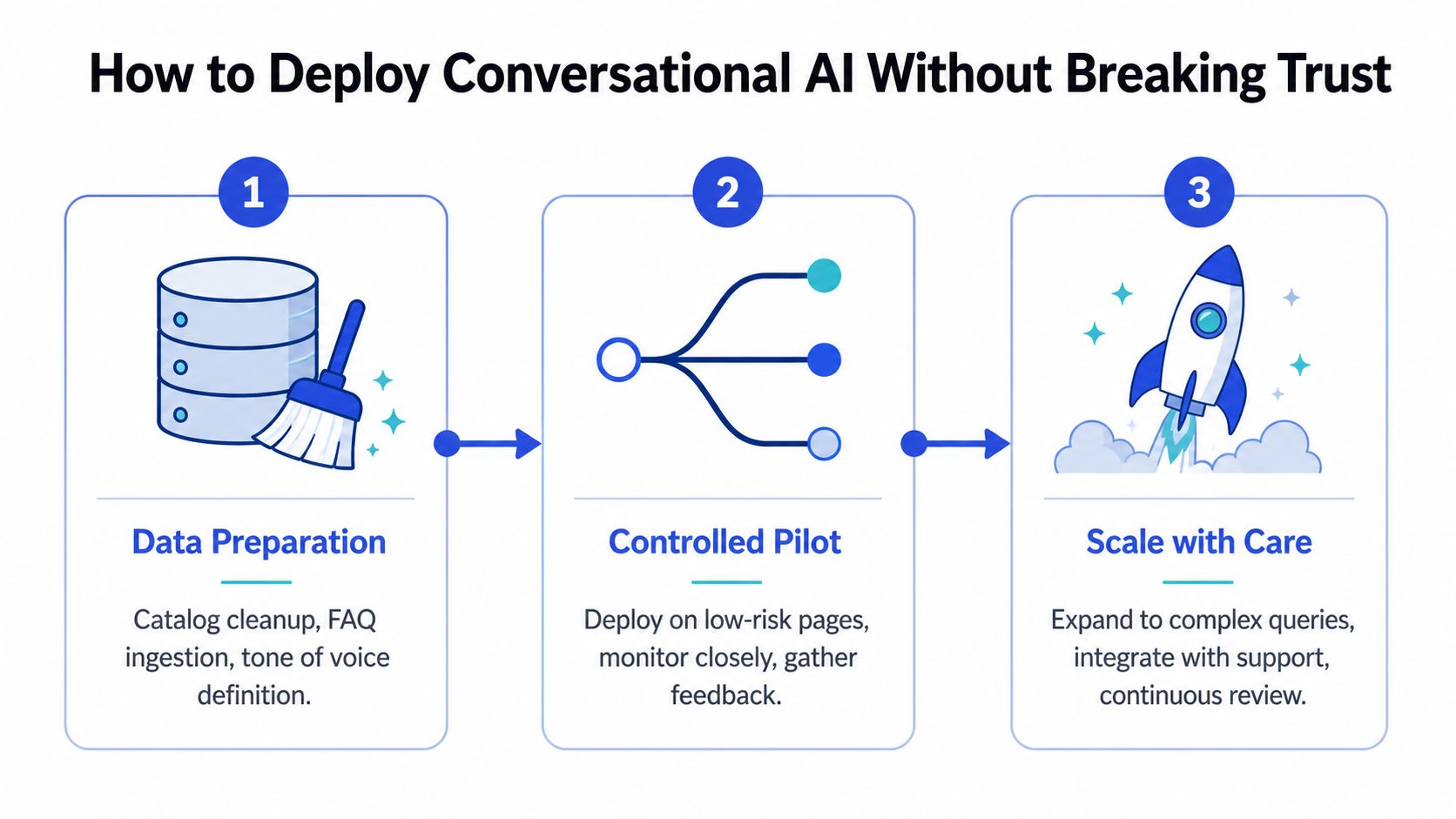
Start with data, not personality. A friendly tone can't repair an incorrect stock answer, an invented SKU, or a return policy the business never approved.
Phase one focuses on source quality
Clean the catalog, standardize attributes, remove discontinued products, and identify missing sizing or compatibility details. Ingest FAQs and policy documents, then assign an owner who can approve changes. Define the brand voice, prohibited claims, refund permissions, and topics that always require a person.
Phase two keeps the pilot narrow
Choose two or three low-risk intents, such as product questions, shipping information, or order tracking. Place the assistant on selected product pages or support entry points, and provide an obvious escalation path to a helpdesk or live agent. Review transcripts daily at the beginning and classify failures by intent, retrieval error, tone problem, or missing integration.
Phase three adds guardrails before reach
Create suppression rules for out-of-scope questions. Pricing exceptions, medical guidance, legal issues, payment disputes, and unusual delivery cases shouldn't receive confident improvisation. Set confidence thresholds, require confirmation before irreversible actions, and make the human handoff carry the transcript, customer details, and attempted resolution.
Phase four connects the revenue loop
Once the pilot is stable, connect the assistant to the commerce platform, inventory, order management, helpdesk, and approved marketing tools such as Shopify and Klaviyo. Add proactive triggers only where the shopper has shown a clear need. A chat prompt during comparison can help; an interruption on every page usually creates noise.
Trust failures deserve explicit testing:
Hallucinated products: The assistant recommends an item that isn't in the current catalog.
Fabricated policies: It invents a return window, discount, warranty, or delivery promise.
Silent escalation failure: It says a human will respond but creates no ticket or loses the conversation.
Unsafe automation: It performs a refund or account action without adequate verification.
Deployment standard: Every important answer should have a trusted source, every action should have a permission boundary, and every failure should have a visible recovery path.
Before launch, verify the catalog, test current inventory, challenge the system with ambiguous wording, force an escalation, inspect the created ticket, confirm disclosure and consent language, and review the transcript from the shopper's perspective. Teams working through data connections should document the requirements in a customer data integration workflow before expanding the agent's permissions.
Choosing the Right Vendor for SMBs and Agencies
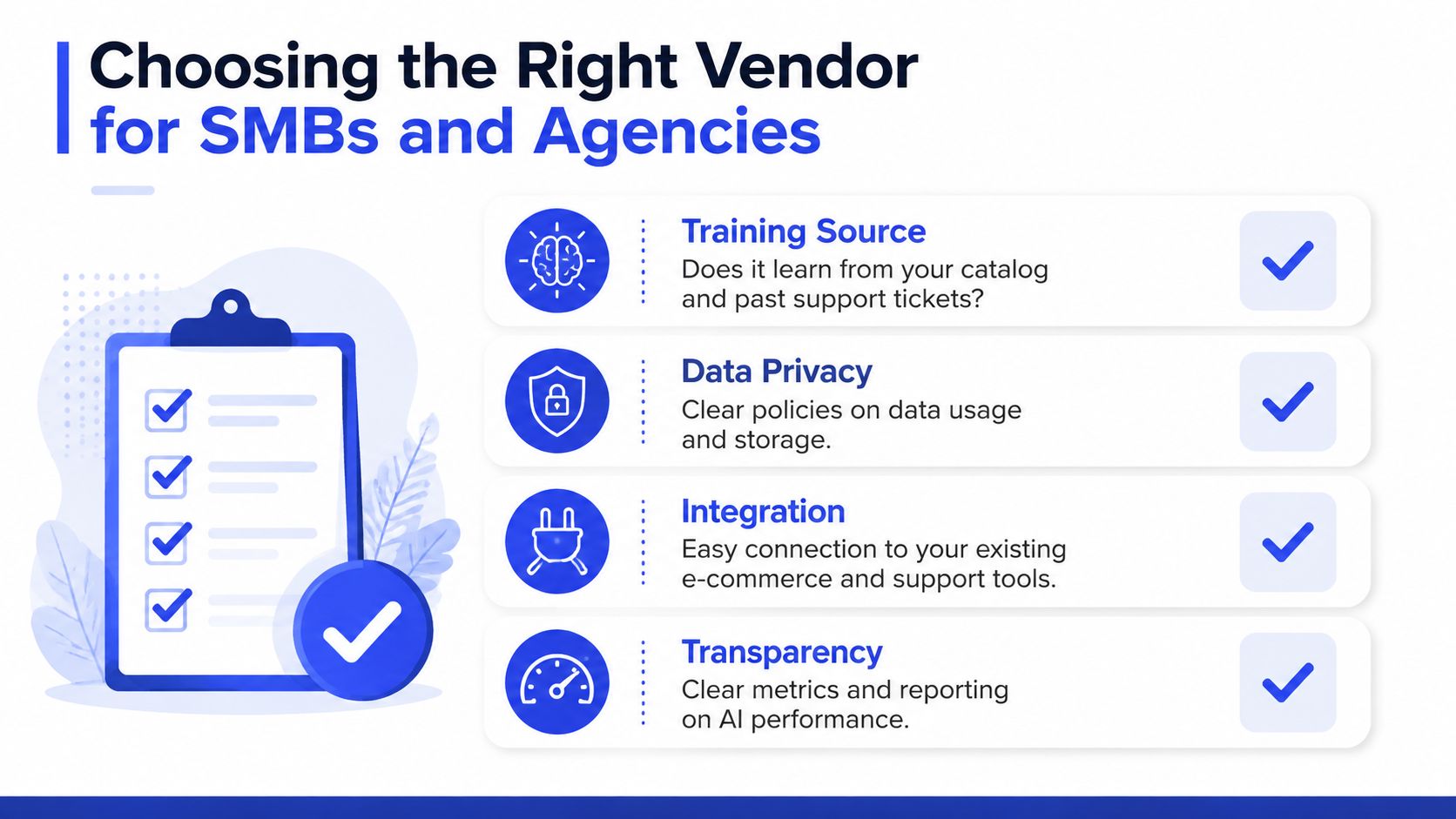
Feature lists hide the questions that decide whether a store gets value. Ask vendors to demonstrate the system against your catalog, your policies, and real customer language.
Training source: Can the platform learn from your product pages, pricing, FAQs, and past support conversations? Can you approve, update, and remove source content without waiting for a custom development cycle?
Escalation behavior: Does the assistant recognize uncertainty and frustration? Does it transfer the full context to a human, create the right ticket, and tell the shopper what happens next? A system that traps users in a loop isn't saving support cost.
Pricing transparency: Understand whether pricing is based on seats, messages, resolutions, usage, integrations, or a bundled plan. Ask what happens when the store expands from one agent to several workflows.
Reporting depth: Require intent-level reporting for assisted conversion, unresolved conversations, escalation outcomes, repeat contacts, and source-document failures. “We handled many chats” isn't a revenue report.
Data handling: Review PII access, retention, storage, deletion, consent, and data-use terms. Your vendor should explain the operational boundaries in plain language.
Time to value: Request a sandbox or controlled pilot using a realistic subset of the catalog. Time-to-value depends more on data readiness and integration scope than on a demo's fluency.
Chatgrow fits stores that want to train custom support agents on website, pricing, FAQ, and product content, use Smart Intent to route requests, and pass qualified conversations to a team through smart escalation. An agency may still need custom work for complex order-management, payment, warehouse, or cross-channel attribution integrations. Treat it as one candidate to validate, not an automatic answer.
Walk away from vendors that can't show deflection by intent, hide how pricing works, or refuse a sandbox pilot. Those gaps will become your reporting, budget, and customer-service problems after deployment.
Your 30-Day Plan to Launch and Measure
A focused launch doesn't require a long transformation program. It requires a narrow scope, an accountable owner, and daily contact with real transcripts.
Week one audits the inputs
Pull the product catalog, FAQ content, policies, and your top 50 support tickets into a review set. Map those questions to five priority use cases, then mark which answers are safe for automation and which require a person.
Week two configures behavior
Define escalation rules, brand voice, consent capture, and data permissions. Test GDPR and CCPA requirements with the people responsible for compliance. Create an initial evaluation set containing clear questions, ambiguous questions, unsupported requests, and requests that should escalate.
Week three runs a soft launch
Use one traffic segment, such as returning visitors or paid landing-page traffic. Review conversations every day, fix hallucinations immediately, suppress weak triggers, and record whether escalations reached a human with enough context. Don't expand because the assistant sounds natural. Expand when it behaves reliably.
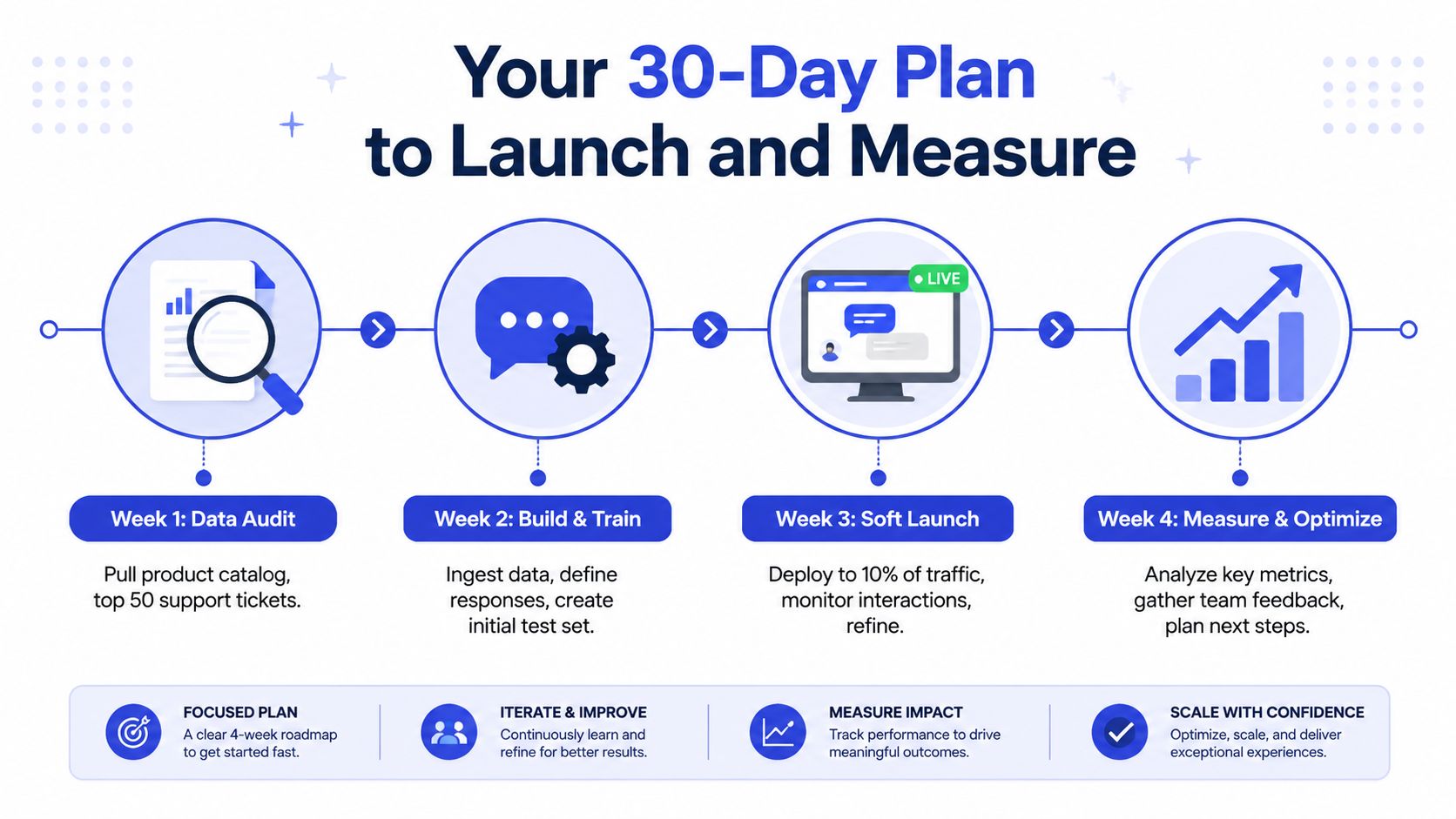
Week four measures commercial impact
Track deflection by intent, assisted conversion, average order value, repeat-contact rate, CSAT, and escalation outcomes. Review leading indicators daily, including intent coverage, failed answers, and escalation completion. Review lagging indicators weekly, including revenue, margin, repeat purchases, and support workload.
Two metrics regularly mislead teams. A high escalation-to-human rate may indicate good detection of complexity, while a low rate may indicate that the assistant is hiding the handoff. Containment on repeat queries can look strong while customers still contact support elsewhere. Pair both metrics with repeat-contact and satisfaction data.
Use chatbot analytics guidance to structure the reporting layer, then review how conversational discovery affects visibility outside your website. If AI assistants become a first-touch shopping channel, teams may also need to compare brand monitoring tools for AI search rather than measuring visibility only through traditional search reports.
The channel question is now commercial, not theoretical. In one recent market dataset, 71.5% of consumers said they'd consider completing a full purchase inside an AI chat app, and 32.2% preferred starting shopping or support journeys in AI chat apps, roughly comparable with traditional search engines. (Market data on conversational shopping behavior)
That doesn't mean you should remove on-site search or navigation tomorrow. It means your catalog, policies, attribution, and escalation design need to work wherever the first conversation starts. Satisfaction remains uneven, with an online retailer survey reporting that more than half of users were only somewhat satisfied and 14% were very satisfied. Market coverage also reports a projected conversational commerce market of $12.64 billion in 2026 and $22.56 billion by 2031, with retail and e-commerce representing 27.84% of market share and Asia-Pacific leading with 38.91%. Those forecasts reinforce the need for governance, not blind autonomy. (Research and retailer survey coverage of conversational commerce)
Chatgrow lets you train custom AI agents on your store's website, product pages, pricing, FAQs, and policies, then deploy them on high-intent pages with Smart Intent and smart escalation. Visit Chatgrow to test a focused e-commerce workflow, review conversations, and turn unanswered buying questions into measurable sales opportunities.
Related Posts
Continue Reading
More articles from the ChatGrow Team.