
Blog
Mastering First Contact Resolution: Boost CX & ROI
By
Nelson Uzenabor

A 1% improvement in first contact resolution leads to a 1% increase in customer satisfaction, according to SQM Group's research on FCR as an operating philosophy. That's the statistic that should change how most support leaders think about the metric.
Too many teams still treat first contact resolution as a reporting line item. It's not. It's one of the clearest signals of whether your support operation respects the customer's time, equips agents properly, and removes friction instead of creating it. When customers have to come back, repeat themselves, or get transferred from one person to another, the cost shows up everywhere. Ticket volume rises, queues get longer, agents get frustrated, and loyalty takes a hit.
For SMBs, this matters even more. You usually don't have excess headcount to absorb preventable repeat contacts. Every unresolved issue consumes capacity twice. Sometimes more. Improving first contact resolution is one of the few support initiatives that can improve customer experience and operational efficiency at the same time.
Table of Contents
Why First Contact Resolution Is Your Most Important Metric
Around 70% is the average FCR rate across industries, and high-performing teams push toward 80% or higher, as noted earlier. That gap matters because it shows how much room there is between a support team that answers contacts and one that resolves them.
First contact resolution should be the primary focus for any support leader who wants a measurable business result. It connects customer effort, operating cost, and loyalty more directly than response speed or handle time ever will.
A fast first reply still leaves the business exposed if the customer has to contact you again. Every repeat contact adds cost, increases queue volume, and raises the risk of churn. In practice, low FCR is one of the clearest signs that a team is spending money twice to solve the same problem once.
That is why FCR carries more weight than a standard support KPI. It gives leaders one metric that reflects whether the operation is reducing friction or creating more of it. For SMBs in particular, that matters because support capacity is limited and every avoidable recontact eats into margin.
Practical rule: If your team is proud of response speed but customers still recontact you, you don't have a speed problem. You have a resolution problem.
I have seen teams improve CSAT and lower cost per resolution without hiring a single new agent. The change usually comes from fixing preventable failure points: missing account context, weak handoff rules, narrow agent permissions, or AI deployed as a deflection layer instead of a resolution tool. Small process and technology changes can produce an immediate return when they reduce repeat contacts.
This is also where FCR shifts from an efficiency metric to a growth metric. Customers remember whether getting help felt easy or expensive in time and effort. When issues are resolved in one interaction, retention gets stronger, reviews improve, and renewals become easier to protect. When they are not, the support team does not just absorb extra workload. The business gives up revenue it should have kept.
What First Contact Resolution Actually Means
A good way to understand first contact resolution is to think about a pit stop in racing. The team doesn't win by touching the car quickly. The team wins by doing the whole job correctly, in sequence, without sending the driver back around with a loose wheel or unfinished repair.
That's what first contact resolution means in support. The goal isn't only to answer the customer fast. The goal is to fully resolve the issue in the first interaction so the customer doesn't need to follow up.
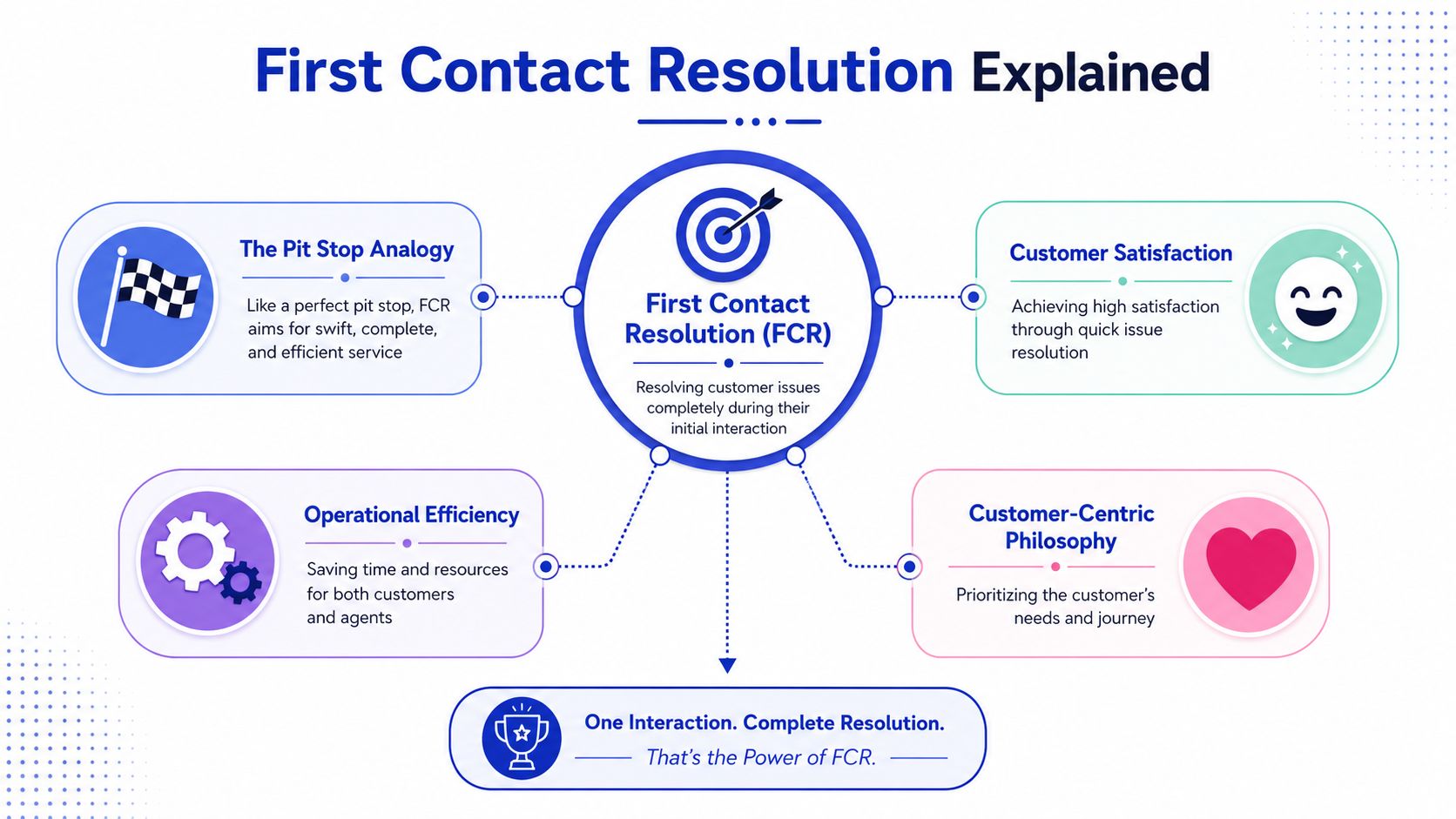
The older term was first call resolution, which made sense when support happened mostly by phone. Today, support runs across email, live chat, social media, messaging, and voice. That's why the broader concept matters. It reflects the customer's experience across channels, not just what happens in a call queue.
What counts as a real resolution
Many teams exhibit carelessness at this point. A contact is not resolved because an agent replied. It is not resolved because the ticket was marked closed. It is not resolved because the issue was handed to another queue.
According to Sprinklr's explanation of first contact resolution, a resolution is when the customer's issue is fully addressed to their satisfaction during that initial interaction, with zero need for follow-up calls, emails, or escalations.
That strict definition matters because loose definitions inflate the metric and hide operational problems.
A practical test is simple:
No repeat effort: The customer doesn't need to come back on the same issue.
No internal handoff: The issue isn't transferred or escalated during that initial interaction.
No partial answer: The agent doesn't send a placeholder response that pushes the substantive work later.
The formula is simple, but the mindset is not
The calculation itself is straightforward. Divide the number of issues resolved on the first try by the total number of contacts, then multiply by 100. Using Sprinklr's example, resolving 740 issues out of 1,000 contacts yields an FCR rate of 74%.
What's harder is building a support culture that values complete resolution more than superficial efficiency. Teams often chase first response time because it's visible and easy to improve. First contact resolution demands deeper changes. Better diagnosis. Better access to answers. Better escalation design. Better systems.
The customer doesn't care that your internal process is fast if their issue is still open in practice.
That's why strong FCR is always a sign of something larger. It means your operation is aligned around customer outcomes, not just queue management.
How to Measure and Benchmark Your FCR Rate
A small reporting error can turn FCR into a vanity metric. If one team counts tickets closed on the first touch and another counts only issues that stay solved, the comparison is useless and the staffing decisions that follow will be wrong.

Set the measurement rules before you set the target
The first job is operational consistency. Every manager, QA lead, and channel owner needs to score resolution the same way or the rate will drift based on interpretation instead of performance.
Use one formula across the business:
FCR rate = issues resolved on the first contact / total contacts x 100
Benchmarks help, but only after the counting method is clean. As noted earlier, many teams treat 70% to 79% as solid performance, and 80% or higher as top-tier. Those ranges are useful for context, not as a universal target. A password reset queue should outperform a technical troubleshooting queue. An SMB with a lean team should benchmark by contact type and business model before setting compensation, staffing, or automation plans around FCR.
That matters for ROI. If leadership applies one blanket target to every queue, agents start protecting the metric instead of solving the issue. The result is more transfers, more callbacks, and lower trust.
Use a recontact window, not just closure status
I have seen plenty of teams report strong FCR while customers were still coming back a day later through chat, email, or phone. Closed is an internal status. Resolved is a customer outcome.
Use a short validation window, usually 24 to 48 hours, to catch false positives. That extra step makes the number more reliable and gives operations leaders something they can use for cost control, forecasting, and coaching.
Track FCR with a few inputs working together:
Ticket reopen data: Fast way to spot issues that were marked solved too early.
Repeat contact matching: Helps catch customers who switch channels after an incomplete answer.
Post-contact survey responses: Best used to confirm whether the customer considered the issue finished.
Agent disposition codes: Useful for pattern analysis, but weak as a standalone source.
If your team is building a broader service dashboard, this guide to customer service KPIs that matter helps put FCR in context with the other numbers that affect retention, cost, and team productivity.
Benchmark by channel, issue type, and queue
Aggregate FCR hides expensive problems. A blended score can look healthy while one queue is generating repeat volume that eats your margins.
Break the rate down at minimum by:
Channel: Voice, chat, email, social, messaging
Issue type: Billing, account access, onboarding, product setup, technical support
Team or queue: New customers, high-value accounts, tier 1 support, specialist teams
The metric's value emerges. If chat resolves simple account questions well but fails on billing disputes, the fix is rarely "train agents harder." It is usually a workflow, permissions, or knowledge access problem. If email FCR lags because agents lack authority to issue credits, the ROI case is straightforward. Expand decision rights for the right cases, reduce repeat contacts, and recover capacity without adding headcount.
A good benchmark gives you two things: a realistic baseline and a clear next action. If it does not help you decide where to change process, staffing, or tooling, it is only reporting.
The Hidden Costs and Causes of Low FCR
Every repeat contact costs twice. You pay once in handling time and again in churn risk, lower CSAT, and work that crowds out revenue-generating service moments. For SMBs, low first contact resolution is not a reporting problem. It is a margin problem.
Where the cost shows up
Start with capacity. Every unresolved issue creates another ticket, another callback, another transfer, or another email thread. That repeat work fills the queue with demand you already paid to handle once. In smaller teams, the effect is immediate. Senior agents spend less time solving complex cases and more time cleaning up preventable follow-ups.
Customer trust erodes just as fast. When someone has to restate the issue, re-verify details, or wait for a promised update that never arrives, confidence drops. The original problem may be minor. The service experience turns it into a reason to leave.
There is an internal cost too.
Low FCR creates avoidable stress for frontline teams and managers. Agents inherit partial notes, broken handoffs, and customers who are frustrated before the conversation begins. Team leads get pulled into escalations instead of fixing the system that caused them. If you want a practical way to connect resolution quality with loyalty outcomes, this guide on improving customer satisfaction through support operations helps make that link clear.
Teams burn out from repeatable failure patterns, not just high volume.
What breaks first
Poor FCR often comes from several small failures stacking up inside one interaction. One of the most common is early misdiagnosis. Agents move too quickly to the first plausible answer, especially when the queue is full or the knowledge base is hard to trust. They close the immediate question, but not the actual issue.
I have seen this happen in billing, onboarding, and technical support. The agent sounds confident. The customer leaves with instructions. Then the contact comes back because the root cause was permission-related, policy-related, or tied to a different product setup step entirely.
Other root causes tend to follow familiar patterns:
Siloed information: Customer history, order details, and troubleshooting steps sit in separate tools, so agents piece together the answer manually.
Weak knowledge management: Articles are outdated, hard to search, or written for product specialists rather than frontline teams.
Limited authority: Agents know the correct fix but cannot approve the credit, replacement, exception, or account update needed to finish the job.
Messy escalation paths: Cases move to another team without context, and the customer has to repeat the story.
Training that favors scripts over diagnosis: Agents learn required language but do not build the questioning skills that surface the underlying issue quickly.
The ROI case is straightforward. Higher FCR reduces contact volume, shortens queues, protects retention, and frees capacity without adding headcount. That is why low FCR deserves process analysis, not blame. Review the repeat contacts, find the broken handoff or missing decision right, and fix the underlying workflow.
Proven Tactics to Improve Your FCR Rate
Most FCR improvement programs fail for one reason. They focus on agent behavior while ignoring process design. Agents matter, but they can't consistently resolve issues on first contact if the workflow, tooling, and knowledge structure work against them.
Fix the process before you train harder
Start with the top repeat-contact reasons. Don't start with generic coaching. Pull a sample of unresolved cases and look for patterns in what blocked the first interaction from ending in resolution.
Process problems usually show up in places like these:
Approval bottlenecks: Agents need manager intervention for common exceptions.
Fragmented workflows: The agent has to jump across systems to answer one basic question.
Missing next-step logic: There's no standard path for edge cases, so contacts bounce around.
Unclear ownership: Two teams can solve the issue, so neither team owns it cleanly.
If one issue type regularly generates follow-up contacts, redesign that journey first. A narrow fix usually delivers more value than broad training.
Train for diagnosis, not scripts
Agents improve FCR when they get better at understanding the issue early. That sounds obvious, but many training programs spend too much time on product facts and not enough time on problem framing.
GHD identifies early issue diagnosis as a major factor in FCR performance, and that should shape how managers coach. Focus on questioning, clarification, and verification. The best agents don't rush to answer. They slow down just enough to identify the underlying blocker.
Useful coaching prompts include:
What was the customer trying to do?
The stated problem and the underlying goal are often different.What information was missing at the start?
Find the data point that would have shortened the path to resolution.Where did the agent assume instead of confirm?
Most repeat contacts begin there.
Manager's note: If an agent gives the correct answer to the wrong issue, that interaction still failed.
Build a knowledge base people can actually use
A current knowledge base is not optional. It's one of the technical prerequisites for high FCR, because documented troubleshooting steps and easily found answers let agents solve issues during the first interaction instead of improvising or escalating.
What works:
Task-based article titles: “Refund for duplicate charge” is better than “Payments policy overview.”
Decision-tree structure: Let agents follow yes-or-no logic quickly.
Ownership: Every critical article needs a named owner who reviews it.
Search terms from real conversations: Use the language customers and agents naturally use.
What doesn't work is a document dump. If your knowledge base is full of long policy pages, frontline teams won't use it under pressure.
For teams also trying to improve customer satisfaction while fixing resolution quality, this breakdown of practical ways to improve customer satisfaction complements FCR work well.
Design escalation so the customer doesn't start over
Not every issue should resolve at tier one. Forcing frontline teams to handle everything can backfire. The answer is not “avoid escalation.” The answer is “make escalation invisible to the customer.”
That means the next team should receive:
The reason for contact
What was already checked
What the customer wants as an outcome
Any promised next step
A bad escalation resets the conversation. A good escalation carries the conversation forward.
After you've built that foundation, video walkthroughs can help teams visualize where AI-assisted routing and escalation summaries fit into the flow:
Use AI where it removes friction
AI improves first contact resolution when it handles the repetitive, well-defined work that clogs the queue and delays human attention. It hurts FCR when it creates dead ends, hides escalation, or gives confident but incomplete answers.
The best use cases are narrow and operational:
Instant answers to common questions: Shipping, billing basics, account steps, policy lookups
Knowledge retrieval for agents: Surface the right article or workflow during a live interaction
Structured intake: Collect the details humans need before they take over
Escalation summaries: Pass a concise issue summary so customers don't repeat themselves
That's the key trade-off. Automation should reduce effort, not add another layer the customer must fight through. If your AI experience can't recognize limits and hand off cleanly, it won't improve FCR in any meaningful way.
Your FCR Improvement Implementation Checklist
The fastest way to stall an FCR initiative is to make it too ambitious at the start. Teams don't need a giant transformation plan. They need a sequence that improves measurement first, then removes the biggest sources of repeat contact.
Phase 1 in the first 30 days
Begin with an audit. Pull recent repeat contacts and categorize them by issue type, channel, and failure point. Keep the review practical. You're looking for patterns, not perfection.
Use this checklist:
Define resolution clearly: Make sure every manager and team lead uses the same rule for what counts as first-contact resolution.
Set your measurement window: Include reopen and recontact behavior so false closures don't inflate the metric.
Identify repeat-contact drivers: Pull the most common reasons customers came back.
Review escalations: Look for transfers that should have been unnecessary.
Audit top knowledge articles: Check whether the most-used guidance is current and easy to find.
Phase 2 in days 31 to 90
Focus on quick wins. Don't try to repair every workflow. Fix the issues that create the most friction most often.
A practical sequence looks like this:
Priority | Action | Expected impact |
|---|---|---|
High | Rewrite the most-used knowledge articles | Faster, more consistent answers |
High | Remove common approval bottlenecks | More issues solved without manager intervention |
Medium | Standardize escalation notes | Less customer repetition during handoff |
Medium | Improve intake questions for common issue types | Better diagnosis earlier in the interaction |
If your systems are fragmented, this is also the right phase to address customer context. A connected support environment gives agents the history they need to resolve issues without restarting discovery. This guide to customer data integration for support teams is useful when you're cleaning up that foundation.
Phase 3 after 90 days
Once the basics are stable, scale what's working. This is the point where more advanced routing, structured QA reviews, and carefully scoped automation become worth the effort.
Focus on three habits:
Review failed first contacts weekly: Use them as operational evidence, not as isolated mistakes.
Segment by channel and issue type: Don't manage from one blended average.
Keep knowledge current: FCR gains disappear fast when documentation drifts.
Small process changes often outperform large training initiatives because they remove friction for every agent, on every shift.
That's the implementation principle worth keeping. Build repeatable resolution paths first. Then coach to them. Then automate the parts that are stable enough to deserve automation.
Conclusion From Metric to Mindset
First contact resolution isn't just a support metric. It's a visible sign of whether your company values the customer's time enough to solve the issue properly the first time.
Teams with strong FCR usually aren't winning because they hired superhuman agents. They win because they made resolution easier. They tightened diagnosis, cleaned up workflows, improved knowledge access, and designed escalation so the customer doesn't pay for internal complexity.
That's why the ROI is so attractive. Better first contact resolution reduces repeat work while improving the experience customers remember. Few support initiatives deliver both outcomes at once.
If you're starting from scratch, keep it simple. Pick one repeat-contact issue this week. Audit the journey. Fix the knowledge, process, or handoff that keeps it unresolved. Then measure again. First contact resolution improves the same way most strong operations improve. One preventable failure at a time.
If you want to put more of these resolutions on autopilot, Chatgrow helps teams create AI support agents that answer common questions instantly, stay aligned to your brand and knowledge base, and escalate cleanly when a human needs to step in. It's a practical way to reduce repetitive contacts, protect agent time, and improve first contact resolution without making customers fight through automation.
Related Posts
Continue Reading
More articles from the ChatGrow Team.