
Blog
Steps to the Sale: A Practical Playbook
By
Nelson Uzenabor

70% to 80% of the B2B buyer journey is typically complete before a salesperson is contacted, according to a 2026 buyer-journey summary. That single benchmark changes how sales teams should think about the steps to the sale. If your process starts when a rep receives a form fill, it starts after much of the buyer's decision has already taken shape.
The practical answer isn't to abandon the classic sales process. It's to modernize it. Keep the discipline of defined stages, measurable checkpoints, and clear ownership, then add the operational layer that modern buying requires: continuous qualification, useful self-service content, multi-stakeholder engagement, and fast handoff when intent becomes real.
Table of Contents
Why the Classic Sales Funnel No Longer Matches How Buyers Buy
Qualifying Leads So Sales Only Talks to the 25% Who Are Ready
Handling the Five Objections That Kill Deals Before They Close
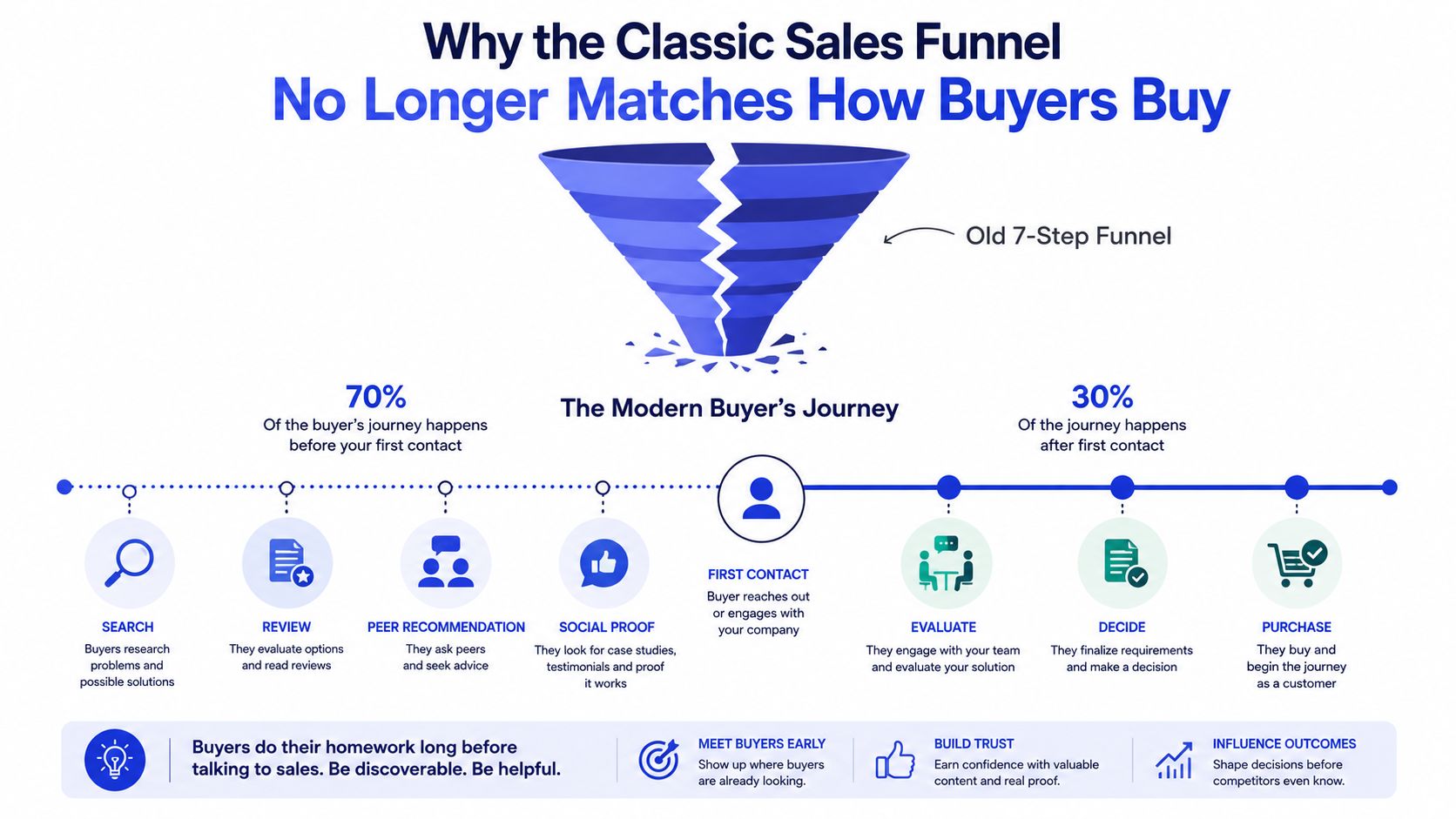
Why the Classic Sales Funnel No Longer Matches How Buyers Buy
The traditional seven-step model still gives sales teams a repeatable operating structure. A peer-reviewed article formally codified the classic sequence in 2005 as prospecting, preapproach, approach, presentation, overcoming objections, close, and follow-up. That framework continues to shape CRM stages and sales training (historical seven-step sales-process article).
Its weakness appears when teams treat those stages as a straight line. Buyers search, compare vendors, review proof, consult colleagues, revisit pricing, and validate implementation details before agreeing to a call. One buyer may enter through a product page, return through a comparison article, ask a support question, and then send pricing to procurement. That path does not fit a clean awareness-to-action funnel.
Three operational mismatches
First, buyers research independently. The same 2026 summary reports that buyers complete 70% to 80% of their journey before sales contact, participate in committees often containing 6 to 10 stakeholders, and complete an average of 27 distinct interactions across channels during a considered purchase (buyer-journey benchmarks). Sales teams therefore need content, qualification, and capture mechanisms that work before a rep joins the conversation.
Second, the original champion rarely decides alone. A product manager may identify the problem, finance may assess commercial risk, IT may check integration, security may review access, and an executive may approve the priority. A pipeline record that follows one contact hides the buying process and weakens handoff decisions.
Third, intent arrives in bursts. A prospect can stay quiet while researching, then ask several detailed questions in one session. A form fill may provide weak evidence. A pricing question paired with product usage and implementation questions signals a more developed opportunity.
Practical rule: Treat every stage as a combination of buyer signals and seller actions, not a permanent lane the prospect must follow.
The answer lies in modernizing the classic sales process. Keep defined stages, measurable checkpoints, and clear ownership, then add continuous qualification, useful self-service content, multi-stakeholder engagement, and rapid routing when intent becomes credible.
Your CRM should store the evidence behind movement. Record pages viewed, questions asked, stakeholders identified, objections raised, next steps agreed, and the reason a lead was routed or rejected. Teams refining their definitions can use this guide to optimize sales funnel stages.
For SaaS and e-commerce teams, pipeline hygiene rather than pipeline volume should guide the operating model. Build around multiple entry points and qualify continuously. Human reps should handle context-rich conversations, while documented answers and AI agents absorb repetitive questions and qualification work. Conversational marketing platforms can support that layer when visitors need answers before they are willing to identify themselves.
The Seven Steps of the Sale, Modernized for 2026
The classic model remains useful scaffolding, but the modern version updates the operating language so each stage maps to a CRM action, a measurable signal, and a realistic automation opportunity. Buyer journeys are rarely linear. Much of the evaluation happens before a sales conversation, so the process must capture evidence early and route attention when intent becomes credible.
A practical translation of the classic process
Signal Capture, formerly prospecting. Identify accounts and visitors showing relevant interest across inbound, outbound, product, and support channels. The CRM should create or enrich a record. Automation can detect intent from questions, page context, repeat engagement, and prior interactions.
Discovery and Context, formerly preapproach and approach. Gather the buyer's problem, current process, desired outcome, stakeholders, and timing. Reps should enter with usable context, not ask buyers to repeat information already shared with a form, chatbot, or previous conversation.
Qualification. Test fit, authority, urgency, integration readiness, and commercial timing. A scoring model separates curiosity from a credible opportunity before assigning human attention. Chatgrow or another AI agent can collect routine answers, flag missing information, and pass a structured summary to the right owner.
Value Articulation, formerly presentation. Connect the product to the buyer's stated problem. Record the use case, expected outcome, and agreed value hypothesis in the CRM. AI can retrieve relevant FAQs, product details, and approved proof points, while the rep handles the judgment behind the recommendation.
Objection Navigation. Classify concerns instead of treating every objection as a discount request. Automation can answer documented questions and identify recurring friction. Material concerns about risk, authority, implementation, or business impact belong with a rep.
Commitment Sequence, formerly close. Replace one closing event with agreed checkpoints, including confirmation of fit, commercial alignment, implementation planning, and signature. CRM tasks should show the next commitment, owner, due date, and evidence required to reach it.
Expansion and Advocacy, formerly follow-up. Track onboarding, value realization, repeat purchase, upsell, and referral opportunities as part of the revenue process. Follow-up is pipeline creation, not administrative cleanup.
Classic Step | Modernized Step | Primary CRM Action | AI Automation |
|---|---|---|---|
Prospecting | Signal Capture | Create or enrich lead and account records | Detect intent and capture conversations |
Preapproach | Discovery and Context | Store pain, stakeholders, and timing | Ask initial context questions |
Approach | Qualification | Apply fit and readiness criteria | Score and route leads |
Presentation | Value Articulation | Log use case and value hypothesis | Retrieve relevant answers |
Overcoming objections | Objection Navigation | Classify concern and owner | Handle documented FAQs |
Close | Commitment Sequence | Track decision checkpoints | Schedule meetings and send approved information |
Follow-up | Expansion and Advocacy | Create success and expansion tasks | Trigger check-ins and collect signals |
The framework matters because a sales process needs measurable checkpoints, not attractive labels alone. A team cannot improve “presentation” as a concept. It can improve the share of qualified opportunities that confirm a use case, accept a proposal, complete a technical review, or agree to a next step. Each checkpoint also creates a clean handoff between automation and human judgment.
Qualifying Leads So Sales Only Talks to the 25% Who Are Ready
Only about 25% of leads are legitimate sales-qualified leads, while 79% of marketing leads never convert, according to lead-qualification benchmarks. The same source reports that roughly 73% of leads aren't sales-ready, and that 50% are qualified but not yet ready to buy. That's why routing every captured lead to an SDR is a capacity problem disguised as responsiveness.
Use five questions, each scored from one to five. Keep the scoring definitions visible to marketing, sales development, and account executives so the handoff doesn't depend on personal interpretation.
The five-question qualification screen
Budget range: Has the buyer identified funding, a plausible range, or a commercial approval path?
Decision authority: Is the person involved in the decision, able to introduce the decision-maker, or only gathering information?
Pain urgency: Does the problem affect an active priority, or is the buyer exploring without a clear consequence?
Integration readiness: Can the team support the required workflow, data access, implementation, or operational change?
Timing window: Has the buyer identified when evaluation, approval, or implementation needs to happen?
A total of 17 out of 25 can serve as a practical starting threshold for immediate SDR handoff. Don't treat that threshold as universal. Calibrate it against opportunity quality, sales capacity, and the difference between a high-fit account and a high-intent visitor.
Criterion | Score 1–5 | Routing if <3 | Routing if 3–4 | Routing if 5 |
|---|---|---|---|---|
Budget | No known path | Nurture and provide commercial education | Request approval context | SDR handoff |
Authority | Research-only role | Ask for stakeholder introduction | Multi-thread the account | SDR handoff |
Urgency | No active problem | Educational sequence | Monitor intent | Immediate human response |
Integration readiness | Major unknowns | Technical education | Specialist review | Sales or solutions handoff |
Timing | No defined window | Nurture | Scheduled follow-up | Immediate human response |
A hot lead has strong intent, credible fit, and a clear next action. A warm lead may have a real problem but lacks authority, timing, or implementation readiness. Route warm leads into a useful nurture path, not a generic newsletter. Disqualify poor-fit records cleanly and preserve the reason so marketing doesn't recycle the same mistake.
For teams formalizing this model, the Voicedial.ai lead qualification guide offers additional practical context on qualification questions and handoff design. An automated layer can ask the first questions conversationally, collect answers, and pass a concise summary to a rep. See automated lead scoring for the operational pattern, but keep human review for ambiguous or high-risk opportunities.
Handling the Five Objections That Kill Deals Before They Close
Objections surface when buyers lack confidence. Price may signal budget pressure, weak value, procurement procedure, or fear of making the wrong decision. “I need to think about it” may indicate missing authority, limited trust in the implementation plan, or insufficient evidence to defend the purchase internally.
A rep who answers only the literal words can miss the underlying concern. Use a consistent sequence: acknowledge the issue, isolate its cause, connect the response to the buyer's stated problem, and agree on a specific next action. This keeps the conversation diagnostic rather than defensive.
Two scripts worth practicing
Price objection
Buyer: “It's too expensive.”
Rep: “That may be true compared with the alternatives you're considering. Is the concern the total budget, the expected return, or the risk that adoption won't happen?”
Buyer: “We're not sure we'll get enough use from it.”
Rep: “That's a usage risk, not just a price issue. Let's define the first workflow you'd need live, who owns it, and what evidence would show that the purchase is working. If we can't agree on those points, reducing the price would leave the underlying concern unresolved.”
Make the value testable with a concrete operating plan. Define the first workflow, assign its owner, and agree on the evidence the buyer will review after launch. A discount can close a commercial gap, but it cannot repair unclear ownership or weak confidence.
“I need to think about it”
Rep: “Of course. What specifically needs more thought, the fit, the commercial terms, the implementation, or getting the rest of the committee comfortable?”
Buyer: “I need to speak with our operations lead.”
Rep: “That makes sense. Would it help to include them in a short review focused on workflow and ownership? Assuming they're comfortable with those points, is there anything else that would prevent a decision?”
This response turns a vague delay into a decision map. If the buyer cannot name the missing information or stakeholder, the opportunity may need more discovery before a closing request makes sense.
Match the response to the concern
Objection | Stage It Surfaces | Real Concern | Response Framework |
|---|---|---|---|
“It costs too much” | Commercial review | Value, budget, or risk | Isolate the concern, then tie price to an agreed outcome |
“Now isn't the right time” | Discovery or proposal | Priority or internal capacity | Clarify the trigger that would make timing right |
“I'm not the decision-maker” | Qualification | Authority and access | Ask who must approve and create a path to them |
“I don't trust the solution yet” | Presentation or validation | Proof, security, or delivery risk | Provide relevant evidence and define a verification step |
“We already use another provider” | Discovery or comparison | Switching cost or satisfaction | Ask what works, what doesn't, and what would justify change |
A chatbot can answer documented FAQs about plan differences, supported integrations, or basic setup. Keep it away from legal terms, security commitments, sensitive complaints, and buyers who signal serious purchase intent unless the workflow routes those cases to a human. For broader script development, this sales objection playbook provides a useful reference.
Close through checkpoints, not pressure
The trial close checks whether the solution fits:
“Does this solve the problem we walked through?”
If the answer is uncertain, continue discovering. If the fit is clear, use the assumptive close to discuss logistics: “Assuming the implementation plan works, which onboarding date fits your team?” The words assuming and when help the buyer examine ownership without treating the decision as complete.
The final commitment close asks directly: “Are you comfortable moving forward with this plan?” Then pause. Reps often weaken a good close by filling the silence after a price quote or commitment request. Give the buyer room to think and answer.
Use unless to surface hidden blockers: “Is there anything outstanding, unless the procurement review raises a new requirement?” Use when only after the buyer has shown readiness. Language can support momentum, but evidence must carry the decision.
Before asking for commitment, check:
Problem agreement: Has the buyer confirmed the problem and its consequence?
Value agreement: Have they connected the proposed solution to that problem?
Stakeholder coverage: Do you know who can approve, block, or influence the purchase?
Risk visibility: Have you addressed implementation, trust, commercial, and timing concerns?
Next-step clarity: Is the requested commitment specific and easy to act on?
Turning Post-Sale Follow-Up Into a Repeat Revenue Engine
The sale isn't complete when the contract is signed or the first order ships. A customer who never reaches value creates support burden, renewal risk, and weak referral potential. A structured post-sale process gives the team evidence about account health and creates appropriate moments for repeat purchase or expansion.
Track post-sale performance with NPS at day 30, repeat-purchase rate, upsell conversion, and referral pipeline contribution. These metrics don't replace customer conversations. They tell managers where conversations are missing or where a promising account needs intervention.
Four stages after the agreement
Onboarding completion comes first. Confirm that the customer has access, understands the first workflow, and knows where to get help. The CRM should create tasks for the owner and record blockers instead of leaving onboarding inside an inbox.
Next, run a value-realization check-in. Ask what the customer expected to improve, what they've used, and what remains unresolved. A good check-in doesn't force an upsell. It identifies whether the original buying reason has become a delivered outcome.
An expansion conversation belongs after evidence of value, not immediately after signature. For SaaS, that might mean a new team or workflow. For e-commerce, it may mean a repeat-purchase prompt or a relevant complementary product. The offer should follow observed need.
Finally, make a referral ask when the customer can describe a concrete benefit and has no unresolved issue. A referral request made during frustration is poorly timed, even if the account appears commercially valuable.
Sub-Stage | Timing | KPI to Track | Benchmark |
|---|---|---|---|
Onboarding completion | Early post-sale | Completion status and unresolved blockers | Establish an internal baseline |
Value realization check-in | After initial use | NPS and stated outcome progress | Compare cohorts over time |
Expansion conversation | After value evidence | Upsell conversion | Segment by account health |
Referral ask | After positive feedback | Referral pipeline contribution | Track source and resulting opportunities |
Don't invent targets before you have clean definitions. Decide what “onboarded,” “active,” “expanded,” and “referred” mean, then measure consistently. Automated CRM tasks and check-in sequences can make the cadence dependable while still escalating unusual responses to a customer-facing human.
Where AI Agents Like Chatgrow Fit in Each Step
AI earns its place in the sales process when it removes repetitive work without hiding important context. The goal isn't to make every conversation autonomous. It's to let a rep enter at the point where judgment, negotiation, empathy, or commercial accountability matters.
Start with a controlled knowledge base. Connect approved website, pricing, product, and FAQ content, then test answers against real CRM tickets and support questions. Define escalation triggers for phrases such as “ready to buy,” “pricing,” “implementation,” or “speak to sales,” while allowing the agent to answer routine questions without creating unnecessary handoffs.
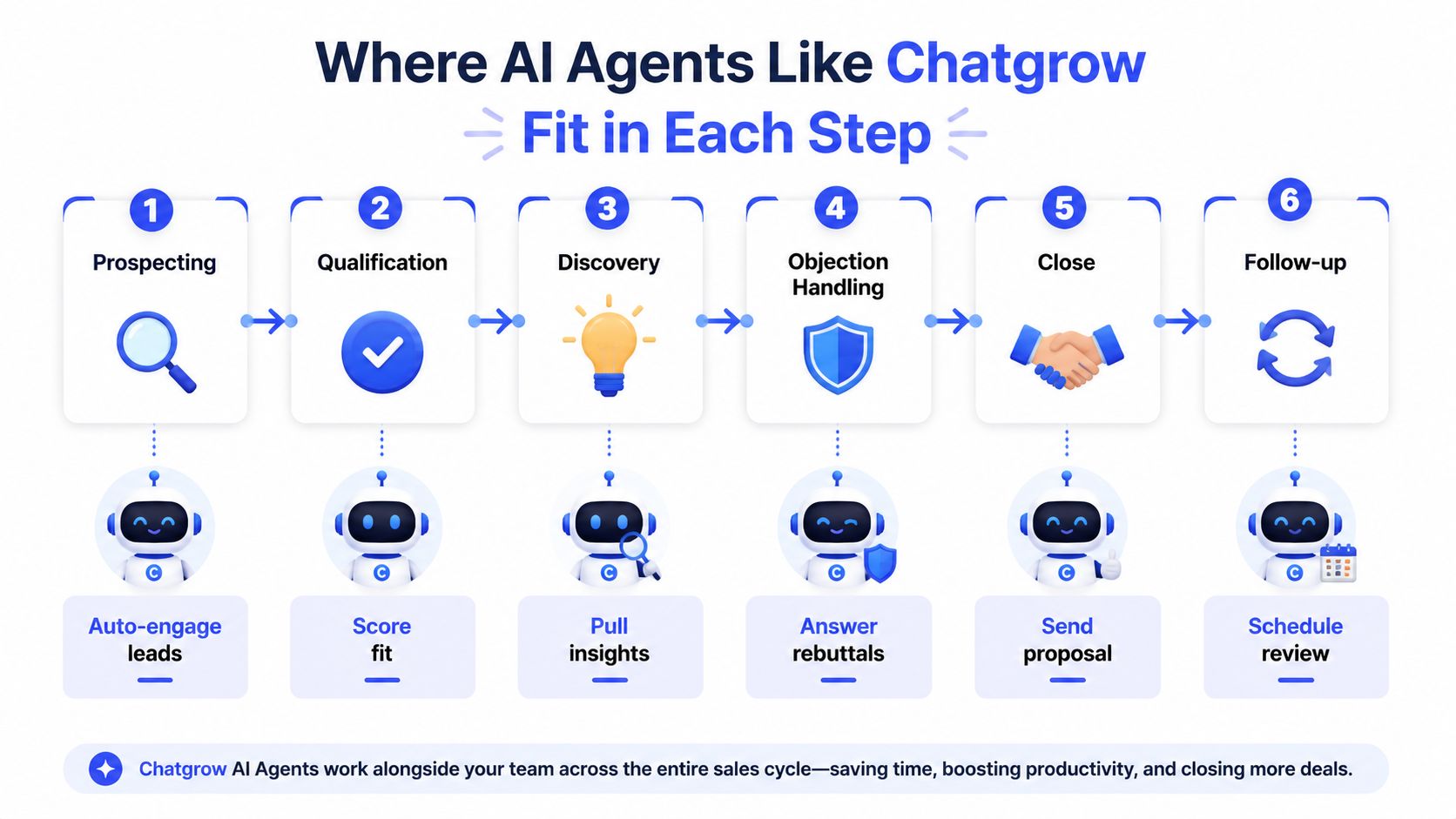
Assign automation by risk and repetition
Prospecting: Engage visitors on relevant pages and identify what brought them there.
Qualification: Ask initial fit, urgency, authority, and timing questions, then apply routing rules.
Discovery: Collect structured context so the rep sees the problem before the meeting.
Objection handling: Answer approved FAQs and escalate concerns that require judgment or policy interpretation.
Close: Support scheduling, provide approved commercial information, and alert the owner when buying language appears.
Follow-up: Trigger check-ins, gather satisfaction signals, and flag expansion or support needs.
A platform such as Chatgrow can create, train, and deploy custom support or sales agents using a business's website, pricing, FAQs, and product pages. Its smart escalation can collect key details and forward a concise summary to the team, while the agent can support lead qualification, meeting booking, and always-on FAQ coverage. The operational principles also apply to other tools. Review AI agents for business when mapping agent capabilities to your existing workflow.
The handoff standard should be strict. Before transferring, the agent should capture the buyer's stated problem, relevant product or service, urgency, stakeholder role, key objection, and requested next step. Preserve the transcript and summary in the CRM. A rep shouldn't ask the same opening questions again.
Here's the test I use: if a rep is still answering a question an agent could answer accurately in under ten seconds, the playbook is misconfigured. Review escalations weekly, inspect incorrect answers, update the knowledge base, and adjust triggers when the agent either over-escalates or misses intent.
A short walkthrough can help teams visualize the operating model:
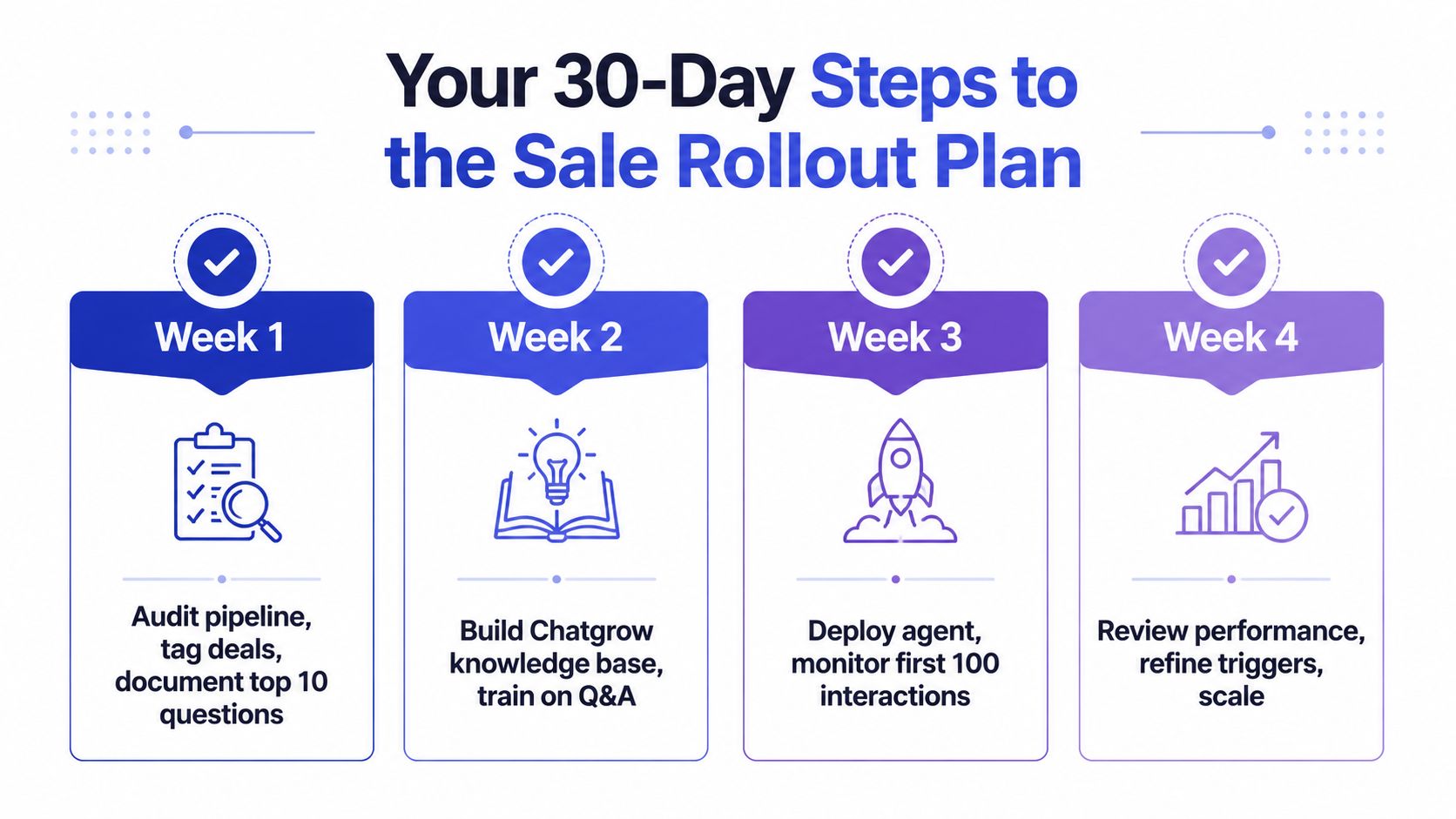
Your 30-Day Steps to the Sale Rollout Plan
A sales-process redesign fails when the team tries to automate an undocumented mess. Use the first month to establish stage definitions, qualification rules, handoff standards, and a review rhythm.
Week 1, audit the existing pipeline
Export current opportunities and tag each record by the stage it occupies, not the stage selected in the CRM. Document the top 10 inbound questions, identify duplicate or stale records, and note where leads wait for a response. Establish definitions for qualification rate, time-to-first-touch, SQL-to-opportunity ratio, and agent containment rate.
Week 2, build the operating layer
Create the knowledge base from approved product pages, pricing information, FAQs, and resolved support tickets. Write the qualification questions and scoring rules in plain language. Define which signals trigger immediate routing, what context must accompany a handoff, and which questions the agent must never answer without escalation.
Week 3, run in shadow mode
Deploy the agent alongside existing flows and compare its suggested answers, classifications, and routing decisions with human outcomes. Once the team trusts the low-risk responses, turn on autonomous qualification for leads that show limited intent. Keep high-intent, sensitive, or commercially complex conversations with trained staff.
Week 4, measure and tune
Review conversations, rejected leads, missed escalations, and false positives. Compare qualification rate, time-to-first-touch, SQL-to-opportunity ratio, and agent containment rate with the baseline from Week 1. Fix the largest source of wasted human effort first, then expand coverage gradually.
Use one diagnostic every week: of every ten inbound conversations, how many reached a human rep that shouldn't have? A high answer points to weak qualification, poor FAQ coverage, unclear routing, or missing CRM integration. A low answer isn't automatically good if the agent is failing to escalate genuine buying intent, so review containment alongside conversation quality.
Chatgrow lets you train custom AI agents on your website, pricing, FAQs, and product information, then use them to answer questions, qualify leads, schedule meetings, and escalate high-intent conversations with context. Visit Chatgrow to test an agent on the repetitive work in your sales process and start reserving human time for buyers who are ready for a meaningful conversation.
Related Posts
Continue Reading
More articles from the ChatGrow Team.