Blog
Conversational Marketing Platforms: The Ultimate Guide
By
Nelson Uzenabor
A likely buyer is on your pricing page right now, comparing you to two competitors and trying to answer one simple question. If your site gives them a form, an inbox, and a promise that someone will reply later, you're asking a high-intent prospect to pause momentum and wait. Many won't.
That gap is why conversational marketing platforms matter. They replace one-way capture with two-way dialogue, right when intent is strongest. Instead of forcing every visitor into the same static path, they let marketing, sales, and support teams respond in context, qualify demand, and move people forward without delay.
The category isn't niche anymore. The conversational marketing software market is projected to grow from USD 0.8 billion in 2025 to USD 3.6 billion by 2035, at a 16.8% CAGR, according to Future Market Insights' conversational marketing software market forecast. That growth tells you something practical. Teams are no longer treating real-time website conversations as a nice add-on. They're wiring them into revenue workflows.
Table of Contents
The End of the Waiting Game
Forms still have a place. They're simple, controlled, and easy to route. But they're also a blunt instrument. They treat a student researching options the same way they treat a procurement lead ready to book a demo.
Conversational marketing platforms fix that by meeting visitors in the moment. A person on a pricing page can ask about integrations, implementation, or fit and get an answer without abandoning the session. A returning customer can ask about billing or delivery status without opening a ticket. A qualified buyer can move straight to scheduling or sales handoff.
That sounds obvious, but execution is where teams get it wrong. They add a chat widget and call it strategy. Then the bot answers generic questions, fails to route serious opportunities, and floods the team with low-value conversations. The result is more activity, not more pipeline.
Practical rule: If the conversation can't change the next step for the visitor, it's just a prettier form.
The strongest implementations focus on moments of intent. Pricing pages. Demo pages. Checkout flows. Renewal pages. Support surfaces with repetitive questions. In those places, speed matters because hesitation costs revenue or increases service load.
There's also a shift in buyer expectation. People are used to messaging. They don't want to decode navigation, hunt through FAQ pages, and wait for follow-up if a fast answer would let them decide now. That's the job.
The opportunity isn't just more conversations. It's better conversion paths, clearer qualification, and fewer dead ends.
What Is a Conversational Marketing Platform
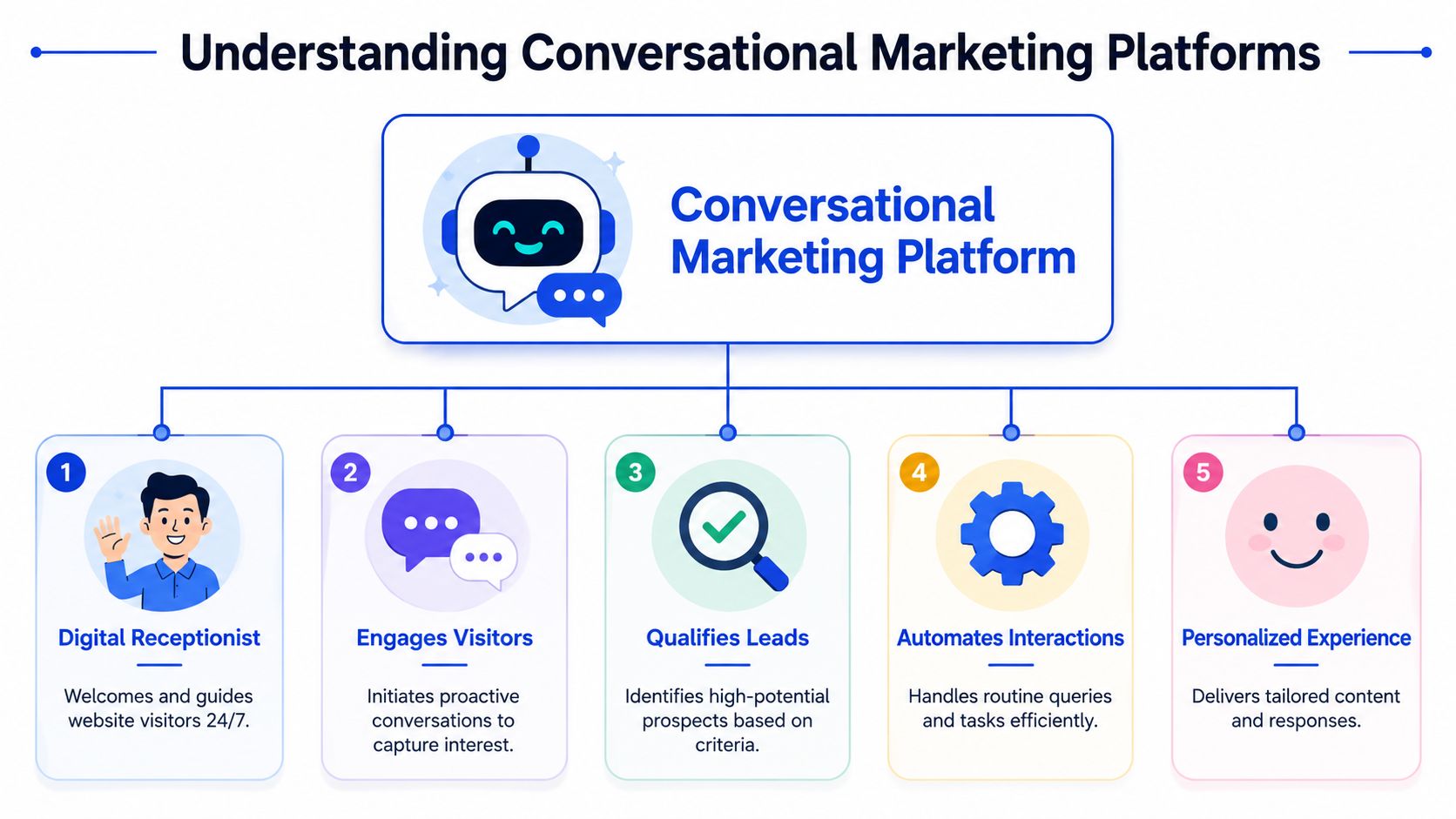
Think of it as a digital receptionist
A useful way to think about conversational marketing platforms is this: they act like a digital receptionist for your website and customer touchpoints. But a good receptionist doesn't just greet people. They recognize urgency, ask a few smart questions, and send each person to the right place.
That distinction matters. Basic chat tools open a message box. A conversational marketing platform should do more. It should understand who the visitor might be, what they're trying to do, and what action the business wants to trigger next.
For a SaaS company, that action might be demo booking or lead capture with qualification notes. For an ecommerce store, it might be product guidance, shipping answers, or cart recovery. For a service business, it might be routing by location, budget, or use case.
This is the mental model I use when evaluating tools. If the platform only produces transcripts, it's incomplete. If it helps the visitor and advances an internal workflow, it's doing its job.
The three layers that actually matter
Under the hood, most conversational marketing platforms follow a three-layer structure described in Salespeak's glossary entry on conversational marketing platforms. They typically include an engagement layer, an intelligence layer, and an action layer.
Here's what that means in practice:
Engagement layer
This is the interface your visitor sees. Usually it's a web chat widget, embedded assistant, or message launcher on a specific page. This layer controls timing, prompts, page targeting, and user experience.Intelligence layer In this layer, the platform interprets the message. It may use NLP, LLMs, rules, or a combination. The important question isn't what acronym is in the sales deck. It's whether the system can identify intent, hold context, and avoid brittle keyword-only behavior.
Action layer In this layer, value gets created. Booking a meeting, pushing data into a CRM, routing to support, escalating to a human, or triggering a follow-up workflow. Without this layer, conversations stall.
A lot of failed deployments come from over-investing in the first layer and under-planning the third. Teams polish the widget, write a friendly welcome message, and never decide what should happen when someone signals buying intent.
The platform matters less than the operating model behind it. Routing logic, ownership, and follow-up discipline decide whether the tool produces revenue or noise.
When you understand these layers, vendor demos become easier to judge. You stop asking whether the bot “uses AI” and start asking whether it can preserve context, trigger actions, and hand off conversations cleanly.
Core Features and Capabilities
The feature list on most vendor sites is crowded and unhelpful. Every platform says it offers automation, personalization, and analytics. What matters is whether those features support a specific workflow you care about.
Engagement features that create the opening
At the front end, look for tools that let you control where, when, and how conversations start.
That includes page-specific prompts, proactive chat triggers, embedded assistants, and live chat fallback. A homepage greeting is easy to launch and rarely where the best results come from. High-intent pages usually outperform broad sitewide prompts because the visitor already has momentum.
The widget itself also matters more than teams expect. Placement, default prompt, mobile behavior, and whether the experience feels interruptive or helpful all shape performance. If you want a deeper view into what makes a widget effective, this guide on web chat widget design and deployment is a useful reference.
Intelligence and automation that separate signal from noise
Average tools often prove inadequate here. The platform needs to distinguish a casual question from a buying signal, and it has to do it without forcing users through robotic scripts.
Strong capabilities here include:
Intent recognition that detects whether the user wants support, sales help, pricing information, or account assistance
Context retention so the system doesn't ask the same question twice
Qualification logic that collects the few details your team needs
Confidence-based escalation so uncertain answers get routed to a human instead of guessed
A useful benchmark from the category is that some well-instrumented systems can resolve a large share of routine interactions. G2 reports that Tidio's Lyro can resolve up to 67% of common customer inquiries in some cases, as noted in G2's conversational marketing category overview. That should shape expectations. Automation can absorb repetitive work, but only if the knowledge source is current and the handoff rules are disciplined.
Integration and analytics that make the tool accountable
If the platform doesn't connect to the rest of your stack, your team will end up copy-pasting transcripts and guessing what happened next.
The integrations that usually matter most are:
CRM sync so lead data and conversation summaries reach sales
Calendar and meeting workflows for direct booking
Knowledge base connections so answers stay aligned with current docs
Support tooling for escalation and case continuity
I'd add one more feature that buyers often underrate: conversation summaries. A short, usable summary attached to the record is far more valuable than a long transcript nobody reads.
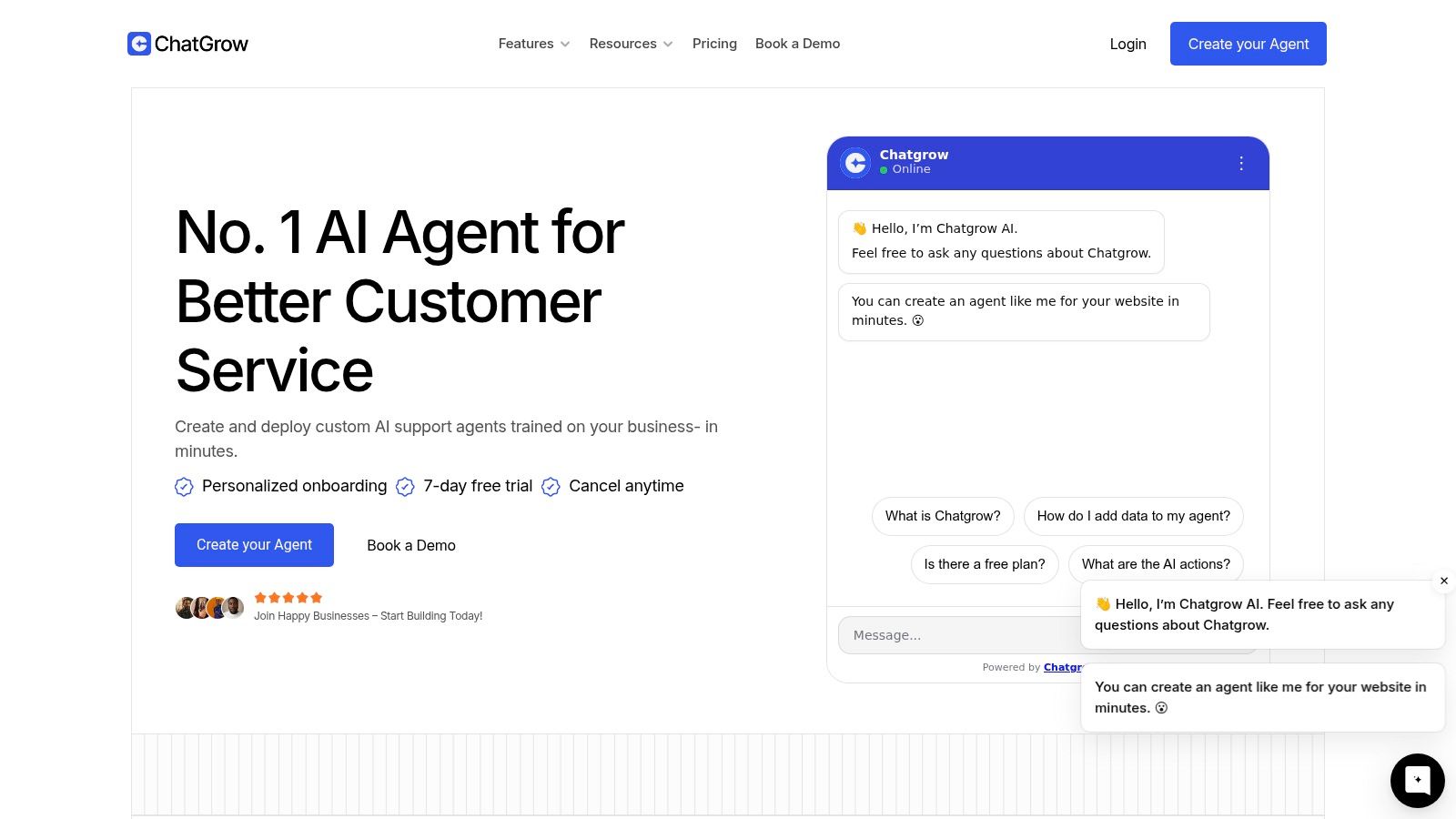
One option in this category is Chatgrow, which lets teams train agents on site content, define lead qualification rules, and escalate with concise summaries. That's a practical fit for smaller teams that need support coverage and lead capture without building a large ops layer.
Primary Use Cases in Action
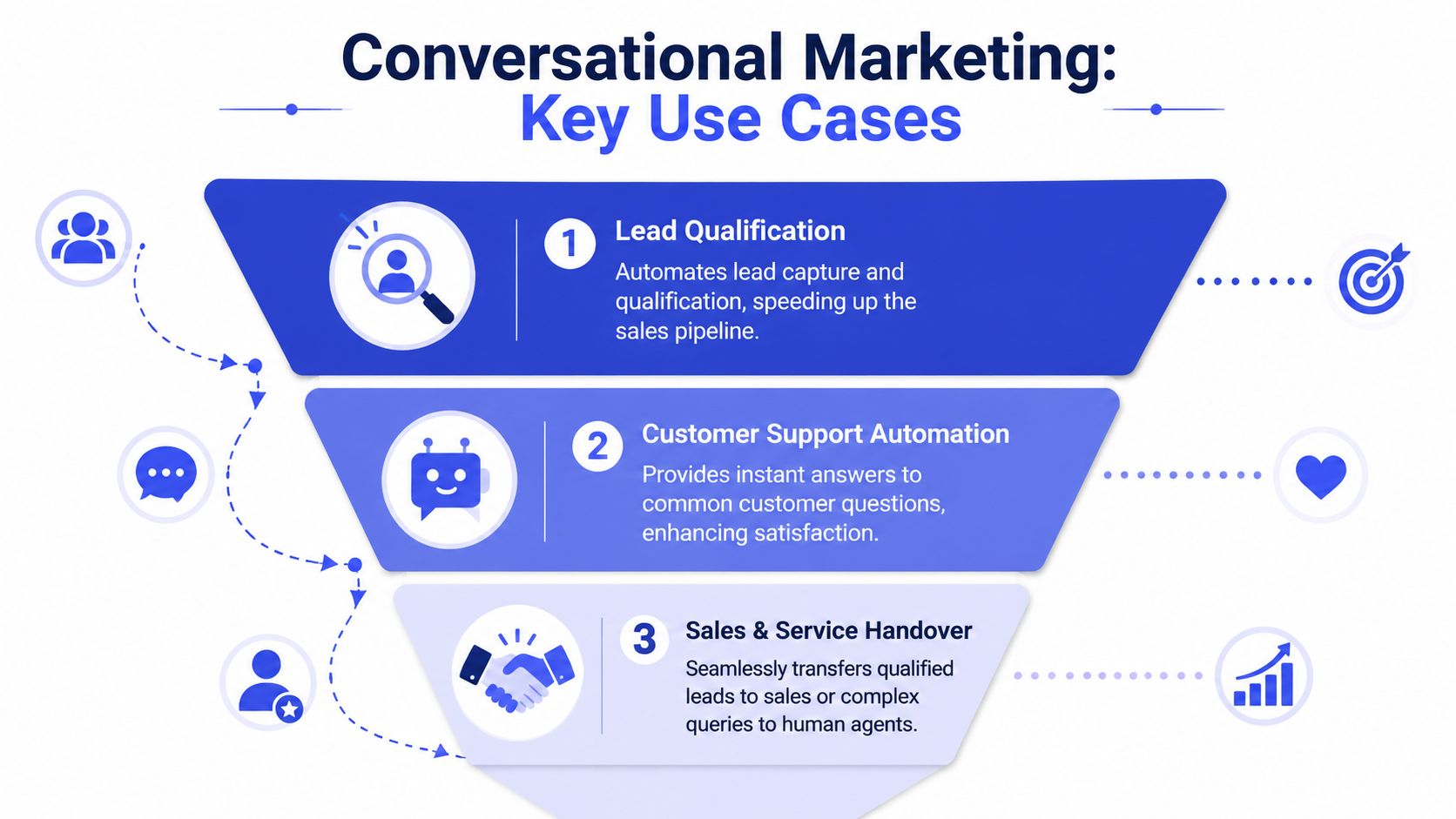
The value of conversational marketing platforms becomes obvious when you look at the workflows they replace. The point isn't chat for its own sake. The point is to remove delays, reduce friction, and route people properly while intent is still alive.
A quick visual makes the three most common patterns easier to see.
Lead qualification on high-intent pages
This is the highest-value use case for many B2B teams. A visitor lands on pricing, asks whether you support a required integration, mentions timeline, and wants to know how onboarding works. A static form collects an email and leaves the rest for later. A conversational flow can answer the question, capture qualification data, and route to booking if the fit is strong.
Salesloft found that visitors who send a high-intent message inside a bot conversation are 5x more likely to convert into an opportunity, according to Salesloft's conversational AI marketing trends report. That's the practical reason to deploy these tools on pricing, demo, and checkout-adjacent pages. They're not just engagement surfaces. They're intent detection surfaces.
If lead generation is your main goal, this walkthrough on using a chatbot for lead generation covers the setup logic well.
Always-on support without endless ticket growth
The second use case is service deflection done properly. Customers ask the same questions repeatedly: shipping, billing, refund policy, booking changes, account access, product compatibility. A conversational layer can answer many of those instantly if the knowledge source is clean and the edge cases escalate fast.
What works:
Narrow initial scope with repetitive, high-volume questions
Clear fallback language when the answer is uncertain
Fast escalation with context passed to a human
What fails:
Overpromising coverage before the system is trained
Letting the bot improvise on policy or account-specific issues
Hiding the human option to force containment
If your support team says the bot creates cleanup work, believe them. Bad automation doesn't remove load. It shifts load downstream.
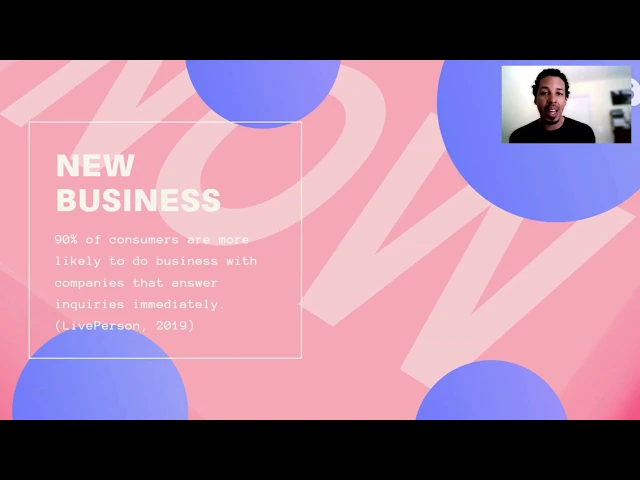
Here's a useful video example of how these workflows are typically framed in practice.
E-commerce recovery and buying guidance
For ecommerce teams, the pattern looks different. The bot can help a visitor compare products, answer delivery or return questions, or respond when hesitation appears near checkout. It can also surface recommendations based on the user's question instead of forcing category navigation.
The trap here is being too aggressive. Constant popups, discount interruptions, or generic “Need help?” prompts can hurt more than they help. The better approach is behavioral and contextual. Offer assistance when a user has a real reason to need it.
In all three use cases, the same rule applies: the conversation should shorten the path to a decision. If it adds steps, it's not helping.
Your Buyer Checklist and Evaluation Criteria
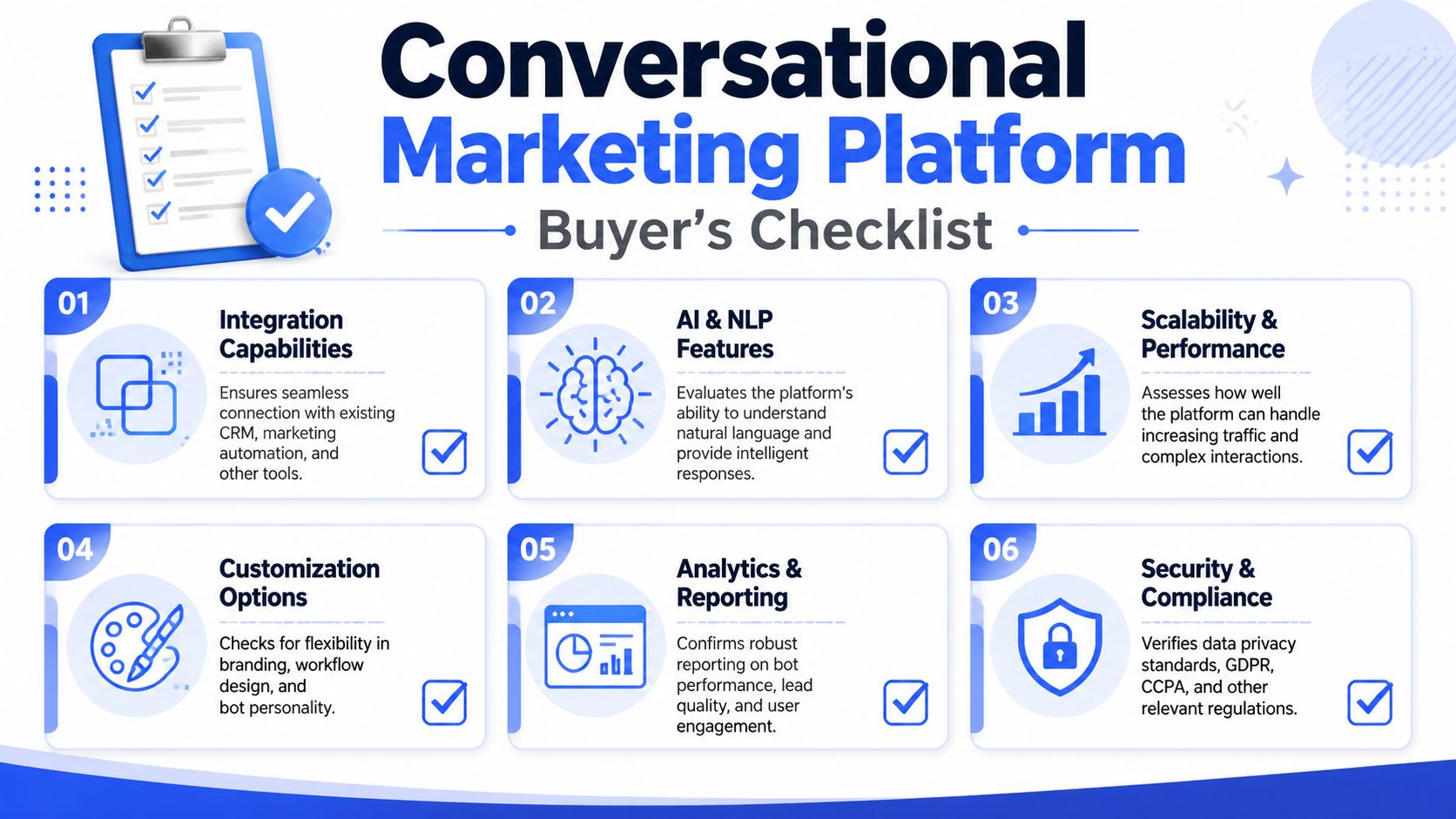
Most buying teams compare conversational marketing platforms by feature count. That's a mistake. Plenty of products can launch a bot, trigger a greeting, and show a dashboard. The harder question is whether the platform can scale without producing wrong answers, fragmented records, and awkward handoffs.
Operational trust should sit near the top of the evaluation list. As noted in Insider's conversational marketing strategy guide, buyers need to ask how a system prevents wrong answers, maintains brand voice, and structures escalation with enough context for humans to resolve the issue quickly.
Questions that expose weak platforms fast
Use these questions in demos and trials:
How does the system decide when not to answer?
If the vendor only shows success paths, push on failure handling. You need to see confidence thresholds, fallback behavior, and escalation logic.What context does the human receive on handoff?
A clean summary, qualification details, and transcript excerpt are useful. A raw transcript dump is not.How much control do we have over voice and boundaries?
You need practical controls for tone, restricted topics, approved sources, and workflow rules.How does it connect to our existing stack?
Native CRM, calendar, help desk, and knowledge base support will save your ops team weeks of workaround design.How are conversations reviewed after launch?
You want searchable logs, answer quality review, missed intent analysis, and version control for changes.
Buy the platform your team can govern, not the one with the flashiest demo.
That last point is where many teams stumble. A bot that sounds smart in a test prompt can still create trust problems at scale if nobody owns review and retraining.
Platform Type Comparison
Platform Type | Best For | Typical Limitation |
|---|---|---|
Rule-based chat tool | Teams with narrow, predictable flows | Breaks on open-ended questions |
AI-first support agent | Repetitive support coverage and FAQ handling | Can drift if governance is weak |
B2B lead qualification platform | Pricing pages, demo requests, SDR routing | May feel rigid outside sales use cases |
Suite-based marketing platform | Teams wanting chat inside a broader automation stack | Can be heavier to implement and manage |
Custom-built deployment | Organizations with strict control needs | High maintenance and slower iteration |
A final buyer note. Don't evaluate in a vacuum. Bring in sales, support, and ops early. Each team will catch a different failure mode, and conversational platforms touch all three.
Implementation Steps and Measuring Success
Teams should generally start smaller than they want to. A broad rollout sounds ambitious, but it usually creates messy routing, weak training data, and conflicting ownership.
A rollout that won't create chaos
A cleaner path looks like this:
Start on one high-intent page
Pick a page where a live answer can change conversion behavior. Pricing is often the simplest place to begin because intent is easier to detect.Train on approved content only
Use current FAQs, product pages, policy docs, and support content. Don't dump in stale documentation and expect good output.Define qualification and routing rules
Decide what counts as sales intent, support intent, and low-priority traffic. Then determine where each conversation should go.Review transcripts and tune weekly
Early launches reveal gaps fast. Tight review loops matter more than broad coverage in the first phase.
The biggest measurement mistake comes right after launch. Teams celebrate conversations started, engagement rate, or total messages and stop there. Those are activity metrics. They don't prove business impact.
KPIs that prove value
The harder and more useful question is attribution. As Velaro's guide on turning conversations into leads points out, buyers need to compare conversation performance against static forms and measure pipeline lift if they want to isolate the impact of AI.
Track metrics like these:
Qualified leads created by conversation
Meeting bookings sourced from chat
Opportunity creation rate from qualified conversations
Human handoff rate
Resolution rate for routine support questions
Speed to first useful response
Pipeline influenced by conversation-assisted journeys
Conversion rate on pages with chat versus a form-only baseline
If you want a framework for instrumenting those numbers, this guide to chatbot analytics is worth using during setup.
A practical measurement rule is simple. Compare the conversational path to the old path. Same page, same traffic intent, different experience. That won't solve attribution perfectly, but it gets you much closer to proving incremental value than dashboard vanity metrics ever will.
Start Your First Conversation Today
Conversational marketing platforms work when they're treated as part of revenue operations, not as a website accessory. The useful ones answer real questions, qualify intent, and trigger the next action without creating extra cleanup for sales or support.
The failure modes are just as consistent. Teams launch too broadly, measure the wrong things, and automate without guardrails. Then they mistake transcript volume for progress. That's how you end up with more conversations and less trust.
The upside is straightforward. Start with one high-intent use case. Build a narrow knowledge source. Define what a qualified lead or successful resolution means. Review handoffs aggressively. Then expand only after the workflow is reliable.
For small and mid-sized teams, that approach is usually enough to prove whether conversational marketing deserves a larger footprint. You don't need a massive transformation project. You need a clear use case, a measurable baseline, and a system that knows when to escalate.
The waiting game isn't helping your buyers. If someone is ready to ask, your site should be ready to answer.
If you want to test conversational marketing without a heavy implementation, Chatgrow is a practical place to start. You can train an AI agent on your site content, deploy it to high-intent pages, define lead qualification rules, and monitor performance before expanding the rollout.
Related Posts
Continue Reading
More articles from the ChatGrow Team.