Blog
What Is Lead Qualification: A Complete Guide for 2026
By
Nelson Uzenabor

Your team's inbox is full, the calendar is messy, and every new lead looks promising for about five minutes. Then the calls start, and you find out the prospect has no budget, no authority, and no urgency, or worse, they're just browsing while your rep burns another afternoon. Lead qualification is the process that stops that cycle, so your team spends less time chasing noise and more time talking to people who might buy.
For a small business, that shift matters fast. A clear qualification process protects rep time, improves follow-up, and helps you route the right people to sales before interest goes cold. It also has to fit the way buyers behave now, because many of them self-educate, compare options, and even talk to AI chat tools before they ever fill out a form.
Table of Contents
What Is Lead Qualification and Why It Matters
A lot of businesses treat every inbound lead like a sales-ready opportunity. A form gets filled out, the rep gets notified, and someone starts dialing, even when the prospect is a poor fit or still gathering basic information. That's why the pipeline feels busy but doesn't move.
Lead qualification is the decision process that separates a real opportunity from general interest. It checks whether a prospect matches your ideal customer profile and whether they show enough buying intent to deserve live sales attention. If you want a practical glossary-style definition tied to RevOps, the guide on what lead qualification means for RevOps is a useful reference.
Fit and intent are the two questions that matter
The simplest way to understand qualification is to ask two things. First, does this prospect fit what we sell? Second, are they ready for a sales conversation?
That sounds basic, but it's where many teams get stuck. A company can look large enough, use the right email domain, and still be a bad fit because the buyer isn't the decision-maker or the problem isn't urgent. A lead only becomes worth live attention when both fit and intent are present.
Practical rule: don't ask, “Is this a lead?” Ask, “Should a rep spend time on this lead right now?”
Qualification is a filtering system, not a label
A common mistake is treating qualification like a tag in the CRM. In practice, it's a filtering mechanism that protects sales time and keeps your pipeline honest. When qualification is weak, reps spend hours on dead ends, and good leads get buried under low-priority follow-up.
That's also why the distinction between a general lead and a qualified lead matters. A lead might be someone who downloaded a guide, requested pricing, or opened a chat. A qualified lead has passed a set of checks that show they're worth pursuing now, not someday.
For small business owners, that difference is often the line between a team that feels constantly busy and a team that books useful conversations. Qualification doesn't create demand, but it does make demand usable.
The Critical Role of Lead Qualification in Your Pipeline
The data makes the problem plain. Across all industries, only 13% of Marketing Qualified Leads become Sales Qualified Leads, which means 87% fail to meet sales pursuit criteria after marketing handoff, according to lead qualification statistics. A broader benchmark cited in the same lead-quality research says only 25% of marketing leads are sales-ready at generation, so 75% need more nurturing before they should be treated like immediate opportunities.
That gap explains why qualification deserves real process, not casual judgment. If most leads aren't ready, then every unfiltered handoff pushes unready prospects into sales motion too early. The result is wasted calls, muddled forecasting, and follow-up that feels random instead of deliberate.
Why poor qualification leaks revenue
The same benchmark set reports that 79% of marketing leads never convert to sales, with poor qualification and nurturing listed as major causes. That is not an abstract marketing problem. It means high-intent prospects can sit in the wrong bucket while your team spends time on people who were never likely to buy.
Good qualification changes that math by creating a cleaner path from interest to action. The sales team sees fewer dead ends. Marketing gets better feedback on which leads are moving. The business gets a pipeline that's easier to trust.
Crescade's discussion of high-ROI leads is useful context here, because it reinforces the same commercial idea, the value of a lead comes from how likely it is to move forward, not just how easy it was to capture.
Speed matters because interest decays
Qualification isn't only about fit, it's also about timing. Research summarized by Landbase reports that responding within 1 hour can generate 7x higher qualification odds than slower follow-up, and that leads contacted within 5 minutes are 9x more likely to convert than those reached later, according to lead qualification statistics from Landbase. Those numbers point to a simple reality, the faster you respond, the more likely you are to catch the buyer while interest is still fresh.
That's why qualification belongs inside your response system. If you wait for manual review, the best leads cool off. If you qualify instantly, the right leads can be routed, booked, or escalated while the buyer is still engaged.
Comparing Lead Qualification Frameworks and Methods
Teams often ask which framework is “best,” but that's the wrong starting point. The useful question is which framework matches your sales motion, deal complexity, and the amount of time your team can spend in discovery. A short transactional sale needs a different lens than a long buying committee conversation.
BANT, CHAMP, and lead scoring solve different problems
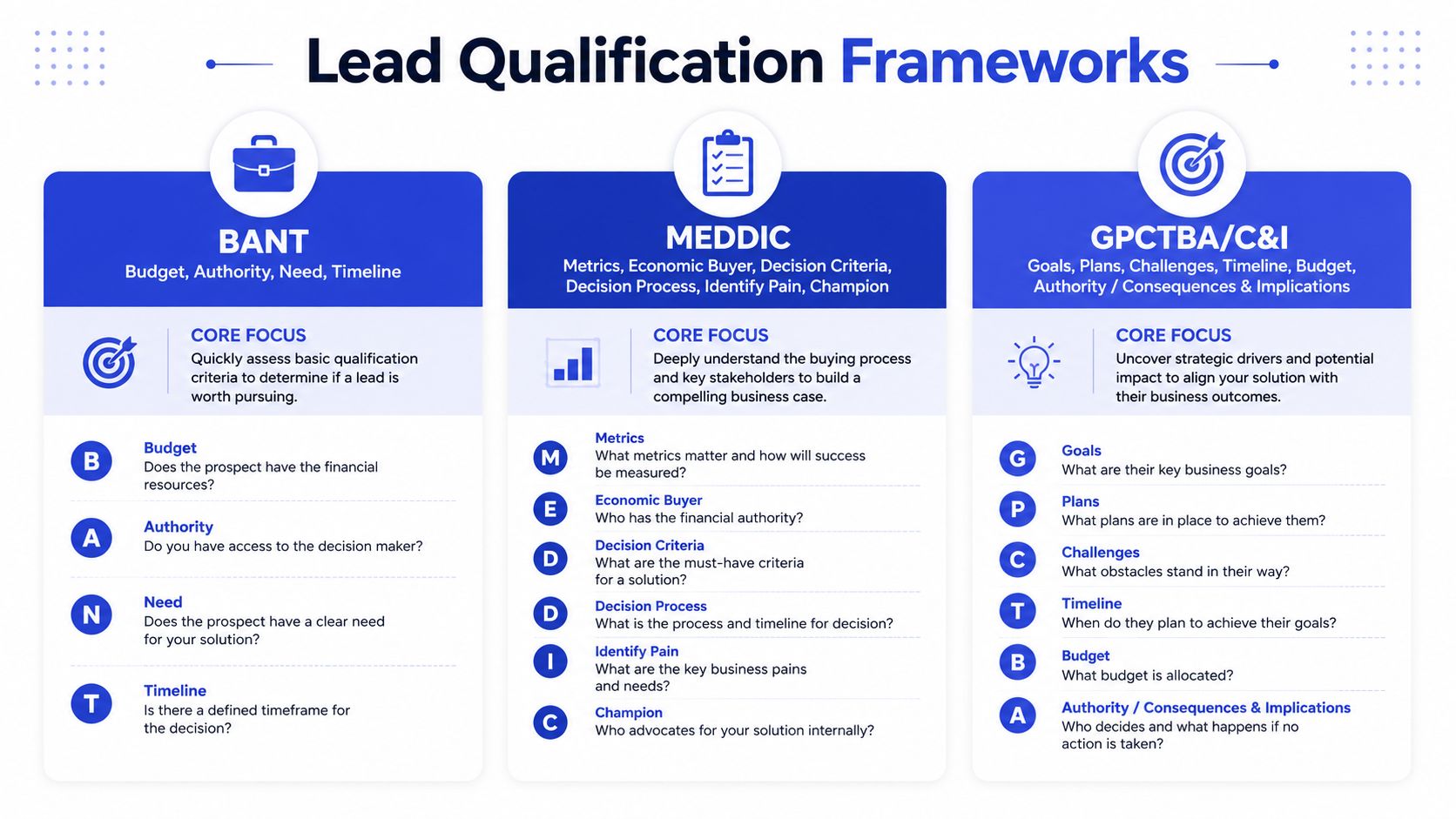
BANT stands for Budget, Authority, Need, and Timeline. It's direct, fast to use, and easy to teach. When a prospect already knows the problem and the purchase path is straightforward, BANT helps a rep decide quickly whether the conversation should continue.
CHAMP shifts the order. It starts with Challenges, then authority, money, and prioritization. That makes it more useful when the buyer is problem-aware but hasn't framed the budget yet. In those conversations, the challenge comes first, and the budget discussion comes later, after the value case is clearer.
Lead scoring works differently. It assigns values to signals so your team can rank leads instead of only accepting or rejecting them. That's useful when you have lots of inbound activity and need a way to prioritize attention without turning every lead into a full qualification call.
Useful distinction: qualification decides whether a lead should get a meeting, scoring decides how urgently that lead should be worked and by whom.
Which approach fits which team
Method | Best for | Strength | Limitation |
|---|---|---|---|
BANT | Simple sales cycles | Fast, clear, easy to train | Can feel rigid when buyers are still shaping the problem |
CHAMP | Consultative conversations | Starts with the buyer's pain | Takes more rep skill than BANT |
Lead scoring | High-volume inbound teams | Helps rank and route leads | Doesn't replace actual qualification |
For many small businesses, the smart move is not to pick one framework and ignore the rest. Use a simple checklist from BANT or CHAMP for conversations, then use scoring or routing logic to decide what happens next. If your team sells a lower-ticket offer, lean toward BANT. If your buyers need more education before they can name a budget, CHAMP usually feels more natural. If the main problem is volume, scoring helps you stop guessing.
Building an Effective Lead Qualification Process
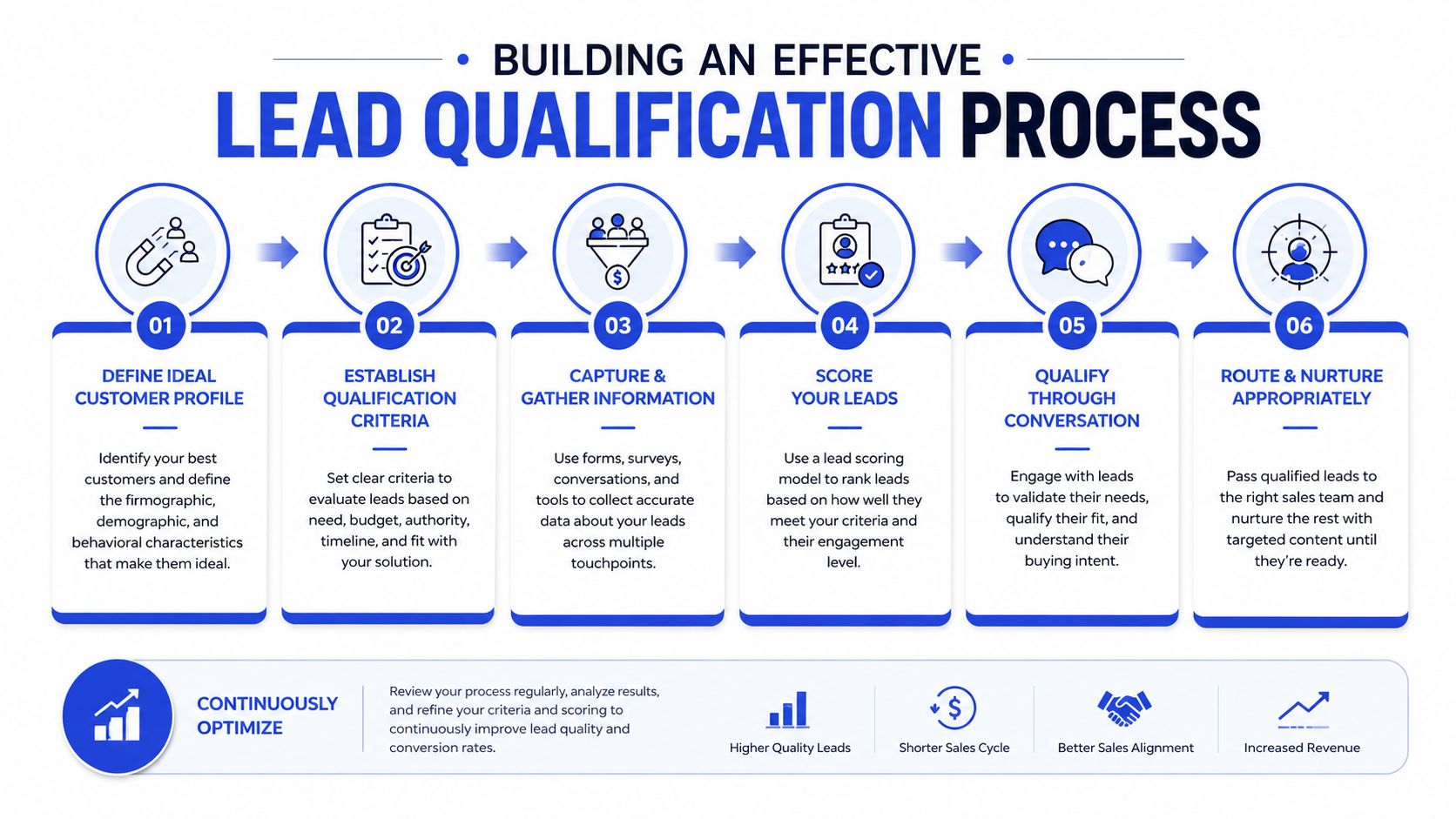
A real qualification process treats the lead as a decision gate, not a number. The gate asks whether the prospect fits your ICP and whether they show enough intent to move forward now. That's a better model than “score it and hope,” because a score can rank interest without making a routing decision.
Start with fit, then test intent
Fit means the prospect resembles your ideal customer. That can include industry, company size, location, or other business characteristics that matter to your offer. Intent means the buyer is showing signals that suggest a real purchase conversation, not casual browsing.
The key is to test both dimensions together. A perfect fit with no urgency may belong in nurture. Strong intent from the wrong type of buyer may need to be disqualified or redirected. When both are present, sales should move quickly.
A practical workflow
Capture the lead cleanly. Keep the form short enough that people finish it, but include enough detail to identify the company and contact.
Check for basic validity. Bad email data, obvious spam, and duplicate records should be handled before any human touches the lead.
Enrich the record. Add company and contact context where possible, so qualification isn't based only on what the buyer typed.
Apply the rules. Use your framework or routing logic to decide qualified, nurture, or disqualified.
Route immediately. If the lead is actionable, send it to the right rep or calendar without delay.
Review the outcome. Track which qualified leads convert, and adjust your criteria when they don't.
For a more operational view of this flow, the lead qualification process is a helpful way to think about how data, routing, and follow-up fit together.
The strongest teams don't freeze their rules after launch. They refine them based on real outcomes, because the leads that close usually reveal what the criteria should have been in the first place.
Sample Qualification Questions and Practical Templates
Good questions make qualification feel like a conversation instead of an interrogation. The goal isn't to trap the buyer, it's to learn whether there's a real problem, a real owner, and a real timeline. If you ask in plain language, most prospects will answer plainly.
Questions by qualification dimension
Budget: “Have you already set aside funds for a solution like this?” Listen for whether they've thought through the investment or are still at the exploration stage.
Authority: “Who else usually weighs in before a purchase like this gets approved?” That tells you whether you're talking to the decision-maker, an influencer, or someone early in the process.
Need: “What problem are you trying to solve right now?” Good answers sound specific. Vague answers usually mean the buyer is still sorting out the issue.
Timeline: “What's driving the timing on this?” A real deadline often reveals more than a generic “soon.”
If the answer stays broad after two follow-ups, the lead usually needs more nurturing, not more selling.
A simple fill-in-the-blank template
Use this as a starting point:
“We help [type of company] solve [problem] by [method]. To see if this is a fit, can I ask how you're handling [current process], who's involved in the decision, and what timing you're working with?”
That structure works because it keeps the conversation focused on fit and intent without sounding scripted. It also gives the prospect room to explain their situation in their own words.
For teams using AI-assisted capture, the same logic can sit inside chat. A visitor can be asked a few qualifying questions before a rep ever joins the conversation, which is often less intrusive than a long form and more useful than a single checkbox.
Common Lead Qualification Mistakes and How to Avoid Them
The biggest mistake is treating qualification like a one-time event. Buyers now self-educate, compare options, and interact with chatbots before they ever contact sales, so a form field or one early conversation can't tell you everything. That older model leaves too much important context out.
Don't rely only on declared answers
If a lead says they're interested, that doesn't mean they're ready. Their behavior matters too, especially repeated visits, pricing-page views, and return sessions on high-intent pages. Qualification should combine what people say with what they do.
The newer buying journey makes this even more important. Buyers often arrive with more context than they used to have, and they may already be halfway through a vendor comparison before anyone on your team speaks with them. That means your process needs to pick up digital intent, not just form responses.
Avoid over-disqualifying too early
Some teams get aggressive and cut leads off before there's enough information. That can save rep time in the short term, but it can also throw away prospects who just need more education or a little more time. Not every weak signal is a bad lead.
A better approach is to use disqualification as a routing decision, not a rejection notice. If someone isn't sales-ready today, they can still be nurtured, logged, or passed to a different workflow. The point is to match the next step to the actual level of intent.
The fastest way to improve here is to look at the leads you almost dismissed. If they come back later and convert, your criteria were too strict or too early. If they never move, your rules were probably right.
Automating Lead Qualification with AI-Powered Platforms
A buyer can spend time on your pricing page, open your FAQ, ask a chatbot about implementation, and still never fill out a form. That is the reality many small businesses are dealing with now. Manual review often misses that trail of intent, so by the time a rep responds, the visitor may already be gone.
Research summarized by Landbase says responding within 1 hour can generate 7x higher qualification odds, and contacting leads within 5 minutes can make them 9x more likely to convert. That is why speed matters so much, and why a form field alone is too thin to guide follow-up. The lead qualification statistics from Landbase make the timing problem hard to ignore.
What AI changes in practice
AI tools can qualify leads while the visitor is still on the page. Instead of waiting for a rep to open the inbox, check the company, and decide what to do next, the first qualifying questions happen right away. That often makes the difference between a booked meeting and a missed chance.
Chatgrow is one example of this approach. It lets teams create and train custom support agents on website content, FAQs, pricing, and product pages, then use those agents to answer questions, detect intent, and collect qualification details from visitors. It also supports Smart Intent for understanding what the visitor is trying to do, Smart Escalation for forwarding concise context to your team, and it can route high-intent conversations to the right follow-up path. For teams that want a closer look at how this fits into scoring and prioritization, automated lead scoring explains how qualification and ranking can work together without adding extra manual work.
AI also helps because buyers now self-educate before they talk to sales. They compare options, read product pages, and ask questions through chat before they ever agree to a call. A form can tell you a name and an email, but it cannot show whether the visitor is curious, comparing vendors, or ready to move. That is why AI qualification needs to read intent from behavior and conversation, not just from declared answers.
A simple setup path
Train the agent on your product pages, pricing, and the objections your team hears again and again.
Define qualification rules so the agent knows what counts as a fit and what should be routed elsewhere.
Deploy to high-intent pages where buyers already show buying signals.
Escalate when needed so humans handle edge cases and complex conversations.
Review outcomes and tighten the criteria based on what converts.
For teams comparing tooling, the CXO's AI lead generation playbook from DialNexa Labs Private Limited is a useful companion piece because it frames AI agents as part of the broader lead-capture workflow.
That setup works best when the agent is trained on the language your buyers already use. If people keep asking about onboarding, implementation, or fit for a specific use case, those cues should feed the qualification logic. A small business does not need a complicated system to benefit from this. It needs a system that catches intent early, asks the right follow-up question, and hands off only the conversations worth a rep's time.
Taking Your Lead Qualification to the Next Level
A buyer may read your pricing page, compare options on their own, and ask an AI chatbot a few pointed questions before a rep ever gets involved. If your process only starts at the form fill, you are already late. Lead qualification works better when it treats every signal, page visit, chat message, and follow-up question as part of one system.
Start with your ideal customer profile, choose a framework that fits your sales motion, and define what should happen to each lead as soon as it enters the flow. The goal is simple. Fit and intent get checked early, strong prospects move quickly, and everyone else gets routed without wasting rep time.
A quick self-check can reveal where the process breaks down. Does it test fit and intent? Does it route fast enough? Does it give your team a clear next step when someone is not ready yet? If the answer to any of those is no, the process needs work.
The next step is to make qualification measurable. Track which leads become real opportunities, which ones need nurturing, and which ones should never have reached sales in the first place. Then keep refining the rules from actual buyer behavior, because people reveal intent in different ways now, including the questions they ask before they ever submit a form.
If you want a practical way to compare approaches, explore these lead qualification tools. For teams that want to capture intent at scale, Chatgrow can help qualify visitors around the clock with AI agents trained on your own content. That matters when buyers are self-educating and talking to chat before they ask for a call, because the system needs to spot buying signals sooner and send the right leads forward without delay.
Related Posts
Continue Reading
More articles from the ChatGrow Team.